Lord British’s Shroud of the Avatar: Forsaken Virtues
Posted by Rampant Coyote on March 8, 2013
Richard Garriott (de Cayeux) is back into Fantasy RPGing?
Single-player AND online multiplayer?
Deliberately reminiscent of the Ultima series (and Ultima Online)?
Okay, Kickstarter, you’ve won once more. Dangit.
Gotta admit – I’m a little skeptical here. As much as I loved the earlier Ultima games, things kinda fell apart in the end, and I never really warmed up Ultima Online or Tabula Rasa. 😛
It’s “not” an MMO, he claims. It’s… well, it’s interesting enough for me to throw in again. *Sigh*. I’m such a sucker. I really want to believe…
Filed Under: Game Announcements - Comments: 19 Comments to Read
Sneak Peek Into Rampant Games’ Super-Secret Development Methodology
Posted by Rampant Coyote on
Without a producer or manager, here at Rampant Games, we (and by ‘we’ I generally mean ‘me’, unless I manage to wrangle some time out of contractors for far less than they are worth) have to work extra hard to stay on-task, on-schedule (HAH!), and productive on projects that are really just too frickin’ huge for a tiny studio to ever be developing, particularly as a part-time venture.
But now I’m going to show you a slice of the incredible development process responsible for our incredible success* in the indie games field. Here’s a peek into a couple of four-hour days of Frayed Knights 2 development:
— DAY 1 —
Hour 0:00 – Okay, I am TOTALLY going to get Feature A done. Time to get cracking!
Hour 0:15 – Okay, email is done. Now I am TOTALLY going to get Feature A done. Time to get cracking!
Hour 0:30 – Okay, my wife needed to chat for a few minutes. But now I’m TOTALLY going to get Feature … uh, which feature was that again? Lemme check my list. Oh, yeah! Feature A! TOTALLY going to get that done. Right now. Time to get cracking!
Hour 0:45 – Uh, okay. How am I supposed to test Feature A once I get it implemented, ‘cuz I don’t have feature B done, where I can actually do something with it.
Hour 1:00 – Got some code done on Feature A, but until I get B done, I can’t really do anything with it. I guess I need to shift gears and do B instead.
Hour 1:15 – Uh, you know, B is a pretty big project. I can do a simplified, scaled-down version of it with just Feature C, though. That’ll give me enough functionality to test Feature A when it’s done being implemented.
Hour 1:45 – Feature C is pretty dependent upon unfinished code over in this other spot. Lemme do this – Feature D – which will give me a solid foundation to finish up C.
Hour 2:30 – Feature D is working. Now time to test it! Oh, but let me first celebrate my victory with a five-minute Twitter break.
Hour 2:55 – Oops! Why am I still surfing the Net? That was supposed to be a five-minute break! Why am I on TVTropes.org? Dang it! Back to work, me!!!! Now, what was I doing again? Oh, I was working on Feature A, wasn’t I? Okay, let’s get to it!
Hour 3:00 – Oh. Right…
Hour 3:15 – This is still not working right. Feature D, you are not that hard? Why are you bugging up on me?
Hour 3:25 – Oh, the incomplete Feature C was causing the weird behavior. Disabling that made Feature D work. YAY! Oh, wait, mostly…
Hour 3:45 – I’ve spent the last 10 minutes silver-plating Feature D. This is really just supposed to be there to support Feature C, after all. Back to C.
Hour 4:00 – Feature C is still not done. I know I was only supposed to do this for four hours, and I’ve gotta get a blog post done for tomorrow, but… fifteen more minutes!
Hour 4:15 – Okay, I guess Feature C is kinda-sorta working. Good enough, I guess. Dang, I’m tired. And I have to write that blog post.
— DAY 2 —
Hour 0:00 – Okay, I am TOTALLY going to get Feature A done. Time to get cracking!
…. ETC.
So there. Now you have taken a peek into the mind of this game developer, and glimpsed the method to his madness, and the secret that makes him such a success* in the indie game world! Now go do thou likewise. Or, uh, not!
(* Success if not measured in purely monetary returns. ‘Cuz, really, that might get a little depressing…)
Filed Under: Production - Comments: 7 Comments to Read
Game Development: Playing to Strength
Posted by Rampant Coyote on March 7, 2013
When I first started programming the Commodore 64, I was coming to grasp with a more complete version of the BASIC language. And, slowly, coming to grips with the limitations of the C-64. While in comparison to my previous computer (a Sinclair ZX80) it was overwhelmingly powerful, writing action games in BASIC would bring you very quickly to some of those limitations.
For those who don’t know, BASIC (at least as traditionally implemented) is an interpreted language. This means that there’s a language interpreter parsing your code while it runs. This means that every step of the way, there’s a complex program trying to understand what your code wants it to do, and then executing. By comparison, most applications you run today are compiled languages, which means that you run a compiler on your code in advance which does all the interpretation into the machines’ own native language. So at run-time there’s not as much overhead.
So anyway – BASIC was slow. And I wasn’t quite to the point of teaching myself machine code (or Assembly, the much easier-to-use Next Best Thing). So I found myself writing games that took advantage of the strengths of the language (and the computer) rather than the weaknesses.
Probably the best example of this was printing and scrolling. On the C-64, moving a bunch of character-sized things around on the screen could get very slow. Putting a three-character block that looked something like this [=] on the screen involved six interpreted lines of code telling the machine what memory location to use and what value to put there (three for the shapes, three for the colors). If you were to move it, you’d have to include at least three more lines of interpreted code to erase the three pieces at their previous location.
Obviously, you didn’t want to move too many objects around on the screen like that. Even in machine code, there were limits. Now, for larger objects, there were some built-in hardware-controlled sprites – a total of eight that could be on-screen at a time – which could be combined with more static backgrounds to make a pretty decent game.
But when I hadn’t quite mastered sprites, there was another trick of the hardware and BASIC interpreter I took advantage of . I wrote a particular game multiple times (a little better each time) taking advantage of the strengths of the interpreter. For one thing, while moving an entire screen’s worth of character objects was a massive hit, there was (IIRC) some hardware performance shortcuts that made scrolling pretty fast. And while having the BASIC interpreter draw objects one at a time was really slow, the “PRINT” statement – designed to render lines of text – was pretty dang fast, with rapid machine-code handling of a chunk of data. Likewise, string manipulation – while not fast – was still faster doing it with built-in BASIC commands than trying to do it “by hand.”
So I wrote a car game. In the game, you controlled a car at the top of the screen. The road was actually created by a series of print statements which would print the road using a subset of a string (a line of text) like this:
" [=] [=]"I’d use a keyword to eliminate some of the spaces at the front of the string, and just print it out. So I’d get a track like this:
           [=]     [=]
          [=]     [=]
         [=]     [=]
        [=]     [=]
       [=]     [=]
        [=]     [=]
         [=]     [=]
          [=]     [=]
          [=]     [=]
         [=]     [=]
        [=]     [=]
       [=]     [=]
        [=]     [=]
To make the entire screen scroll, I’d just print a new line at the bottom.
It made for pretty jerky movement, but it worked. Then the car could be moved by using the left or right arrows (or the joystick). As difficulties increased, I could use a different string that narrowed the road, or throw in the occasional variant string that had an obstacle in the middle of the road.
For collision detection, I just kept a couple of arrays of values that I’d rotate through to keep track of which road piece had been used, which would tell me what the left and right boundaries were (or if there was an obstacle). Since it was all blocky with integer-based movement, it was fast and easy.
It wasn’t a great game. And an arcade gamer would be really put off because it played “upside down”. But it worked pretty well, and was easy to write. Easy enough to write in a single afternoon, and to write multiple times (with various enhancements).
Why do I share this?
I think there are a few game development lessons to be derived from this example from now-ancient technology:
#1 – Start simple.
Especially when you are first learning a platform or just learning to write games, it’s a lot easier to learn with simple examples than being bogged down with industrial-strength crap. For one thing, it’s easier to figure out if the problem is in your (limited) code, or if it’s an issue with the platform. And you can get the basic stuff done quickly to move on to the more advanced topics. Like – in this example – with the basic “prototype” game so easy to code, I was able to focus on learning how to do sound effects or joystick control.
#2 – Play to the engine’s strengths, and take advantage of what you are given.
Here’s the thing: There’s no such thing as a “perfect” game engine or API. All of them come with limitations and trade-offs. While it’s easy to go off and scream, “design is law” and feel all heroic bending the engine to your will, it’s often far, far better to take advantage of the power of the engine and simply avoid playing to its weaknesses. With a few exceptions, those battles you choose to fight because they will definitely raise the awesome factor by a good three notches. Use the advantages of the game engine to your own advantage, even if it means modifying your game design to match.
#3 – There are many ways to skin a cat.
Pardon the expression, cat-lovers. But there are usually several different ways of accomplishing your goal in making a game, particularly if you can be flexible on details. If a particular approach or implementation seems pretty cumbersome given your tools, try to think outside the box and see if there’s any other way to accomplish something close enough. You may even find your “Plan B” approach is far better than your original!
And my favorite:
#4 – You don’t need to be an expert to start making games!
This was one of my very first (if not THE first) action-games I ever wrote. I didn’t know much about programming. But it was something really fun and motivating I could work on as I was learning, and I know of some indies out there who have done okay with commercial releases of their products that they learned-while-making. The bottom line is that you don’t need to complete any kind of degree or even a six-week course to get started.
I think these principles are just as applicable today on modern game systems as they were in 1983 on the C-64.
Filed Under: Game Development - Comments: 12 Comments to Read
Torment: Tides of Numenera now open for backing!
Posted by Rampant Coyote on March 6, 2013
Torment: Tides of Numenera is now an official Kickstarter project, as of this morning. I know. It’s a Kickstarter. If you have faith (I do), this is a gimme for RPG fans. And as of right now, almost a third of the extra-cheap limited slots for early backers are already taken, so there’s probably only a few minutes left to get going on this one at the bargain-basement pre-order deal ($20). Not that an extra $5 is a big deal for the next tier. I went higher still, ‘cuz I enjoy soundtracks, and I am a fan of Mark Morgan’s work. Like I said, I have faith.
So you can go back Torment: Tides of Numenera on Kickstarter right now if you want to get in early.
Torment: Tides of Numenera is a spiritual successor to Planescape: Torment. It’s by InXile, the guys working on Wasteland 2, run by Brian Fargo, the guy who founded & ran Interplay (which published Planescape: Torment). A few of the original developers are involved in the new project, and it takes place in a new campaign setting by Monte Cook, one of the main designers of the Planescape setting back in the day. Colin McComb, also on this team, was one of the other key designers of the original setting. If you feel a designer can actually get better with age and experience, this suggests that Numenera can be everything Planescape was, and more. Personally, I wasn’t fond of the PS setting anyway, and I thought Torment was its sole redemption.
And Chris Avellone, lead designer of the original, has given his blessing (warning, colorful language):
So as Kickstarters go, this is pretty low-risk. Established team w/ track record, a pretty decent foundation, modeled after a critically acclaimed game that some of the team was directly involved with. The key points should warm the hearts of most western-style RPG fans: Story driven, single-player, iso view, join up w/ NPCs, and it promises the thematically “deep” narrative with lots of personal choices. Again, if it mirrors its spiritual ancestor, it should do well.
But there’s a lot more details at the Kickstarter page.
And with that, I leave you to decide. As I’ve said before, I like Kickstarter and have been a frequent backer, but I do have certain misgivings about recommending projects to others. After all – it’s always a gamble. I have little doubt personally that this project will get funded (they’re nearly halfway there only three hours in!), or that it will achieve fruition – and be available for sale in a couple of years. So you can simply wait until then if you choose, and help make it more profitable in the end. Your call.
But either way, I’m excited about this one…
Filed Under: Game Announcements - Comments: 7 Comments to Read
I’m Too Young For Reboots and Remakes!
Posted by Rampant Coyote on March 5, 2013
When movies I loved as a kid started getting remade, I started feeling old. Remakes, in my mind, were for old black-and-white movies or foreign films. I could barely tolerate them when they were movies from my childhood that I barely remembered. Although, admittedly, by “tolerate” I often mean “enjoyed, albeit with grumbling.” But reboots of newer franchises? If it weren’t for the fact that Nolan’s Batman reboot was freaking awesome, I’d have been far more annoyed. And the Spider-Man reboot? I haven’t seen it, but… WAY WAY WAY too soon, guys. Toby Maguire still looks young enough to pull off the role as a grown-up Spider-Man. And Star Trek? It was in desparate need of some fresh blood to breathe life into old stories and roles.
 When it comes to video games getting the ‘reboot’ treatment, such as with XCom: Enemy Unknown, or the new Tomb Raider game or the upcoming Thief reboot…. I dunno.
I mean, on the one hand, video games have historically been pretty technology-bound – something that’s only recently entered the murky zone of diminishing returns. In some cases, it’s hard to even get these older games to run (though this problem has been mercifully alleviated thanks to the emulator scene – which GOG.COM and others use commercially). There have been a lot of great improvements in UI design since the bad ol’ days, which can make some games with otherwise opaque interfaces a lot more fun to get into. And of course, who doesn’t appreciate prettier graphics, so long as they don’t detract from the spirit of the original? I love the idea of a new generation of gamers finally experiencing some of these classics in a new, improved experience – with a fresh take on an awesome story.
But there’s an ugly side too. A “reboot” or “re-imagining” can very easily obliterate the very thing that made the original so compelling or charming. I haven’t played the new Tomb Raider, but it looks like becoming “just another third-person action-adventure” game is a very real risk. And the claim that the new Thief reboot is going to be a lot more like Dishonored leaves my blood cold. I don’t want classic game series to be more like modern games – on the contrary, I want modern games to be a lot more like their classic progenitors. Not that everything these old games did was made of platinum, but I find the modern (mainstream, AAA) gaming scene to be growing awfully homogeneous and boring (If also very pretty).
There’s also the purely subjective side where I whine that I’m too young for my favorite games to become completely remade in someone else’s image. I guess it comes with the turf of being in such a rapidly-changing industry, but when one of my first commercial videogames, Warhawk, was effectively replaced by the PS3 version, it did sting a bit. But again, it’s a rapidly-changing industry, and the only real value of doing a remake rather than a new property is that it’s still early enough to capture the attention of a generation of older gamers who fondly remember the original. I mean, let’s face it – the world and history of Ultima‘s Britannia is not exactly Middle Earth. Sure it was packed with some fascinating ideas (and retcons of its own), but really its value is in what we old-school players invested in it. But it’s not like modern designers could be spared a ton of effort lifting Mondain, Minax, and Exodus rather than making up their own villains.
I guess overall I’m cautiously in favor of it, but I’d be much more enthusiastic if I really trusted the guys who are now handling the franchises.
Filed Under: Biz, Retro - Comments: 14 Comments to Read
Analyzing Wing Commander
Posted by Rampant Coyote on March 4, 2013
When I was a kid, first learning to program games on the Commodore 64, I used to dream about making a 3D space combat game. I was in love with Star Wars (what geeky kid wasn’t?), and I really wanted to make a game (or games) where I got to be in the pilot seat of an X-Wing. Oh, I’d played games in the arcade where I got to do just that, even before I started programming (starting with Exidy’s Starfire, and of course there was the still-awesome Star Wars arcade game).
I wanted to fight with big ol’ Imperial Star Destroyers. In my mind’s eye, there were kind pixellated, as I was imposing technical restrictions from around 1983 on my vision. While I made some attempts at 3D arcade-style shooters, nothing worked very well. I mean, it was a C-64. The best I ever got – with a different programming language that had some nice line-drawing routines – was something that would draw simple 3D shapes in wireframe mode.
 A few years later, I played Wing Commander. In a battle against a Ralari, with Paladin as my wingman, I saw my dream game take form. The Ralari destroyer, sorta reminiscent of Star Wars’ star destroyers, was even pixellated, as I’d imagined. That alone would have made Wing Commander an all-time favorite with me, but it went much further than that. Fundamentally, it was still just an arcade game, with simulator trappings. But the story and characters – as simple and archetypical as they were – sucked me into that world. I memorized the schematics and data that shipped with the game (primarily included for copy protection purposes, I believe). I came really close to writing fanfic for that universe.
A big part of my learning about game design came from that game. Some days I wish I could apply those lessons better in my own work.
I’m one of the few people who actually preferred Wing Commander 1 to the sequel, which is generally considered the best of the series. For me, the main difference was that you were in control in WC1, and in WC2 you merely followed a linear storyline. In WC1, your wingmen could die, and you could lose missions and could find the story and style of missions change based on your success. The winning and losing tracks frequently crossed over themselves, with similarities in the missions. The final set of missions had you either kicking the Kilrathi out of the sector, or fighting a delaying action while the Kilrathi kicked you out of the sector.
The lesson that Origin learned in the original was that very few players explored the ‘losing’ missions – they’d reload and replay until they were successful in each mission. Therefore, roughly 1/3rd of the missions – the ‘failure’ mission sets – went unseen by 90% of the players. I guess the math that went into WC2 was that by eliminating that option, they could make the game 1/3rd bigger with no additional cost.
While that perhaps dampened my enjoyment of what was otherwise a clear improvement over the original, Wing Commander 2 was nevertheless a wonderful, wonderful game that I’m still in love with 20 years later.
Alexander Freed goes into some detail about the magic of the Wing Commander series – particularly Wing Commander 2 – in this article:
Why It Worked – Wing Commander II
Freed focuses mainly on the narrative aspects of the game – which IMO got a little over-emphasized as the series progressed. Still, I have to agree, all the little narrative elements were what sucked me into the game – or more particularly, into the game world (or universe). While the later games X-Wing and TIE Fighter, taking place in the honest-to-goodness Star Wars universe, were far superior in terms of gameplay (not to mention the excellent Freespace series), they weren’t as compelling to play – because they lacked that stronger narrative element. More particularly, while they had reasonable storylines explaining what was going on, the games never made it personal. There were no relationships between people. Your wingmen were simply mission-dependent callsigns, not people.
It may have been an accident with the first game, but if so, Wing Commander stumbled into a winning formula in their combination of gameplay and narrative. I fear that today, many developers have learned the wrong lesson – simply declaring narrative to be good and throwing more and more of it at the player.
Filed Under: General - Comments: 3 Comments to Read
Indie 101
Posted by Rampant Coyote on March 1, 2013
 Derek Yu has written a fantastic article entitled, “Making it as an Indie: A Starter Guide.”
Any aspiring indie ought to read this article. Twice. In fact, it doesn’t hurt for a veteran indie to read it a couple of times, either.
One thing that really stood out to me was his definition of indie. Now that indie has kinda taken over, and there are so many incredible ways of going around the gatekeeping machine that previously dominated the industry, it can be really hard to define what “indie” is all about. So why bother, some people ask? Derek defends the answer:
Under that definition you still run into gray areas, but hey, just because we don’t know when “red” turns into “purple” doesn’t mean the words aren’t useful. Just think about someone who wants to make a game with a small team and self-publish it… what should they type into Google for inspiration, advice, community, etc.? “Indie” is still as good a word as any, in my opinion.
Bingo. I also maintain that it’s helpful to gamers, too, for completely different reasons.
By the same token, he approaches the definition of “indie” with an eye towards it’s usefulness, rather than splitting hairs over who is and who isn’t indie. At it’s core (subject to all hair-splitting), it’s about small, (relatively) low-budget teams making games without support from somebody bigger.
I could argue a little bit – but only around the edges – over his comments on marketing and gimmicks. Fundamentally, I think we’re on the same page, but I’ve played a lot of excellent indie games that baffled me that they did so poorly – and what it really came down to was a lack of marketing. And part of that was a lack of something to make it stand out – which I guess you could call a ‘gimmick.’ Truth is, you could have the best fantasy RPG ever written – but if it looks / sounds generic, nobody will pay any attention to it. Derek actually agrees with this on another point, referring to artwork: “And even if you don’t, it’s easy to underestimate the importance of having a unique style of artwork… even ugly is probably better than generic, all told.” So perhaps we’re actually disagreeing on the definition of the term here. Maybe he’s referring to the truly egregious “cheap tricks” that are devoid of merit other than attracting attention.
His #1 piece of advice is absolutely identical to mine: FINISH YOUR GAME. I’d add, “and release it to others.” I don’t take issue at all with someone calling themselves ‘indie’ when they haven’t actually released a completed game yet, but at some point you are just kidding yourself.
Switching gears a little to another article – along the lines of “where do I start?” – here’s an article from PC Gamer in November about several popular game engines available at indie budgets today:
The Indies’ Guide to Game Making
I would also like to refer you to Random Gamer’s excellent discussion of the same from last week – Part 1 and Part 2 of choosing a game engine.
Now here’s a shocking bit of news. You know how I keep saying things like, “the indies won?” Check this out, from a Gamasutra news article “Indie Game Development on the Rise in a Big Way” – ‘The number of indie developers in North America is on the rise, according to the Game Developers Conference’s State Of The Industry survey, with 53 percent of respondents now calling themselves “indie.” ‘ And more than half have of them only been indie for less than 2 years – so it’s a recent thing.
Of course, a massive surge on the supply side does not indicate a victory in the marketplace – that might only result in a glut, unless demand catches up. But it does provide evidence that a fundamental shift has happened. While I’ve been at it long enough to believe that indie is here to stay, it’s clear that – for the time being at least – indie is trendy.
Weird.
Filed Under: Game Development - Comments: 3 Comments to Read
So What Happens After Steam Opens the Floodgates?
Posted by Rampant Coyote on February 28, 2013
So Steam’s Greenlight was a failure.
That may be a pretty harsh thing to say. For many developers and fans, Greenlight was pretty awesome. But as Valve founder Gabe Newell explained recently, “[Steam] should stop being a dictator and move towards much more participatory, peer-based methods of sanctioning player behavior. Greenlight is a bad example of an election process. We came to the conclusion pretty quickly that we could just do away with Greenlight completely, because it was a bottleneck rather than a way for people to communicate choice.”
By the sounds of it, it’s becoming more of a platform than a portal. The really funny part is that until Greenlight happened, that’s how many if not most Steam users assumed it worked. “Why don’t you just release your game on Steam?” gamers would ask endlessly, infuriating the developer who’d been turned down on Steam for reasons unknown.
And so they’ll be opening things up. A lot. Instead of user Greenlight pages, there’ll be user storefronts on Steam. This definitely scales things a bit. Will Steam become the Amazon of downloadable PC software? The “Apple Store” for all desktops & laptops? It’s clear that if Steam doesn’t move on it NOW, Microsoft is going to take over on the Windows side (but my personal opinion is that, with the direction Windows 8 is taking, Windows is taking a big step in its long, slow decline).
We’ll see. In the meantime, here are some industry experts looking into their own crystal balls to see what the future might hold:
Gamasutra Editors: Let’s Talk About Steam Opening Up
As for me, I don’t know enough details to make an accurate prediction. But I can throw out some speculation and pull guesses out of the air like anyone else.
If any game – sold through any means – can be “Steam Enabled,” and if Steam provides a way that any game could be sold on Steam if it passes minimum requirements (not be a malware vehicle, etc.) and featured on user stores… in other words, if it abdicates not only dictatorship over curation but also over monetization – then there’s not going to be anything stopping its dominance in the marketplace. Big time.
It’s that latter part that’s going to be a trick – the monetization. If they lock that up – and all games on Steam must be sold through Steam (which is actually a departure from how things run now – I play a lot of Steam-enabled games that I purchased elsewhere) – then they are going to be leaving themselves open to lots of competition. But if don’t pull a Microsoft (or, admittedly, an Apple) here and leave Steam as an “open platform” – I think just about everybody who isn’t a direct competitor will be making their games available through the Steam store anyway, just not exclusively. Most most indies I talk to who are on Steam tell me that Steam sales almost always represent the majority of their PC sales (maybe not a majority of their revenue, but definitely the bulk of their sales), so it’s not like Steam would be losing a lot of money with that approach. In a sense, they’d be saying, “Sure, sell what you can on your own and through other portals, and it’ll still be a full-fledged Steam game. We’re cool with that. And when you are done, please consider letting use help you sell your game to the remaining 80% of the market that you missed”
It’d be a win-win. They are the “good guys,” and there’s zero reasons for anybody to NOT be on Steam.
Now “discovery” is another issue. But this is an issue that every indie worth the label is intimately familiar with. For indie developers, and long-time indie game fans, this is pretty much part and parcel with the whole indie experience. It’s nothing new. It’s so NOT new, in fact, that it predates indie gaming, gaming, modern technology, and just about anything else – it’s been a part of the free-market experience since day one. In fact, the only way to avoid this problem is to create giant, powerful gatekeepers that are extremely difficult to successfully bypass. That’s an aberration, and (eventually) doomed to failure. That’s what the whole “indie” movement has always been about!
It’s only too many customers (and, sadly, gaming journalists) who were shocked to discover that there were far more games out there than were being marketed by TV commercials and pop-up ads on major websites.
So really, if Steam does it right, it will likely be a game-changer. It’ll be a great thing for indie gaming. It may not so great for some indies who have enjoyed something of a protected status in the past, but I doubt they’ll be hurt much by it, either.
Filed Under: Biz - Comments: 4 Comments to Read
The Rise and Fall of the Arcade
Posted by Rampant Coyote on February 27, 2013
Another great article about the history of the game arcade (primarily in the U.S.A.) –
For Amusement Only: The life and death of the American arcade
While I want to believe in Bushnel, I’d have to agree that I can’t really figure out how the coin-op arcade could make a comeback. It’s a cool idea in that it brought people together (kinda), but I don’t really remember the arcade being an overly social experience. I wasn’t too involved in the competitive fighting-game scene.
The thing is, today, people bring their arcades with them in their purse or pocket. The systems today are more powerful than last-gen game consoles, let alone the arcade systems of fifteen years ago. I feel sorry for the people who missed out on that experience. It was a wild few years. And as a kid, you expect the entire world to be static, and that the way things are when you are twelve years old are the way they’ll be thirty years later (only with flying cars instead of land-bound ones, and much cooler arcade machines). That’s not how it works.
But here’s the thing: While the arcade is pretty much dead, at least by the standards of the 80s and 90s, it’s not buried. Like the text adventure game, it may never completely go away, so long as boutique manufacturers will still distribute machines. Most cities still have some an arcade or little centers (or movie theaters) with a game room. Do you know if you have one near you? Have you been? Maybe it’s not something you do casually anymore, but it could still be something you can turn into An Event. Take your date or your family to the arcade on a Friday night! Okay, if it’s a date, maybe you should take them to a nice dinner, too. 🙂
And while it may not be exactly lucrative, I know there are some possibilities for indies in the arcade-game space.
Filed Under: Links & Tidbits, Retro - Comments: 7 Comments to Read
Driftmoon Released!
Posted by Rampant Coyote on February 26, 2013
 In some ways, I think my fondness for Driftmoon may lay in the fact that it’s been in development even longer than Frayed Knights. Seven frickin’ years. Or nine, depending on how you count it.
Anyway – for the patient, this long-awaited game has finally been released. And it can be had right now for a launch-time discount.
I avoided playing the early pre-release versions all this time to wait until the final release. Aside from plenty of previews (and a two-part interview here at TotRC between developer Ville Mönkkönen and community Ruber Eaglenest), I’ve kept it something of a surprise.
From what I managed to play last night, the surprise has been a pleasant one. It’s an RPG with rich narrative and adventure-game style goodness, a very rich world full o’ stuff to discover and explore. It’s charming and humorous without getting goofy (or lame), and full of amazing detail. If it’s a sign of things to come for 2013, it’s going to be one hell of a year for indie RPGs.
Filed Under: Game Announcements - Comments: 2 Comments to Read
Vespers 3D – Act 1 Nearly Complete?
Posted by Rampant Coyote on February 25, 2013
 A long time ago, I interviewed Mike Rubin about his “3D Interactive Fiction” project, Vespers 3D. In fact, it was the first time I interviewed another game developer. You can check out the interview here – Part 1 and Part 2.
While it has had a development period that almost makes Frayed Knights look like a quickie game jam project, it has still been an active (if slow) project. Fortunately, as he’s a local here in Utah, I’ve been fortunate enough to be able to continue chatting with him about the project at Indie Nights over the years. It’s progressed in fits and starts, and has gone through a seemingly endless number of animators, but it’s never been abandoned.
It seems that Mike has crossed a threshold for at least getting the first act out at a level of completion good enough for an IndieCade submission. This thing may see the light of day after all! Sadly, Indiecade suffers the same problem as many other indie gaming competitions, in that games with extensive narrative content tend to get the short shrift in favor of games that can be played and evaluated very quickly. But we can hope!

The “Adventure Game” genre is looking a lot healthier today than it did several years ago when I first talked to Mike about this project. And, truth be told, even then it was a bit healthier than I gave it credit for. But Vespers 3D is more than just a first-person-perspective adventure game. It’s got the full-on text parser and everything – the full “Interactive Fiction” treatment. This has caused a number of challenges as a game developer, some of which he discussed in the interview, and some I’ve talked to him about later.
On the simplest surface of things, he suffers some of the same challenges I faced making a turn-based RPG: the ‘atomic’ actions are on a much smaller scale. In the text adventure, for example, the command to go “North” can count as a single action, and the game can respond properly. But in a 3D, first-person perspective, the player may wander around for several minutes in a generally northward direction without crossing the threshold into a new area that would have constituted a north movement in the original version.
Then there’s always the question of how content is represented. A “cluttered kitchen” can be described in two words in a text adventure, but when represented in full 3D, interactive glory it can be a ton of work. All those bits of clutter need to be modeled, textured, possibly animated, converted, tested, and placed inside the game. It’s a big chore.
Hopefully, the subsequent Acts – taking place with largely the same characters and setting – will have far less new content requirements and can come together quickly once Act 1 is reasonably complete. It’s just cool to me to see a few projects – including this one – which have been in development for such a long time finally hitting some level of completion.
Filed Under: Adventure Games - Comments: 2 Comments to Read
This is how the world ends: A bunch of post-apocalyptic game setting variants
Posted by Rampant Coyote on February 22, 2013
I’m a fan of “post-apocalyptic” settings in fiction and computer games, though I realize it’s as hard a term to define as “role-playing games” (or “indie games”, for that matter). Over the years, we’ve had tons of video games taking place in a post-apocalyptic setting. And, happy me, we’ve got several new games coming soon that explore survival in a heavily depopulated world.
Post-apocalyptic settings are ripe for role-playing games, in particular, because they do mimic the ultimate test of survival that’s hardwired into every human being’s brain. When we no longer have the ‘safety net’ of civilization and modern convenience to rely upon, could we survive? Can we test certain traits experimentally and safely to see how well they’d perform under certain scenarios? Can we do more than survive, and actually thrive? Post-apocalyptic stories and games do exactly that.
While there have been many interesting variants on the theme, and some games that incorporate tons of concepts into a single setting (Fallout, in particular), I thought I’d point a bunch of them out today as sort of a reminder to aspiring game developers that there are a lot more ways to end the world than zombies or nukes. Here are a bunch of ideas ready to be mixed and matched.
The Pandemic: Most of the human race dies of a disease, leaving only those with an immunity. Stephen King’s book (and excellent miniseries) The Stand explores some of the potential for this setting. For games, this is most often used as more of a background for a zombie apocalypse, but a very interesting part of it for me is how it leaves the remnants and memories of civilization fully intact, but lacks a civilization and population size necessary to sustain it.
 The Monsters Invade: Horrible monsters invade from outer space (most alien-invasion stories), or from another dimension (Half-Life), or our robot servants turn on their creators (Battlestar Galactica, The Matrix). How does humanity survive?
The Ecological Disaster: Through nuclear war, global warming, a new ice age, an asteroid smashing into the earth, or some other natural or man-made disaster, the surface of the world is no longer capable of sustaining human life on a large scale. Humans are forced underground, or into space, or into pockets of the world where they are able to eke out a survival.
Post-Post Apocalypse: This setting explores how society re-forms long after disaster has struck. It’s really the setting of the Fallout series, and can be fun to explore a new culture that develops after a painful reset button is pressed. In particular, it can be interesting to see how a sheltered new society encounters and is affected by remnants of the past, or re-encounters other human societies separated by generations and independently evolving cultures.
Technological Breakdown: In this variant, the technology we’ve all become dependent upon suddenly ceases to function, forcing a breakdown of society built upon that expectation – and the appropriate violence and death that comes with this kind of transition. This could be from some bizarre phenomenon suspending (or augmenting) the known laws of physics, such as in the TV series Revolution. In Pat Cadigan’s cyberpunk novel Synners, it’s a far more believable breakdown: A society dependent upon a future version of The Internet – including the ability to interface directly through their brains – collapses when a massive viral attack makes the ‘Net unusable (and kills those connected to it via their brains).
Sudden Evolution / Devolution: While evolution is a process that is normally so slow it would not qualify as an “apocalypse” (the transition is so slow as to be imperceptable), a sudden change – as in the zombie apocalypse variant – would not. Eloi vs. Morlocks vs. pure strain humans, anybody?
 The Civil Breakdown: This is the sort of apocalypse originally envisioned by the movies Mad Max and The Road Warrior, although the third movie retconned it into a plain ol’ nuclear apocalypse. In this case, external wars and internal breakdown of law results in humanity pretty much preying upon itself. Without a massive external pressure forcing the issue, this is generally anticipated as a short-lived transitional period, where some new social order will eventually rise from the ashes, probably in less than a generation.
The Fantasy Apocalypse: What if Sauron had re-obtained the ring and won, the elves had (mostly) fled, and most humans, hobbits, and dwarves were dead, in chains, or completely thrown in with the Dark Lord? The plague of Mordor was spreading over much of Middle Earth, and only a few survivors were left trying to evade the Eye by whatever skills and magic remained to them? (As I understand it, the upcoming crowdfunded RPG The Banner Saga suggests this kind of setting… post-Ragnarok… but I don’t know if they are really embracing it as a post-apocalyptic story)
Zombie Apocalypse: The zombie apocalypse thing seems (to me) to be mainly played out. But there are some unexplored variants. What if the zombies weren’t actually inhuman bloodthirsty walkers, but instead were still just changed people? Perhaps thinking and rational, a la the movie Omega Man, or the book it was based on, I Am Legend, or some of the ghouls in Fallout. Or perhaps their intellectual functions had degraded to the level of basic instincts and little else, not necessarily bloodthirsty but lacking any moral compunction against cannibalism. Or perhaps they are just inflicted with an insanity that can be controlled with drugs? This would rob many action games of the moral excuse for blowing away human-like foes by the thousands. But for a role-playing game, these could be pretty rich setting, with lots of tough moral decisions.
The Body Snatchers: This is really another zombie apocalypse variant (in my mind), where the horror comes from something alien inhabiting the physical form of a once trusted / loved individual. But in this case, the change is made more terrible in that it’s subtle. The person once there is gone, and something else has taken over, yet it is still able to pretend to function normally. Once this threat is discovered, it could lead to widespread panic and paranoia – as in the Twilight Zone episode, “The Monsters are Due on Maple Street.”
 Other eras: How about a post-apocalyptic Star Trek? The Borg really were – effectively – a threat of Space Zombies. What if they had won? The Battlestar Galactica remake took this thought and played with it, but there’s a lot more that could be done. What about the earth as we knew it being destroyed during the late 1800s, as in H.G. Wells’ War of the Worlds? Or the medieval era? I mean, the Black Plague was pretty much a real-world apocalypse. I understand something similar happened to the Native Americans, allowing European colonists to move in.
Sudden Disappearance: By alien abduction, the Rapture, a dimensional shift, or who knows what else (perhaps the very mystery the plot involves solving), a large number of people suddenly disappear from the world. They leave confusion and a (temporary?) breakdown in civilization in their wake.
A Strange New World: As a result of whatever kind of apocalypse destroys civilization, survivors might take to populating a remote island, another planet, or even another dimension far from home. They take a few modern conveniences with them, and a memory of their former home, but otherwise must struggle to deal with an entirely alien, possibly hostile environment. This variant is a little different in that the characters are no longer surrounded by the remnants of civilization, but rather are themselves the only (available) remnant. For whatever reason, there’s no going back, and no expectation of anything or anybody else arriving from “back home.”
An Evil Overlord: In this setting, the invading monster is a human, and he (or she, or they) culls the population by violence to maintain control. Once again, civilization as we know it has been replaced by an external force, remaking it in their image. Or it could be a dystopian society that has inflicted some kind of unnatural state upon humanity.
The Cozy Catastrophe: In spite of disaster wiping out most of the human race, the survivors are able to maintain a comfortable existence. At least until somebody breaks their eyeglasses or something.
 The Monsters Return: Similar to The Monsters Invade, but this is more of a massive return of ancient legends, from Elder Gods of Lovecraftian proportions, to the legendary supernatural horrors like vampires and demons (the TV series Supernatural explores this kind of apocalypse averted or happening in ‘slow motion’), to a return of beasts (and magic) of ancient myth – dragons, faeries, goblins, and even a return of magical power to the world. Whatever the case, humanity is often decimated, or at least has to radically change to adapt. Whether it realizes it is changing or not…
A Technological Revolution: Some new technology has had a massive, transformative effect on civilization – maybe even for the better (at least on the surface) – but has had side-effects similar to an apocalypse. For example – a drug that eliminates aging. What does that do to the population, when the older generation no longer dies to make way for a younger? How much violence and civil breakdown would result?
The Slow Decline: In this setting, civilization goes into decline subtly, and the story may take place somewhere in the midpoint or late stage of such a decline. It could be dramatic – such as a world where there are suddenly no children being born. Or it could be subtle – a slow civil breakdown, or a slow plague, or a devolution of most of the human race over successive generations.
Filed Under: Design - Comments: 8 Comments to Read
Guest Post: Craig Stern on graphics, imagination, and immersion
Posted by Rampant Coyote on February 21, 2013
While Jay is out of town, some very talented folks have graciously offered to help out with the articles. Today’s article is brought to you by game author Craig Stern. And the letter G. Craig Stern is an indie developer currently working on the turn-based tactical RPG Telepath Tactics. He is the founder of IndieRPGs.com, and can often be found rambling in short, 140-character bursts on Twitter.
Nathan Grayson of RockPaperShotgun recently had the opportunity to ask a question of Bethesda head Todd Howard: how does he plan to make the world of the Elder Scrolls games feel more tangibly alive? Mr. Howard’s response:
“Everybody always wants more power,” he said. “As a developer, you always want more. How good will it look with more memory? How many people can we put on screen if we have more processing power? But even with all of those things, I think people discount graphics. They’ll say, ‘Well, the gameplay’s what really matters,’ and it does. But I do feel that graphics and your ability to present something that feels new, real, and believable puts people in that environment where they can really enjoy what they’re playing.”
This is not the answer I would have given; not for RPGs in general, and certainly not for the Elder Scrolls series.
The fact is, graphics are not necessary to make a player feel that a game’s world is “tangibly alive.” Game worlds don’t feel alive to us because we’re so stupid that we can’t distinguish between realistic images on a monitor and real life—they feel alive because we willingly suspend our disbelief.
In actuality, you don’t need graphics at all to make someone feel that a fictional world is alive. Books immersed people for centuries before the requisite technology for video games even existed, spawning the popular idiom “lost in a book.” Deeply engaging with the characters and setting of a novel makes the world of that novel feel tangibly alive. When we suspend disbelief, our brains play along—no graphics necessary.
Video games have not changed that basic fact about us. The one game most notorious for completely sucking players in also has some of the crudest graphics in gaming: Tetris. It’s nothing more than a bunch of four-block shapes falling, row by row, down a grid. And yet, Tetris immerses players so fully that it bleeds over into the real world in a phenomenon called (you guessed it) “the Tetris Effect.”
So, does this mean that graphics aren’t valuable? Absolutely not! Good graphics are valuable in a game for the same reason that a particularly skillful painting is valuable: aesthetics give us pleasure. In games, specifically, aesthetics can heighten an already compelling experience, giving us shocking and beautiful things to look forward to when exploring the world.
But Mr. Howard isn’t making a broad argument for aesthetics here: he’s aiming specifically for “real” and “believable.” He’s making a narrow appeal to more photorealistic graphics by leveraging computers’ ever-increasing RAM and processing power.
Photorealism represents a narrow subset of aesthetic approaches to games. Arguably, it’s the one approach which demands the smallest investment of vision on the part of the creator (to say nothing of the smallest investment of imagination from the player). It is, in essence, demanding that things look as much like they already look in the real world as possible. It’s a particularly dull approach to take for a game meant to transport the player to a fantastical world. It says to the player: “Yes, yes, we want fantasy, but…let’s just make it as mundane and familiar as humanly possible.”
If the push for photorealism were merely inadequate to make a game come alive for its players, then Howard’s answer could be dismissed as myopic but harmless. However, the nearly industry-wide insistence on photorealism by big studios explodes game development budgets, which is anything but harmless. Like a giant leech sucking blood out of the host studio, a mandate for photorealism siphons off needed resources, directly impacting a developer’s ability to hire people working on other areas of a game—areas which are at least as important as visuals for engaging players.
The Elder Scrolls series itself is instructive. I remember my first time playing The Elder Scrolls: Morrowind. The wide-open nature of the game was striking to a first-time player. The whole world was open to exploration from the word go, and what a world! The changing weather, the way chance encounters felt like organic moments…I spent weeks exploring Vvardenfell, suspending my disbelief without a problem.
Of course, Morrowind’s graphics are miserable by today’s standards. For the time, however, they were good—better than good, in places. I was absolutely floored the first time I saw the game’s water rendering. Morrowind’s use of real-time reflections and displacement effects was well ahead of its time. (Morrowind was released in 2002; one year later, its contemporaries were still rendering water like this or this.)
Still, there did eventually come a time when I stopped suspending my disbelief, when Morrowind ceased to feel like a real place. That moment had nothing to do with the graphics. It was the characters. They had started repeating themselves. I could travel from one end of Vvardenfell to the other, talk to completely different NPCs, and get the exact same dialog in response. They had revealed themselves as hollow marionettes, something that no amount of graphical fidelity could fix. Thinking back, this brought on one of those moments of cold disgust that only a gamer can feel; I’d overinvested myself in this world inhabited by empty nothings. “I’ll never get that time back.”
Years have passed; graphics have improved. Skyrim is far more realistic-looking than Morrowind ever was, but the old flaws remain. The “arrow to the knee meme” exploded because it represents the same old flaw. It’s meant to sound like a personal anecdote to give the game’s guardsmen character, but every single guard in the game says it. It pulls back the curtain, reveals the fraud, erupts the suspension of disbelief. Better models, better textures, normal mapping, facial animations: what does it matter? They’re still just hollow husks.
Perhaps I put it best back in 2011:
Imagination transcends technology. It does not depend, and has never depended, on a 1-to-1 graphical representation of the thing being imagined. To say otherwise is to conceive of immersion as a mechanism by which the game disengages a player’s imagination and replaces it with direct sensory input.
Imagination replaced by direct sensory input. That’s a sad way to think of the role of video games. It doesn’t represent the promise of RPGs, and it certainly doesn’t represent the kind of industry I want to be a part of.
Filed Under: Biz, Guest Posts - Comments: 10 Comments to Read
Guest Post: “Run Away!” by Lars Doucet
Posted by Rampant Coyote on February 20, 2013
While I’m out of town this week, I’ve invited some very talented individuals to help me with posts. Seriously, I think they are way more interesting than I am. Today, Lars Doucet has a very well-thought-out post about an RPG option that really should be more interesting and better used than it typically is…
Hi there! I’m Lars Doucet, one of the developers of Defender’s Quest, and I’ll be filling in for Jay.
Today, I’d like to talk about running away in RPG’s. These games give lots of attention to battles, but usually downplay the means of avoiding or escaping them. This is quite different from our everyday lives as well as the natural world, where flight is usually preferable to fight. Combat risks injury and often death, and the defeated generally don’t explode with cash and prizes sufficient to justify the conflict in the first place.

Since video game conflicts carry less risk, there’s less need for an escape mechanic than in the real world, and some don’t allow escape at all. Today I’ll be analyzing the approach classic RPG’s have taken over the years*, ending with a fascinating new approach in an Indie RPG that breaks a lot of new ground.
*I’m not nearly as well versed in CRPG lore as Jay, so I’m sure I’m going to leave out a lot of your favorites. Also, I’m pretty sure that most of my examples didn’t originate the concepts I’ll be exemplifying below.
A Reason to Run
First of all, there has to be a reason to escape. If your party regains all their health and mana after a battle, and the game autosaves every step of the way, you’ve got nothing to lose from defeat other than your time. This is how Defender’s Quest works, and thus it doesn’t need an escape mechanic – just an option to quit or restart the battle.
Most RPG’s are different, since they rely on endurance challenges. It’s pretty much a given that your party can defeat 5 imps in the early game or even 4 red dragons in the late game. The real question is whether you can get from one save point to the next, surviving dozens of battles and crawling through dungeons without running out of supplies and getting wiped out.
This is where escape comes in. Sure, you can probably take on 2 ogres in the short term, but you can’t afford the gradual wear and tear on your party. But what if you can’t pull off the escape? Then you’ll be forced to fight anyway, and at a disadvantage. This is the fundamental risk/reward dynamic of running away.
Final Fantasy : the “RUN” command
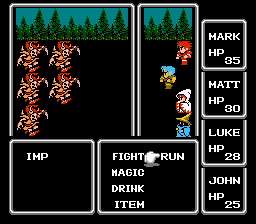
Let’s start with the original Final Fantasy, which has one of the simplest escape mechanics.
To successfully escape, a character’s luck stat must be higher than a die roll of (0 … Level+15). At least, that’s what’s supposed to happen. According to this GameFAQs guide, a weird bug in the original NES version makes running away instead check against (0…WTF+15), where WTF is a different value depending on the character’s position in battle.
The upshot is that only characters in slots 1 & 2 have a reasonable chance of running away. In those cases, the WTF value is the status byte for characters in slots 3 and 4 respectively, so in the above picture, Mark’s chances of running away decrease if John dies, gets injured, is poisoned, etc. Perversely, this bug makes running away harder the more your party gets into trouble, so you have to commit to escaping before you get overwhelmed.
With our without bugs, running away in Final Fantasy is an all-or-nothing thing. If you make the die roll, your entire party escapes at once, and if you don’t, the character’s turn is wasted. There is no sense of making “progress” towards escaping. Since running is an individual character’s action, you can hedge your bets, sacrificing only one or two character actions on running while the rest try to beat back the enemy.
Running away improved substantially in future Final Fantasy games. In Final Fantasy IV, holding down the L & R keys makes the characters all attempt to run away. From what I can gather, you must hold down the keys for a certain amount of time, at which point all the characters will escape. However, they will drop an amount of money equal to 1/4 of what you would have gained from winning the battle.
Final Fantasy IV uses an active-time battle system rather than a strictly turn-based one, and you can start and stop running away independently of choosing battle actions. Thus, running away risks losing money and being distracted from fighting rather than leaving yourself completely exposed. Characters also had the ability to decrease the time taken to run (Porom’s “cry” ability), as well as use items and spells to escape immediately with no financial penalty.
Almost without exception, you cannot run from boss enemies in any Final Fantasy game.
To sum up, in Final Fantasy escape is a simple on/off affair, and there is no concept of retreat, ie, moving towards escape but having not yet achieved it.
Fallout : Retreat
In the original 2 Fallout games, escaping from combat was a bit more straightforward – just get all your characters to the edge of the map. This adds board position and retreat to the mix.

Like Final Fantasy, Fallout’s battles are turn based, but making an effort to escape gets you closer to the goal whether it succeeds on that turn or not. Furthermore, as long as you’re not killed or blocked, if you keep retreating you will eventually get away.
The risk/reward dynamic here is much more tactical – as soon as you start running away, you’re ceding the best position on the battlefield to the enemy. Furthermore, your characters might be in different places and some of them might be trapped, so whether you can even escape at all has a lot to do with the specifics of the fight you are in.
 Secret of Mana : Organic Escape
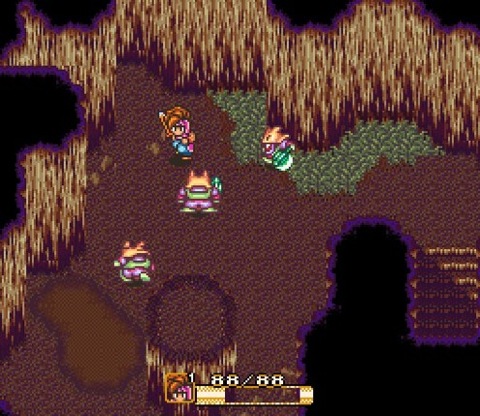
SNES classic Secret of Mana was an action RPG where there was no separate “battle mode”, monsters just appeared on the overworld and you fought them in real time. This made escape rather simple – if you wanted to get away from a fight, you just kept running. In the CRPG world, Baldur’s Gate took a similar approach.
This is much closer to escape in the real world, and it’s lack of formalism adds both subtlety and sloppiness. There’s a lot of depth and nuance to running away when you can engage and disengage at any time, but in these games it essentially boils down to just running in one direction for a while until you can’t see the bad guys any more. As long as you have a viable exit and you can run faster than them, escape is trivial, and inescapable battles are usually ones where the exits are all locked.
Adding depth to escape
In real life, escape involves more than just running away, a full list could look like this:
- Flee
- Gain distance / retreat
- Deny pursuit
- Escape
- Avoid detection after escape
That’s where Indie CRPG gem Neo Scavenger comes in. At least in my play-throughs, the combat engine is more of a “running away system” than a “battle system.” And it’s awesome.
 Neo Scavenger
This game is basically about being a homeless person in a dystopian future filled with ferocious dog-men, looters, and disease. Early on, the simple discovery of a pair of pants and something larger than a plastic grocery bag to hold your things in feels like true riches indeed.
Combat in this game is closely modeled on real life, which is to say that fighting to the death will usually get you killed or horribly injured, even if you win. Instead of managing simple hit points, you have to deal with blood loss, fatigue, hunger, cold, as well as specific diseases and injuries like diarrhea, hypothermia, and head trauma.
I’m reminded of that scene from Fight Club, where the members are given a “homework assignment,” to get in a fight and lose. Edward Norton narrates, “This is not as easy as it sounds. Most people, normal people, will do just about anything to avoid a fight.”
Of course, tons of thing in Neo Scavenger will try to kill you at first sight, but as soon as it’s clear who has the upper hand, the loser will try to flee rather than fight to the death. Usually the loser is you.
Although battle is turn-based, it embodies escape in high detail. Furthermore, running away is a process you have to master. First, you need to put sufficient distance between yourself and the enemy – this value, “range” is one of the central battle variables. You can’t even attempt to escape battle mode unless you are a minimum distance from the enemy. You can move away at various speeds, and faster actions like running and sprinting carry higher risks of making you trip and fall. Once you’ve gotten far enough away, you can try to make your escape.
Usually the enemy will catch up to you once or twice when you have an unlucky fall or they have a lucky sprint. When you’re in a vulnerable position like this new options become available – do you want to try to get up so you can run on your next turn? If they land a hit while you’re getting up, you’ll fall back down. On the other hand, you could stay down and try to kick them in the leg, which will knock them down, forcing them to lose a turn, giving you time to get up and try running again.
If the enemy loses sight of you and you have the hiding skill, you can take cover and then slowly retreat while remaining hidden. On the flip side, if an enemy attacks you at night you might not be able to detect them and have no choice but to flee blindly in a random direction.
Once you’ve escaped battle mode, the fight isn’t over. The enemy will still pursue you on the overworld map, and now it’s up to you to keep gaining distance, covering your tracks, and finding a place to hide and lose them for good. This is easier if you choose skills like “hiding” and “tracking” like I usually do.
Neo Scavenger is the first game I’ve seen put this much thought and depth into escape mechanics. I’ve never had this much fun running for my life.
Filed Under: General - Comments: 3 Comments to Read
Guest Post: Random Gamer on Choosing Your Game Engine, pt 2
Posted by Rampant Coyote on February 19, 2013
(This is a continuation of yesterday’s post from Random Gamer, a long-time community member, and frequent contributor both on the blog and in the Forums. He’s earned war stories the hard way on indie game development. You can read Part 1 here. Enjoy!)
The last time, I talked about some of the lessons I’ve learned in my attempts . This time, I’ll talk about some of the engines and tools I’ve tried, ending with the current set of tools I’ve decided to use for the new project. This isn’t an exhaustive list and I’d like to re-iterate that this is my experience – the engines that I rejected may be perfect for you and your project.
 PyOgre/PythonOgre – http://python-ogre.org/ – PythonOgre is 3D engine API for the Python programming language. It is quite low level and since I’m a fan of Python, I was very excited for this. I started a very ambitious 3D space RPG in this engine, bought some pre-fab textures and 3D objects and got as far as getting the player walking around in 3D. It ground to a halt on the art pipeline – I simply couldn’t afford to pay for the assets I needed and I simply could not produce what I needed in Blender.
PyGame – http://www.pygame.org/ – PyGame is a 2D game engine for Python. I didn’t do anything serious in it, but I have used it for small games/experiments in the past.
 Pyglet – http://www.pyglet.org/ – So, having considered PyGame, I ended up going with Pyglet, another 2D game engine for Python. The advantage for me was it had much better support for UI elements like buttons and for tile based games, because I was going to re-start my space RPG as a 2D old school RPG. The thinking was that the art problem would go away with the shift to 2D… but it didn’t. I was able to locate some appropriate sprites, but not nearly all the ones I needed, and nothing I could create myself was remotely close to what I had located. Once more, a project killed by lack of art – or more accurately, a lack of forethought.
Torque Game Builder – http://www.garagegames.com/products/torque-2d – I’ve tried Torque Game Builder (now Open-Sourced as Torque 2D) on a number of occasions, but I had what I thought was a project that could really use it. I came up with a concept of a procedural murder-mystery – a bunch of AIs, one of which got murdered, and the player had to figure out motivation, etc. I decided to do it in Adventure Game style and this time actually considered art pipeline right off the bat. Since it was set in a modern day manor, I built ‘sets’ using Google Sketchup, saved those as images and then ran them through a few filters to take away the obvious ‘Sketchup’-ness of it. In a burst of enthusiasm, I had purchased Torque Game Builder, but ended up deciding I really didn’t like the way it pushed you into its way of doing things. Especially with me wanting to procedural content, this was the wrong way of doing things for me. Please ignore the programmer art stick figure in the picture below – thanks!

Unity3D – http://www.unity3d.com/ – Encouraged by the use of Sketchup in the previous attempt, I decided to see about doing another 3D project, this time in Unity3D (the same engine that the new version of Frayed Knights is being done in!). This, again, petered out on art assets – while I could produce base levels with Sketchup, I simply couldn’t make the things necessary to bring the world alive. I went back to and back to and back to this approach several times, but simply couldn’t make it work.
 Monkey – http://www.monkeycoder.co.nz/ – Monkey’s big advantage was its cross-platform ability (for the paid version). It was extremely enticing, but ultimately, what caused me to reject this platform was the limitations – if I was to do cross-platform, I’d be very limited in my ability to save large amounts of data and if I didn’t do cross platform, I didn’t see the advantage to Monkey. I did have some fun writing in this language, though, and if I ever write a shoot-em-up, I may take a serious look at Monkey again, since it could potentially get me onto all mobile devices + web.
Java + Slick2D – http://www.slick2d.org/ – I write Java for a living. Going to Java made sense as it allowed me to leverage all the tools (Eclipse, FindBugs, SVN integration, etc) that I am used to using every day. Slick2D is a 2D game engine that doesn’t do very much for you – it gives you a very thin skeleton and requires you to flesh it out. This was ideal for me, as I was still really interested in a procedural game. Rather than going with the murder mystery idea (though that one may resurface), I started work on a 2D Star Flight inspired space exploration/trading/combat game. This is the project I am currently working on and pushing towards a pre-pre-pre-pre-pre-alpha release, with just a touch of the core gameplay done, to see if it is actually any fun. This time, before doing any serious work, I set out a tools chain. I purchased Corel Paint Shop Pro X5 to replace GIMP – I used a very old version of PSP back in the day and always loved it and while they have concealed a lot of the old program behind a layer of cruft, once you strip that away, there is still a very decent image editor there. I stuck with using Google Sketchup with the limited models I needed (the ships and space stations, which would only be shown as informational images). I added Anime Studio Debut to create character portraits. I worked through to having images ready to import into the game before I decided that the pipelines would work. I also ensured that installers and launchers were easily built, settling on WinRun4J for the launcher and Inno Setup to create an installer. There are downsides to this approach – I’m having to re-invent the wheel a lot, as I’m not using any of the available GUI packages. I perhaps have veered to far away from letting the Game Engine take care of some things, but so far, I’m really enjoying this process and making some progress. If you’d like to keep an eye on how I’m doing, I’ve been posting occasional updates in the “Game Making” forum of this very website.
Thanks for reading! I’d be interested in what you think of my ‘lessons learned’. I’d like to re-iterate that this is only a few of the engines out there (this isn’t even an exhaustive list of the engines I’ve tried, just the ones I’ve done more significant project attempts in) and that these are based on my experiences – each of these engines have people using them successfully every day. They all have their advantages and disadvantages – I’m just hopeful these articles will help you make up your own mind.
Filed Under: Game Development, Guest Posts - Comments: 9 Comments to Read
Guest Post: Random Gamer on Choosing Your Game Engine, Pt 1
Posted by Rampant Coyote on February 18, 2013
Today’s (and tomorrow’s) post comes from Chris “Random Gamer” Rovers, a long-time regular here in the Rampant Games community. An experienced developer in the “real world,” he’s got some lessons to share about picking the right tool to fit your game project (or vice versa). You can read part 2 here.
I’m one of those indie-developer-wanna-bes, though I’m hopeful that this time, for real, I’ve got a project I’ll push to release. There’s a lot of reasons why projects die (and I’m not going to get into all of them), but one of the big issues I had was trying to match the wrong project with the wrong game engine and the wrong game engine with the wrong art pipeline. So that’s what I’d like to talk about – some of the lessons I’ve learned, some of the engines I’ve explored, and some things to think about if you decide to go down this path.
The first big lesson, which I guess should have been obvious, is know yourself. Know what sort of developer you are. Professionally, I program in Java in a multi-million lines of code enterprise business application – my skills are primarily in data manipulation engines and the underlying guts of things. I’m not an artist nor a 3d modeller, though I can write descriptions and text reasonably well. I’m also not an interface guru. Those weaknesses aren’t a great thing in a one-person team, but they are where I am and many of the false-starts I made were from failing to match what I was trying to do with what I was good at.
The next lesson learned concerns art pipeline. If you’re a one person shop, you’re going to be doing your art end-to-end – from concept to execution to conversion to whatever format your engine is going to require. Yes, you can buy art, but unless you’ve got a significant budget, you’ll be doing lots yourself. That means at every stage, you need tools you can work with, that you can .be productive in. I have discovered that two of the most popular open source tools simply don’t work for me – GIMP (the open source image editor) and Blender (open source 3D modelling software) seem to work in ways that my brain does not. Several of my projects were going to require me to work with those tools and though many developers seem to be successful with them, it seems I’m not going to be one of them. Thus, my major lesson is that when you’re evaluating a game engine and choosing a game to make, make sure that you check out the pipelines that you’ll need to use and that everything works end to end in a way that you’re going to be happy doing over and over.
That brings us to game engines. Many of the game projects I’ve started (and the project I’m currently working on) are procedural in nature and I tried on several occasions to cram a procedural game into a game engine that expects designed and built levels. Don’t. Just don’t. Match the game engine to what you are doing. For me, I’ve found that I get frustrated by game engines that try to do too much, so less is more for me. Your preferences may vary, but there are so many game engines out there, you don’t need to compromise on this. Keep looking around till you find something that works for you and for the game you want to make. In the next part, I’ll give a quick run through of a few of the engines I’ve played with and the projects that started and ended with them. I’ll end with describing the engine and tools I’m using for the current project.
Filed Under: Game Development, Guest Posts - Comments: 6 Comments to Read
Copyright © 2026 Rampant Games | Privacy Policy
Powered by WordPress.
