PuppyGames: The Customer as a Commodity
Posted by Rampant Coyote on August 19, 2014
Since I’m sleep-deprived and exhausted and haven’t had much time to spare to the blog with this Comic Con demo coming up, I’ll just link to a really good (and, no doubt, soon to be demonized) blog post by fellow indie Cas Prince:
Because You’re Worthless: The Dark Side of Indie PR
Because I have a fairly niche audience, I haven’t been through quite the meatgrinder that my more popular fellow indies have. While I’ve gotten some bug reports and had to help with some issues, I’ve been able to maintain more than a 20:1 ratio of supportive emails vs. critical emails. Since one nasty email has a negative influence proportional to twenty positive ones, that’s important.
Accept it or argue with it, he makes an interesting point. While the race to the bottom has commoditized games, the flip side is that they’ve commoditized customers as well. When things get super cheap, only big numbers count.
Stuff to ponder in the new indie world.
Filed Under: Biz - Comments: 5 Comments to Read
To swap or not to swap game engines …
Posted by Rampant Coyote on August 18, 2014
I love Unity. I’m very, very happy about it. My art guys… well, maybe not so much, but I think it’s more of a matter of what they are used to.
But although this article isn’t favorable towards Unity (it’s not really unfavorable, either), it’s an outstanding discussion of the analysis and challenge of switching game engines – and a little bit of why they chose the Unreal 4 engine in the middle of development.
If I were in their shoes, I might make the same decision. And yeah, that’s me, Unity fanboy. The weird thing is, in two years, the analysis might come out completely differently. A year or two ago, it clearly *did* come out differently.
We live in a strange, new world. Engines have become a commodity within the reach of any indie. Grab ’em off the shelf at indie prices. They compete in price, features, platforms, intended audience, and style. This is a great thing for game developers at all levels. Okay, maybe for us programmers, who historically were on the front-line of awesome creating the technology (and also making us the bottlenecks), it drops our importance down a few pegs. You know what? I’m okay with that. I’ve been okay with games not being tech-driven for many years.
I made the painful and expensive decision to switch to Unity rather than the upgrade of the Torque engine for the sequel to Frayed Knights. This meant having to rewrite a ton of code, and learn a whole new way of doing things. That took time. But I don’t regret that decision, at all. And I’ve had to let a ton of sunk costs go (including about a year of work).
I’m still sticking with Unity for the foreseeable future. Unity 5 is promising some new new features to compete on several fronts, and I’m sure the leading competitors will offer some outstanding improvements to match. It’s a win / win for me.
Filed Under: Production - Comments: 4 Comments to Read
Frayed Knights 2: First Official Screenshot
Posted by Rampant Coyote on August 15, 2014
Getting Frayed Knights 2: The Khan of Wrath in photogenic state was a lot more difficult than expected. Aside from having a major rethink on the art style to try and improve the apparent quality of the graphics, and totally redoing the UI (I’m still paying the price for that one), and the Steam release of Frayed Knights: The Skull of S’makh-Daon (ditto), there were just a lot of little challenges getting it from the world of gray boxes and stand-in monsters to something we can use in a promo shot.
Now, there are a couple of schools of thought on these. Some people will think nothing of throwing together pretty visuals into a mock-up and calling it a screenshot. However, I’m not one of those people. While there was a little bit that was staged, I wanted the actual game to be running, so what you see is what you get. Kind of. I wanted stuff to come through the actual pipeline, viewed from the party perspective, with the (current, minimalist) UI running, the works. I wanted it to be a true screenshot from the game.
This entailed a lot of technical work as we’re ironing out the kinks in our process. But I think the final results are… well, reasonable. I don’t know if this particular orc is going to survive the art pass without having some kind of surgery to change his looks, but for now, he’ll do.
This is a dungeon known as the Valerian Vault. For backstory that might not ever be fully revealed in the game, this vault was built by the Valerian family in the early days of the Wizard War to protect their entire family – and fortunes. However, while some precious treasures were stored there, the family never fully relocated, waiting for the imminent threat to appear. Instead, their city was destroyed quite suddenly one night, and the family was slaughtered almost entirely, the bulk of their treasures looted by the forces of Nepharides. They never did use their vault. The entrance eventually collapsed and was revealed via erosion, and the vault was filled with vermin of various levels of deadliness. A small orc tribe recently found it, and were amazed to learn that they not only had a new lair, but that it came pre-stocked with a handful of precious treasures. But there are parts of the the vault where the orcs will not go. The old Valerian family had cleverly built defenses into their lair, should it ever be discovered or breached by the wrong people.
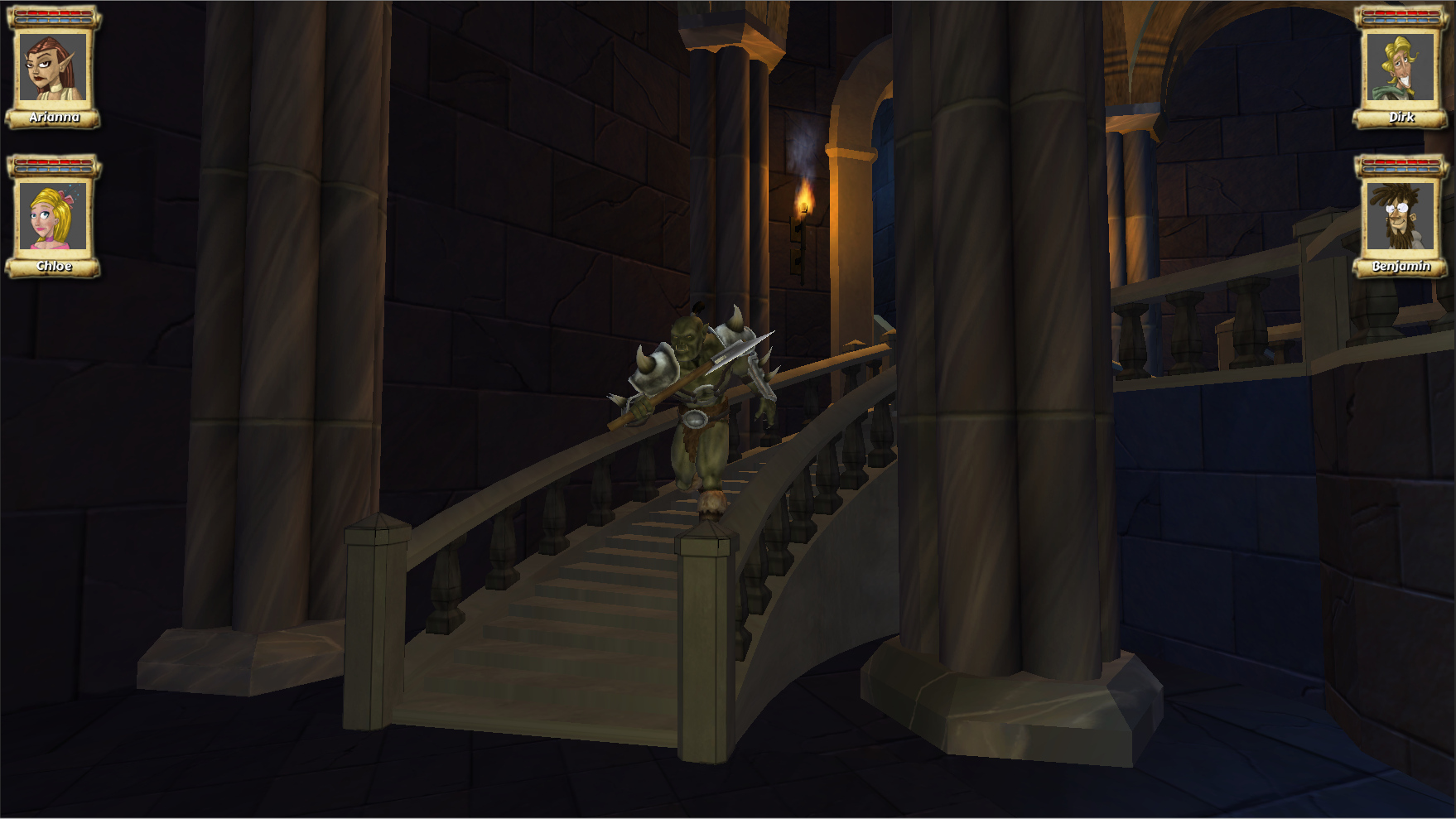
Of course, the Frayed Knights are, almost by definition, always the wrong people…
Filed Under: Frayed Knights - Comments: 7 Comments to Read
The Comic Con Upgrade
Posted by Rampant Coyote on August 14, 2014
I remember back in the 90s when a computer upgrade was almost a mandatory bi-annual thing… on odd years I’d replace parts to keep it kind of up-to-snuff, and then on even years I’d replace the whole machine. Man, I don’t miss those days. PC gaming was an expensive hobby. Nowadays, PCs cost half as much (before accounting for inflation!), and a decent gaming system can last you at least three years before you have to even start thinking about an upgrade.
My system is about four and a half years old, and has had an innards upgrade with a replacement video card about 2 years ago, a second hard drive put in about three years ago, an upgrade to Windows 7 about a year ago (yes, it was originally an XP system), and replacement case fan about a year ago. Surprisingly, it isn’t really limping along… it’s been humming along decently and has been able to play games like Skyrim, Borderlands 2, and even Bioshock Infinite reasonably well. No, I don’t crank up the visuals into the stratosphere on those, but it’s not been hard to find a decent balance between visual quality and fast framerate.
But as we’re coming up on five years, with some cool games coming up that may finally tax the system, I considered options. I decided that as a motivational factor, I wouldn’t replace my machine until Frayed Knights 2 shipped. After all, who’s gonna have time to play games until then, anyway, right? And Frayed Knights 2 sure doesn’t have problems running on this old box!
Well, as a side-effect of all that surgery, my poor old machine is missing its side-panel (because the mounting rails that supposedly came with the system are too big for that extra hard drive and the limited sideways (!) space, so it pokes out to the side. Well, who cares about heating problems anyway….? 🙂
As a result — it’s pretty immobile. Not a problem, it’s a desktop. I have a laptop and a tablet for when I’m on the go.
But I just discovered that my laptop doesn’t want to interface with the big monitor I’m supposed to use for my Comic Con booth. 780p televisions, no problem… but not this 27″ monitor. Nor could it support the higher resolution, if it could interface.
So the laptop won’t work. The desktop… won’t travel. I *could* bug friends to try and find if they have a computer to spare that will run Frayed Knights 2 at high resolution until September 9.
Instead, I broke my little promise to myself. The desktop is finally getting an upgrade. Yay. Maybe I’ll finally be able to play DCS: A-10 Warthog or, when it comes out, Star Citizen. Assuming I ever have time to play games again…
Man, I hope I sell a lot of games and get a lot of exposure at Comic Con… this whole thing is getting more expensive by the week…!
Filed Under: Geek Life - Comments: 4 Comments to Read
Passion and the part-time indie: Why the candle gets burned at both ends
Posted by Rampant Coyote on August 13, 2014
When one is a part-time indie game developer, one comes to expect certain things. Like the inevitability that crunch mode at the Day Job will coincide with crunch mode for indie dev. If you are a serious, “professional” indie, this may also mean that you find yourself coming face-to-face with some very real deadline issues that can’t be easily dismissed.
That’s been my reality the last few weeks.
I haven’t pulled any all-nighters (yet), but I have pulled some nights with only 3 or 4 hours of sleep. 12-hour days at the day job followed by five or six hours doing the indie thing, with a break in-between only for dinner, a chance to remind my family that I’m still alive, and maybe 15 minutes of guitar practice. And of course, taking care of hygiene needs, and catching what sleep I can, because the following day won’t be much better than this one.
Waitaminute! Isn’t this supposed to be what going indie was supposed to get me away from? That whole psycho-work-week thing, long hours, no-sleep, no-time-for-life lifestyle that the major studios have been forcing their employees into for years?
Well, yes and no.
First of all – the day job is the day job. Crap happens. It’s the way of things. I’m still quite dependent on the steady paycheck from the day job, thankyouverymuch, and so there’s that. At least it’s not in the games biz.
Secondly – it’s a whole ‘nother ballgame when it’s your own game, and you have a stake in the results. I don’t harbor any illusions about Frayed Knights 2: The Khan of Wrath becoming any kind of mega-hit or anything. But it is my baby. I take pride in it. I’m excited about it. This is all intrinsic motivation… with some self-created (or at least signed-up-for) external deadlines to provide some extrinsic sticks to go with my intrinsic carrot.
I willingly sign myself up for this kind of crap, so I really can’t complain too much. And… let’s be honest… even if all it does is pay for my out-of-pocket expenses, it’s still a win to create something this cool, and have it go out there into the public, and to have it be fun and cool and enjoyed by others. There’s a level of satisfaction I obtain from that which is hard to beat. And it’s not just indie game devs – I’ve seen this in artists slaving away at web comics, in authors, and people with wild, weird hobbies that nobody seems to understand but themselves. We build things.
That’s really where the indie passion comes from. We create cool stuff, and share it with others. That’s what makes all this other crap totally worthwhile.
But in all this… I still have to give extra credit to my family for putting up with this. They have their own passions, their own things, and indie games development isn’t one of them. But they have always been incredibly supportive of this, with the understanding that I do have to make sure it doesn’t stay full-throttle all the time.
Filed Under: Indie Evangelism - Comments: 2 Comments to Read
Black Triangles
Posted by Rampant Coyote on August 12, 2014
One of my most popular posts was also my very first… which has since been lost to the Great Blog Devouring of ’14. So… here’s the post from over ten years ago (has it been that long?!?!?!) about an event from almost twenty years ago. Still stuff I have to remind myself about some days.
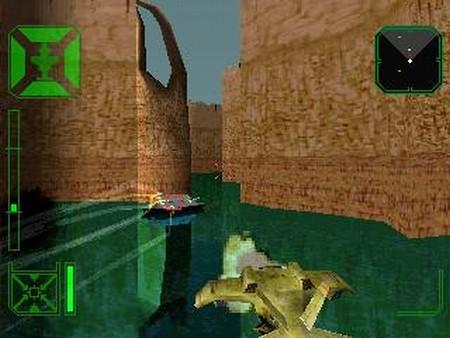 In October of 1994, I’d just started as an honest-to-goodness videogame programmer at a small startup called SingleTrac which later went on to fame and glory (but unfortunately not much in the way of fortune) with such titles as Warhawk, the Twisted Metal series, and the Jet Moto series. But at the time, the company was less than 20 employees in size and had only been officially in business for about a month. It was sometime in my first week possibly my first or second day. In the main engineering room, there was a whoop and cry of success.
Our company financial controller and acting HR lady, Jen, came in to see what incredible things the engineers and artists had come up with. Everyone was staring at a television set hooked up to a development box for the Sony Playstation. There, on the screen, against a single-color background, was a black triangle.
“It’s a black triangle,” she said in an amused but sarcastic voice. One of the engine programmers tried to explain, but she shook her head and went back to her office. I could almost hear her thoughts… “We’ve got ten months to deliver two games to Sony, and they are cheering over a black triangle? THAT took them nearly a month to develop?”
What she later came to realize (and explain to others) was that the black triangle was a pioneer. It wasn’t just that we’d managed to get a triangle onto the screen. That could be done in about a day. It was the journey the triangle had taken to get up on the screen. It had passed through our new modeling tools, through two different intermediate converter programs, had been loaded up as a complete database, and been rendered through a fairly complex scene hierarchy, fully textured and lit (though there were no lights, so the triangle came out looking black). The black triangle demonstrated that the foundation was finally complete the core of a fairly complex system was completed, and we were now ready to put it to work doing cool stuff. By the end of the day, we had complete models on the screen, manipulating them with the controllers. Within a week, we had an environment to move the model through.
Afterwards, we came to refer to certain types of accomplishments as “black triangles.” These are important accomplishments that take a lot of effort to achieve, but upon completion you don’t have much to show for it only that more work can now proceed. It takes someone who really knows the guts of what you are doing to appreciate a black triangle.
Years later, I was chatting with another SingleTrac alumnus, and was excitedly relating my work on the multiplayer code. I’d spent a little over a week working on the underlying architecture, trying to make it clean and reliable and easy to use. It was all UDP rather than TCP/IP (for speed), so I created my own “guaranteed delivery” protocol for those rare packets that needed to be guaranteed. I’d rarely worked low-level network code before, so it was kind of a new experience. When all was said and done, I had another computer join the game and boom! There it was, on the host machine. Wow. No updates, it did next to nothing, but the core architecture was there. The rest SHOULD come together quickly. Explaining this to my buddy over IM, I explained, “It’s a black triangle.” He understood what I meant immediately. It’s a convenient shorthand metaphor.
So feel free to steal the term. And when progress seems a little slow because you are doing a bunch of hardcore architecture work, just remember it’s a black triangle.
Filed Under: Game Development - Comments: 2 Comments to Read
Game Development: Rolling Your Own Engine?
Posted by Rampant Coyote on August 11, 2014
 This weekend in the indie game developers group on Facebook, a vocal minority (very much a minority) ventured “opinions” disparaging developers who don’t build their own game engine from scratch. The predictable crapstorm ensued. Mainly it was troll-feeding and simply fun to pile on, as these Internet arguments often go.
Now, ignoring for the moment the fact that any “opinion” used to put others down is really just vanity, I’d like to talk about this for a moment. If you followed my post from last week about GameMaker, you can guess what I’m going to say.
I wrote my own 3D engine for my first commercial indie game. It was a challenge, and it was also fun. It was nifty getting my hands dirty with trying to optimize collision detection, the rendering pipeline, and so forth. As a programmer, it’s awesome. After that experience, however, I realized that I’d rather write games than engines.
As a gamer – I really don’t care how a game was made. Sure, if you showed me the trickery and shortcuts behind the curtain, I might be somewhat disappointed, because the magic is gone. Or, like the sausage factory, I’m a little grossed out realizing what’s in it. But in the end, all that really matters is having an entertaining product.
Amateurs and the self-conscious seek to impress their peers. Professionals seek to impress their audience.
Now, it’s very cool if a developer *can* and *does* write their own game engine. That’s awesome. And there are cases where they probably should. Especially now that we are back to supporting less powerful devices (mobile), a custom engine allows us to make some optimizations that are just not possible in a general-purpose engine. I’ve seen efforts to provide Minecraft-style visuals in Unity, and so far I haven’t seen one that impresses me.
But if you do go back and create an engine of your own “from scratch,” how far back do you go? Is it okay to use a powerful, high-level SDK? Or do you have to go down to the metal yourself, writing your code in machine code? If so, you are unlikely to complete your game before the platform becomes completely obsolete, but good luck.
Obviously, it gets pretty ridiculous to draw the line too far back. Which, to me, illustrates why the line doesn’t shouldn’t exist at all. If your hobby is creating graphic demos, or writing in assembly, or creating game engines, or writing games for obsolete systems, or any other works of technical prowess, then by all means, go for it! I think it’s cool! But if you are a game developer, making games for a more general audience than just “other developers who appreciate stuff written in assembly,” then you should start at whatever point makes the most sense for their game. If it’s a high-level, genre-specific platform like RPG Maker that lets you do your thing just fine, take it and run with it. If you are making a game for an Atari 2600 emulator just for kicks, you are probably going to have to make friends with machine language.
It’s always all about the audience.
Filed Under: Programming - Comments: 7 Comments to Read
Game Dev Quote of the Week: Little Pieces of Deviation Edition
Posted by Rampant Coyote on August 8, 2014
 “Breaking your game down into small pieces forces you to analyze and evaluate your ideas on a deeper level. This is essential because you always want to be open to changes, you never want to set yourself into a path that you feel you can in no way deviate from. Deviation from the plan can yield the most interesting parts of a game. It’s a more organic way of developing because you are thinking within the game system and are applying new ideas to ideas that have already formed.”
— Team Meat’s Tommy Refenes, “How do I get started programming games???”
Filed Under: Quote of the Week - Comments: Read the First Comment
The Pros and Cons of Making Games with GameMaker
Posted by Rampant Coyote on August 7, 2014
 PC Gamer’s recent article, “No coding required: How new designers are using GameMaker to create indie smash hits” was pretty enjoyable and seemed reasonably accurate – even if its headline is a bit misleading. Part of the reason I picked up GameMaker several months ago and wrote a little arcade game in it was because I’ve been recommending it to wannabe game developers for a while… and thought I should actually get some first-hand experience if I was to keep doing that.
And yeah, I’ll keep doing that. While I don’t see it in my future as my development platform of choice, I came away reasonably impressed. With GameMaker, and a few of the many, many tutorials available online, it’s a pretty awesome way for a person with dreams but little experience to get their feet wet in the game development world.
But that has always been the case. If anything, I’d say it’s a little harder to use now than when I first encountered it many years ago. Originally it was intended more as a learning tool, but YoYo Games has made it more of a professional tool with each iteration. At least based on my dim recollection circa 2006 or so, it seems like the software has gotten a lot more powerful at the cost of some user (especially newbie) friendliness. That’s to be expected – if nothing else, it’s a major chore to keep things even close. I think the tool deserves praise for retaining it’s ease-of-use for new developers.
For a new developer who is doing a genre-specific title, like a 16-bit style console RPG, I might recommend a more specific tool, like RPG Maker, AGS, etc. If you aren’t deviating much from the formula, these kinds of tools might offer something close to the “minimal code” ideal. The tools offer a great deal of power and (relative) ease-of-use at the expense of flexibility.
 That’s really the trade-off. Based on my own limited experience and comments from others, GameMaker has achieved a pretty good balance, probably still erring on the side of catering to inexperienced developers. It has good support, an active community (for getting help or answers when needed), a decent feature set for making 2D games, and is still (relatively) easy to learn. That’s awesome.
It’s also good to see that plenty of indie developers are making popular, successful games with it. In the final analysis, that’s really all that matters: How much did it help you make your game, and how did it help you make it successful? That means different things to different developers. But if the tool solves your problems, is comfortable to work with, and is capable of handling the kind of game you have in mind, it’s pretty golden. For the brave new indie world littered with 2D and “retro” titles, it seems like a pretty hard-to-beat tool.
So, yeah. I still recommend it. But it’s still not my engine of choice.
Filed Under: Game Development - Comments: 5 Comments to Read
Wing Commander III for Free?
Posted by Rampant Coyote on August 6, 2014
The good news:
Origin is giving away Wing Commander III: The Heart of the Tiger for free today.
The bad news:
It’s a very temporary deal, so if you got here late, it’s already changed.
The ugly news:
It’s EA’s Origin online service.
I dunno. Even though I do have a rarely-used account on Origin, I’d rather pick up Wing Commander III from GOG.COM.
While I personally consider WC3 to be the weakest of the original series (Prophecy, Academy, etc. don’t count) both in gameplay and storytelling, it was still a fun game for its time, the first “true” Wing Commander (meaning: not counting Armada) with actual 3D models for ships, and the first with actual actors doing their best to emote on green screen. And Tom Wilson – well, the guy’s just awesome in general, but he makes a great Maniac.
Filed Under: Deals - Comments: 3 Comments to Read
Salt City Steamfest 2014
Posted by Rampant Coyote on August 5, 2014
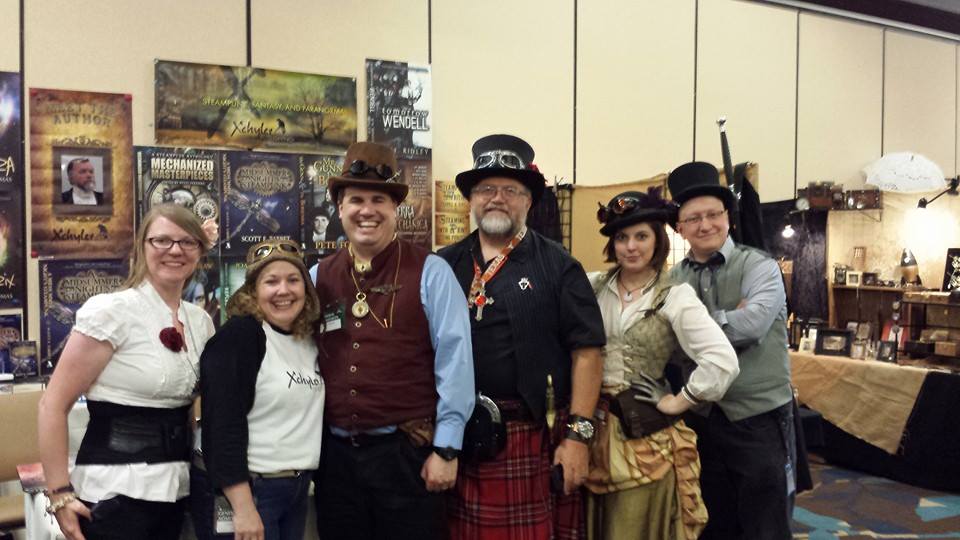 This weekend I donned my top-hat and goggles and went to Salt City Steamfest. This time around, I was a somewhat more active participant – I was involved in two panels with my publisher, Xchyler Publishing, and periodically assisted at the booth selling (and even signing!) books with other authors and editors.
I guess in spite of my software engineering background and heavy geekdom, I’m still kind of a people person. Getting to know (or know better) these folks was a lot of fun. In the picture above / to the right, that’s Candace Thomas (author of Vivatera


Whew. Lotsa books and authors. And a lot of fun.
 But we did more than just, you know, work on things. There were things to do… like send a message to Obi-Wan through a Steampunk R2D2, as my wife demonstrated. We also got an authentic tintype photo taken of her. Complete with the full four-second pose and everything. That was really cool. For the kids, there was a carnival – with cotton candy and prizes. And there were mermaids in the hotel pool.
There was plenty of swag in the three dealers’ rooms. If you are looking for a corset, or a dapper hat, goggles, painted nerf guns, books, art, canes, comics, jewelry, picture books about mechanical bustle racing, or just plain weird, cool stuff… there was plenty.
The panels ran the gamut. I was in two panels on writing & getting published (run by my publisher, of course). My wife told Victorian ghost tales. There were panels on Victorian customs, etiquette, and really scary messed-up traditions and beliefs and culture. I guess that’s why Steampunk is idealized fantasy of the era rather than historical fiction. Again – it’s an alternative to medieval fantasy.
My wife has been dragging me out to do Victorian dancing, and our little group actually got to perform during the ball. That was admittedly kind of fun. And then there was the concern performed by Deus Ex Vapore Machina. They were a fun experimental string quartet that sounds something like a string quartet mixed with industrial mixed with dubstep. I liked ’em, but they weren’t too easy to dance to.

We had a little bit of fun the first night when a bunch of us went to an Italian restaurant and when asked what event we were attending, we gave them weird looks and asked, “Event? Tell me, what year is it?” When we finally got them to answer, we’d say, “IT WORKED! We’re in the future!”
Yeah, we’re jerks at heart.
It was a really fun weekend though.
Filed Under: Geek Life - Comments: Comments are off for this article
Utah Indie Night – July 2014
Posted by Rampant Coyote on August 4, 2014
The July Utah Indie Night was held at Wahoo / NinjaBee Studios in Orem, Utah. The basement common area / conference room was packed with over 50 attendees overall.
The formal presentation was given by NinjaBee’s PR guy, who spoke on attending trade shows & conventions an an exhibitor. Since my convention experience has (until today) been strictly limited to being an attendee, this was all pretty dang informative. Not everything applied to me having a mini-booth (kiosk) in a group effort at Salt Lake Comic Con in September, but some of it did. It was a very useful talk!
The games were all pretty high quality. Momentum is a game where you tilt a curvy track around to maneuver a ball from the start point to the end point. The levels are twisted and follow a little bit of a Moebius Strip stype. It’s all physics-based, so “dropping” the ball and catching it on another part of the track is a real streategy. The game was shown several months ago is looking better than ever.
Califer Games was showed off their match three that teaches some basics of the Japanese language, Kana Match. This was built partly as an exercise to learn Unity 3D, but also as a way to put Curtis’s skills as a Japanese language instructor for English speakers to use, as well as his love of game development. What I liked about this game is that it exposes you to some basics of the language that you can’t avoid while playing – which could make learning Japanese easier in the future – it’s incidental to the gameplay. You don’t need to know anything about Japanese when you play, you aren’t forced to learn anything, but if you play it for a while for the fun of it, you can’t help but come away with some
 Lycan was an interesting FPS-style LAN game where players play werewolves or villagers. The game is short – during day / night cycles that last maybe a minute per cycle, the goal is to transform all of the other side to your side, through biting them (as werewolves) or hitting them with magical potions. What’s interesting is that one side is entirely defensive while the other team “hunts.” And the teams aren’t static – you can change teams with your transformation several times in one game (especially if you suck… like I do).
Script Kiddies is a multiplayer game where you play an 8-bit looking hacker to different computers trying to send a virus to your opponent before he does the same to you. On the computers, you have to hit the right button-pressing sequence to activate the virus. You need to infect your opponent’s computers before he infects yours. I totally sucked at this one, too.
Crashnauts is a 4-player 2D Battle arena game popularized by games like Towerfall and Duck Game. Crashnauts is more sci-fi oriented with plenty of carnage and environmental hazards.
 Kittens & Kobolds was a Game Jam project with — kittens and … kobolds. It was a very experimental game with apparently pretty dynamic rules, about cause and effect, where understanding the point and rules of the game was part of the rules. The devs said something about appearances and preconceptions. I’m just gonna leave it at that.
The latest (and, according to Mike Rimer, the last) DROD (Deadly Rooms of Death) game, DROD: The Second Sky, made its appearance with a number of interesting new features. In the new game, you may need to clear rooms from different directions, and there’s also a temporal / time shifting aspect. DROD: The Second Sky also features more story than in previous games, bringing the entire saga to a close.
 I gotta confess to Darius, I’m not thrilled with the title “Flame Warrior.” But Eidolon Games’ turn-based space combat game with space ships, Newtonian physics, firing arcs, and all that cool stuff is really looking pretty awesome. If the tone from the movement tutorial (where you must fly through a maze of asteroids) stays consistent, it’ll be a somewhat amusing, not-too-serious approach to space combat as well. Play the game at the link… the tutorial is actually pretty challenging and fun. I seem to recall Darius mentioning that he wanted to make sure the tutorial felt more like part of the full game, and not just a practice area.
There was also a board game that I can’t remember the name of … sorry!
A couple of people seemed to be playing games on handhelds. If these were games being demoed, I missed them. It was hard to tell if people were playtesting games or just messing with their iPhones.
And as always, for me a lot of the value at these events are networking with people, putting names with faces, and getting to shoot the breeze with people about games and the games industry.
Filed Under: Utah Indie Game Night - Comments: Read the First Comment
Games as Services: Will you never be allowed to own a game again?
Posted by Rampant Coyote on July 31, 2014
Ben Kuchura at Polygon ventures the opinion that – in light of a very obvious trend in the industry right now from certain major publishers / platform holders (particularly EA) – in the future, nobody will own video games anymore. It’ll all be a rental. Or at best, owning a license for indefinite access to a game which is treated as a service, rather than a product. But – like canceled MMOs – the lights will eventually go off and the game will disappear into the mists of time.
We saw hints of it with Diablo III and Sim City. Even playing a game solo, with no intention of interacting with anybody, required logging into a server which might not be there in a few years (and often wasn’t functioning very well at launch). EA Access on the XBox One is a major step in that direction.
It sounds like s a big publisher’s paradise. You lock customers into your particular service pretty much forever. You can force people to play your new, hot games by phasing our their predecessors, without needing to make any major improvements to encourage the migration. You insulate yourself from hit-driven economics… you need the hits to attract new customers and increase retention, but it’s no longer a live-or-die affair. Without having any actual sales, there’s no such thing as royalty rates, which means they are allowed to structure bonuses to hit-making dev teams and studios in a far less open-ended fashion… basically screwing over dev teams without resorting to creative accounting practices or obviously lousy contract points. And, of course, it finally allows them to combat piracy in an effective way.
As a player – or potentially as a third-party developer – there is nothing but depending upon the publishers to be “nice guys” about i. Meanwhile, the publishers can just keep ratcheting down the bar on what constitutes being a “nice guy” to earn that good will.
Furthermore, Kuchura argues that most gamers won’t care. We’re already being programmed that way now, smoothly sliding down that slippery slope. The entirely predictable losses and frustrations won’t happen until we’re too far down the path to turn back. That’s how these things are done. Always.
I want him to be wrong. As a gamer, I desperately want him to be wrong.
But he’s probably not. This depresses me.
Now, as a developer, I admit there are some kinds of games – even primarily single-player games – for which this kind of model makes sense and the ol’ Idea Fairy keeps hitting me with things I’d love to try. So it’s not like I reject the entire concept. Just the idea that there’s a push to stuff all games in that particular box.
After all, I’m a retro-gamer, and I’m still playing games from companies that have long since disappeared. I’ve still got frickin’ floppy discs in my closet (and a drive on my computer to read them!).
All I can say is… the free market can work wonders, sometimes.
Don’t like it? Vote with your wallet. Support the indie games and publishers that don’t treat you like a wallet with an email account. Buy games direct and download them. If given a choice to buy a game either directly or from a place like GOG.COM that allows you to own and download the product, do that instead of a service that controls your access to the game (*cough*Steam*cough*). Maybe it won’t reverse the trend, but it will help make sure that there will always be alternatives.
Filed Under: Biz - Comments: 10 Comments to Read
Frayed Knights: Free Strategy Guide, and the Adventurer’s Guild
Posted by Rampant Coyote on July 30, 2014
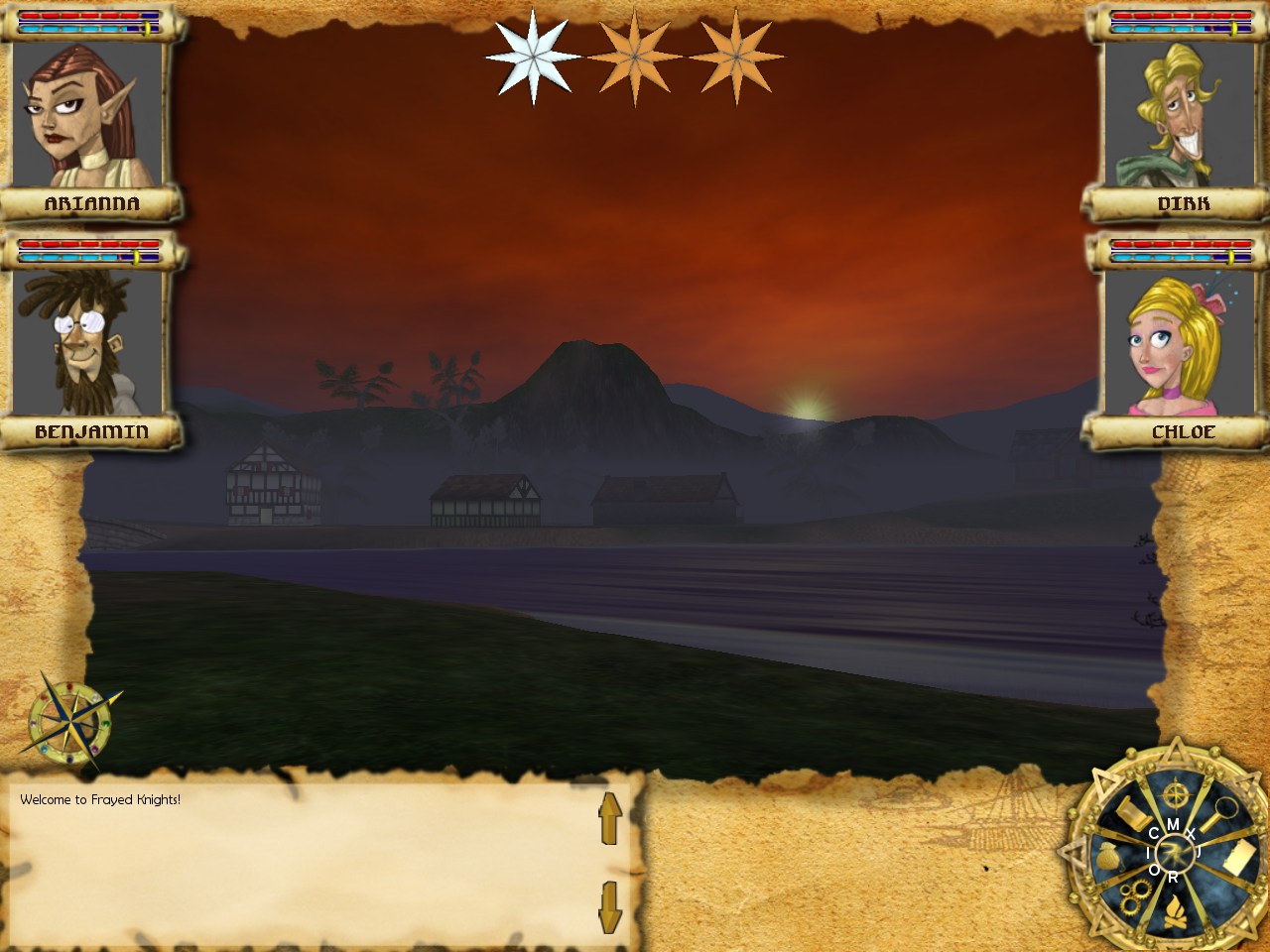
 There are still 24 hours left to pick up Frayed Knights: The Skull of S’makh-Daon on Steam at the launch discount.
If you have already played the game and now own the Steam version, if you feel so inclined, please post a review on the Steam page.
Additionally, if you haven’t done so yet, I offer the strategy guide for the game for free. You can grab it here. The page encourages you to register for the (sadly, rare) email newsletter, but that’s entirely optional. Meaning: Please don’t put in a bogus address just to get the strategy guide. It’s yours if you want it, with or without your email.
The strategy guide is not just a walkthrough. I wanted it to really be an accessory to Frayed Knights: The Skull of S’makh-Daon (in addition to the 69-page manual) with some information on the world itself, peeks under the hood at the game system and content, hints for those who just need a nudge, and a walkthrough for people who really need the help. Which would probably be me, if I was playing, rather than get frustrated by a part of the game.
So if you have the game, grab the strategy guide! Or, hey, grab the strategy guide even if you don’t have the game!
On to a little game-world related topic – the Adventurer’s Guild.
The ‘quest’ of The Skull of S’makh-Daon is to gain entry into the Adventurer’s Guild. The party fails in their first attempt, by getting beaten to the punch by a rival adventuring group. And then the fun really starts. But what is the Adventurer’s Guild?
The guild is sort of a weird idea I came up with long before Frayed Knights. It was me playing with the idea that you could have a world where – like in an MMORPG (or, at the time, a MUD) where you have lots of adventurers running around. In the old-school D&D modules, you were always finding the remains of these guys in dungeons – the group that tried to tackle the dungeon before you. I thought – if there’s enough of these guys running around the world, and the successful ones tend to come back loaded down with cash, wouldn’t a service industry evolve to help them and help relieve them of some of that hard-earned cash?
Thus, the adventurer’s guild.
The guild takes a number of roles in the world of Frayed Knights:
1. It educates adventurers as to “best practices” to survive the threats of a world full of magical and monstrous danger.
2. It informs members of the latest adventuring hot spots, rumors, jobs, etc. (Think Soldier of Fortune magazine).
3. It can act as banking services for adventurers who don’t want to cart all their cash around with them.
4. It offers something of a primitive form of insurance – as a self-funded bounty for an adventurer’s rescue (or the recovery of their body) should they not return on schedule from an expedition.
5. While not really modeled in the game for the sake of convenience to the player, the guild also takes care of buying, selling, and trading magical gear.
6. The guild offers courier services to members
7. Major guildhalls offer temporary lodging for guild members, with the utmost in security that will not be found in your average inn.
8. Looking for group? The guild helps members keep track of each other – very important in a profession with a high mortality rate – and helping members track groups with openings and members seeking openings in new groups.
In the world of Frayed Knights, the Adventurer’s Guild has become somewhat more exclusive. I figured this would be a natural development if the adventurers were as quick to “game the system” as gamers are in our world. For example – if a bounty is offered for recovering the bodies of dead adventurers, a group of assassins might specialize in arranging for the deaths of adventurers just to collect the bounty. “Wannabe” groups might underbid on the best jobs, winning contracts, and then failing utterly – taking the reputation of the guild with it. A few embarrassments like this, and the guild would no doubt start making additional requirements for membership, including recommendations by established members in good standing, and proof of competency.
And so we find Arianna, Benjamin, Chloe, and Dirk in the Temple of Pokmor Xang, on an “official” quest from a senior guild member to prove themselves, in order to gain admittance to the guild.
Filed Under: Frayed Knights - Comments: 2 Comments to Read
Computer RPGs and the Game Controller
Posted by Rampant Coyote on July 29, 2014
 I love my keyboard and mouse for gaming.
Before mice were common, I loved the keyboard.
I remember playing Ultima III and IV, where there was a command for almost every key. It seems a silly idea today, but back then, it at least made the game feel like it was incredibly interactive. Look at all the verbs! Okay, so it was kind of kind of redundant at times, and some commands were used so infrequently they didn’t really deserve their own key. But it felt like a rich command set!
I’ve been a PC Gamer ever since. Sure, professionally, I made games for consoles for a living. I was young and needed the money! Okay, seriously, there were times when I was convinced it was the most awesome job of all time. And I learned to love the consoles, especially the original Playstation. But there was a richness in PC gaming that I felt lacking in many console titles. The console gamers might jeer and call them boring, but those of us playing the original X-Com, Daggerfall, Falcon 3.0 (and later 4.0), and Civilization games knew better. Console ports of games like Diablo paled in comparison. Ditto for the console versions of most PC RPGs.
Once upon a time, back when there really was a larger distance between console and computer games, I remember a journalist explaining that the difference was often depth vs. breadth. Console games – like fighting games – tended to go for greater depth of play within a limited breadth of interactions. PC games tended to go for more breadth of interactions. Over time, that has converged a bit, though I do still love having that breadth of interactions.
Nowadays, from a technology standpoint – there’s not such a difference between consoles and computers. As far as what’s going on under the hood, it doesn’t really matter. As Microsoft’s Surface and will-conceived Windows 8 attest, mobile devices are closing the gap as well. We have HD TVs now that display text almost as well as computer monitors. And the controllers? Well, console controllers from the last couple of generations of systems have been pretty dang interesting. I’ll bet you could eliminate some redundancies, put a few rare controls on a menu, and map the old Ultima controls onto an XBox controller pretty well. While mobile games have diverged a bit in the style of gameplay (mostly owing to small screens and touch interfaces), PC games and console games have converged much more. It’s not always a good thing – I do feel like there’s been a bit of “dumbing down” as a result – but there are good things to be borrowed from both sides.
There’s still something about the keyboard and mouse for me. Especially the mouse. It’s convenient. It’s precise, unlike thumbsticks and touch screens. Even though the world is changing and people are using a dedicated desktop (or laptop) less and less, I’m still a fan. I’m still a PC gamer. I think in those terms. Sometimes to my own detriment.
But reality intrudes. I have to show my next game, Frayed Knights 2: The Khan of Wrath, at Salt Lake Comic Con in about a month, and … well, people really respond better to controllers, especially when faced with a new game. The left stick and right buttons are the first to be experimented with. And – as the adventure games of the 90s illustrated, context-sensitive verbs are a pretty good thing. I really want to hand them a controller, not point them to a keyboard and mouse.
 So now I’m frantically re-thinking my UI in terms of game control input. And it really changes everything. It’s actually a good thing, to a point – because it really forces me to think in terms of simplifying controls for the player. Players of Frayed Knights: The Skull of S’makh-Daon and its rather ungainly UI will no doubt appreciate the effort. This doesn’t mean that players of my beloved keyboard and mouse are going to be stuck with something like an emulated console controller… no way, no how. Keyboard and mouse are still going to be, in my mind, the primary way to play the game. But it does force me to think about economy of movement, careful nesting of what menus are necessary, and – well, simplifying the control of things, even if the stuff going on underneath the hood is still pretty hardcore.
I know it’s the right thing to do. I know it’s the necessary thing to do. I know the game will be better as a result of me streamlining things. I know that I will still be able to play with keyboard and mouse in the way that the gods of PC gaming intended. But there’s still a little part of me that feels guilty about it.
Filed Under: Design, Frayed Knights - Comments: 17 Comments to Read
Frayed Knights Steam Launch Sale Ends Thursday
Posted by Rampant Coyote on July 28, 2014
Just a heads-up to anybody planning on picking up the Steam release of Frayed Knights: The Skull of S’makh-Daon, the launch sale ends Thursday. Just sayin’.
Filed Under: Frayed Knights - Comments: Comments are off for this article
Copyright © 2026 Rampant Games | Privacy Policy
Powered by WordPress.
