Notch – Cashing Out of Indie-dom (for a while)?
Posted by Rampant Coyote on September 10, 2014
 Markus “Notch” Persson is an incredibly lucky person. And with that, I don’t mean that at all as a slight against his skills. The guy paid his dues. He made craploads of games for previous employers. He co-created an MMO. He participated in Ludum Dare competitions. He’s got mad skills. He’s easily in the top 20% of indie programmers – probably in the top 10%, and he’s got a good head for design. He’s better than me. He was destined for success, sooner or later. But now he is a rock star. That’s not an inevitability no matter how good you are. His stardom came through a combination of skill, hard work, and an unbelievable amount of good luck. Things just clicked and went viral, and he was good enough and positioned well enough to take advantage of it.
And now, the rumors are circulating that Microsoft is offering just under $2 billion (with a “b”) for his company. And, of course, Minecraft.
Me? I’d take it. You can fund a lot of startup game studios and new game projects for a couple of BILLION dollars. Of course, we’re not talking about a lump sum of a couple billion dollars of cash here, either. It’s probably staged and a combination of cash, stock, and other assets released in a staged fashion. But I’d be for taking the money and using it to change the world. After all, at a certain point, that’s all that kind of money is good for – it’s exceeded your capacity to use it as a plain ol’ consumer. You gotta hire up people to do awesome things.
 And for that, good on him! The only thing bad about it is that it’s given a lot of people some very strange perceptions of what indie gaming is like. There may be another story like his in the future – I sure hope so – but it’s not like anybody of half his ability and half his diligence (or even an equal amount of both) is just going to go out there, make a game, and expect half or quarter or even 1/100th of the success he’s achieved. Especially not with just one or two games. Sometimes – like Rovio with Angry Birds, or Terry Cavanagh with VVVVVV, it’s a last-ditch effort after innumerable failures that brings success. And sometimes the “big hit” never happens.
Now, if I were Microsoft (or rather, if I was in Microsoft’s shoes… I can’t possibly envision what goes on in the corporate mind that causes them to be so disdainful of their customers), here’s what I’d put on the table:
#1 – The total distribution would be tied to Notch being directly involved in the release of Minecraft 2. Microsoft has it’s eye on a franchise, and it needs to be launched by The Man himself. The guy managed to make himself a rock star – the very thing the publisher / studio system has repressed for the last couple of decades – so you want him to the the front man.
#2 – I wouldn’t mess around with current distribution of Minecraft 1. In fact, I’d allow it to continue being ported to other platforms. The more the merrier. I’d want EVERYONE to have the opportunity to play Minecraft 1. And get addicted.
#3 – Minecraft 2, I’d be a schmuck about and limit it (probably) to Microsoft platforms. So all those people who loved the game on every system under the sun would find their way to own the new one on a PC, console, tablet, etc.
#4 – And yes, I’d milk the name and franchise as much as possible. I’d want new games to come from “the creators of Minecraft!”
Assuming these rumors are for real and it really does go down:
Yeah, there may be some people out there hating on him for even considering this deal. Many of them would probably take that deal themselves in a heartbeat if the situation were reversed. Assuming it goes through, nobody really knows what this means to the game that indie legends are made of. Hopefully, as gamers, we won’t notice a difference.
But you know what? It’s his game, and it’s his call. I hope that, in the end, he’s satisfied with his decisions. I’m pretty happy for him. He didn’t set out with this kind of expectation, and I honestly believe that he did what he did in order to make the coolest game possible. I’m happy to know that occasionally, that still pays off.
Filed Under: Indie Evangelism - Comments: 12 Comments to Read
Category / Genre Doesn’t Mean Squat: Tell Me a Story About Your Game
Posted by Rampant Coyote on September 9, 2014
 I remember as a kid, getting one of the first Commodore 64s off the assembly line, and the absolute dearth of games available. I remember really wanting to get one game – Turmoil – even though it was a clone of an only somewhat entertaining game because it was one of the only ones out there. I didn’t actually get it, to which I may credit my own career in video games. If I wanted games for this new, cool system, I had to make them myself.
For the first few weeks, that was the case – there were so few games available that even “okay” ones would do. That didn’t last long. The C-64 was an amazingly popular platform in its time.
One of the reasons game developers get excited about a new console release is that it finally wipes the slate clean (to a degree). The glut of games they’ve had to compete with over the years will finally disappear in one glorious blast of freshness, and they can be a “launch title” on a platform with only a few dozen titles the first few weeks.
It seems that even this extreme “reset” isn’t quite working anymore. People have many, many options and each new platform release is less of a “revolution” than the previous. Of course, those of us in the computer game side of things are all too familiar with all of this. Especially with Abandonware and places like GOG.COM and Steam keeping the classics alive, I’m competing not only against the current “glut,” but against an entire legacy of classic works.
And then novelists can say to us all, in their best Bruce Willis impression, “Welcome to the party, pal!”
When there are so many options, it can be rough as both a player and as a creator. This was brought home for me a little more fully at Comic Con last weekend. I was certainly excited about the games made by local indies. But in a world with such a glut of games, it was tough getting people excited about Yet More Games. Nobody’s going to go out of their way just to get the chance to play “new games.” They won’t act like Matthew Broderick’s character David Lightman in Wargames and take risk and effort to get a sneak peak at some mysterious unknown, upcoming games. Why? There’s a half-dozen or more games coming out every day on Steam, or every hour on Android & iOS.
Even going by category doesn’t help much anymore. When I first started working on Frayed Knights, that style of game had all but disappeared. First-person, turn-based RPGs? On the day I officially started development, that alone might have been enough to distinguish my game. I like to pretend that I was a trend-setter, but honestly it was simply time for those games to make a comeback. They aren’t common, but it’s not enough. Especially not in a world when I can go online, and for the price of a fast food hamburger (or less) get one of the classics that inspired these indie games in the first place. They might be a little clunky and “low res,” but they are still fun.
I think one of the big tricks really is the classic “elevator pitch.” At the Xchyler booth at Steamfest this year, a fellow author found that once she started describing her story in a thriller anthology rather than simply referring to it as an excellent anthology of thriller short stories, the book started selling. Yeah, this is something that seems obvious to an armchair quarterback, but these kinds of things are easy to lose track of when you are down in the trenches.
As both a gamer and a game developer, I want to hear the story about the game. Just as I’d like the quick two-sentence description of a book or story. That’s what will set this particular game apart from the awful glut of options. It doesn’t have to be audacious, although that certainly works. I heard Lyle Cox of Mount Olympus Games describing his game, “Together: Amna and Saif” as a means of facilitating communication and cooperation between couples. That’s a far cry from my own “elevator pitch,” which was more storyline-centric, but it certainly seemed to work.
I love RPGs, and I am easily addicted to “4X “strategy games. But I have plenty of these games already in my library. You can’t just give me a category or genre and win me over anymore. Sorry. The days of having no games but Turmoil on my Commodore 64 are long over.
I need to know why your game is special. I want an elevator pitch. Keep it short and sweet. Pique my interest, make me want to care.
I want a story.
Filed Under: Indie Evangelism - Comments: Comments are off for this article
Rampant Games at Salt Lake Comic Con – Random Thoughts
Posted by Rampant Coyote on September 8, 2014
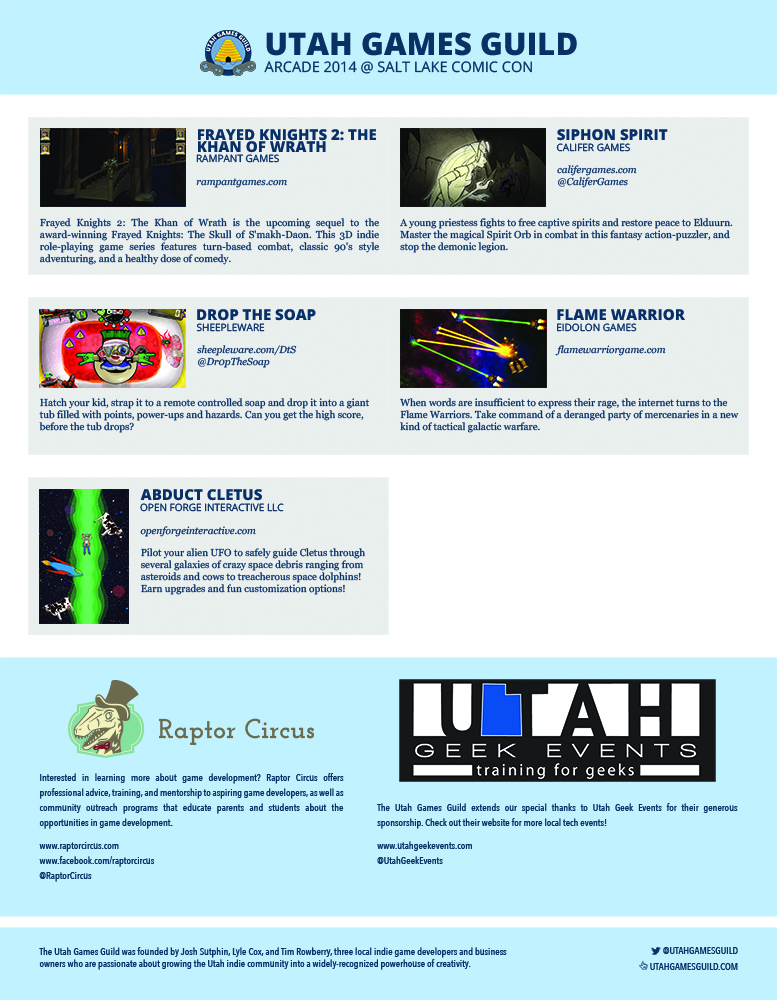
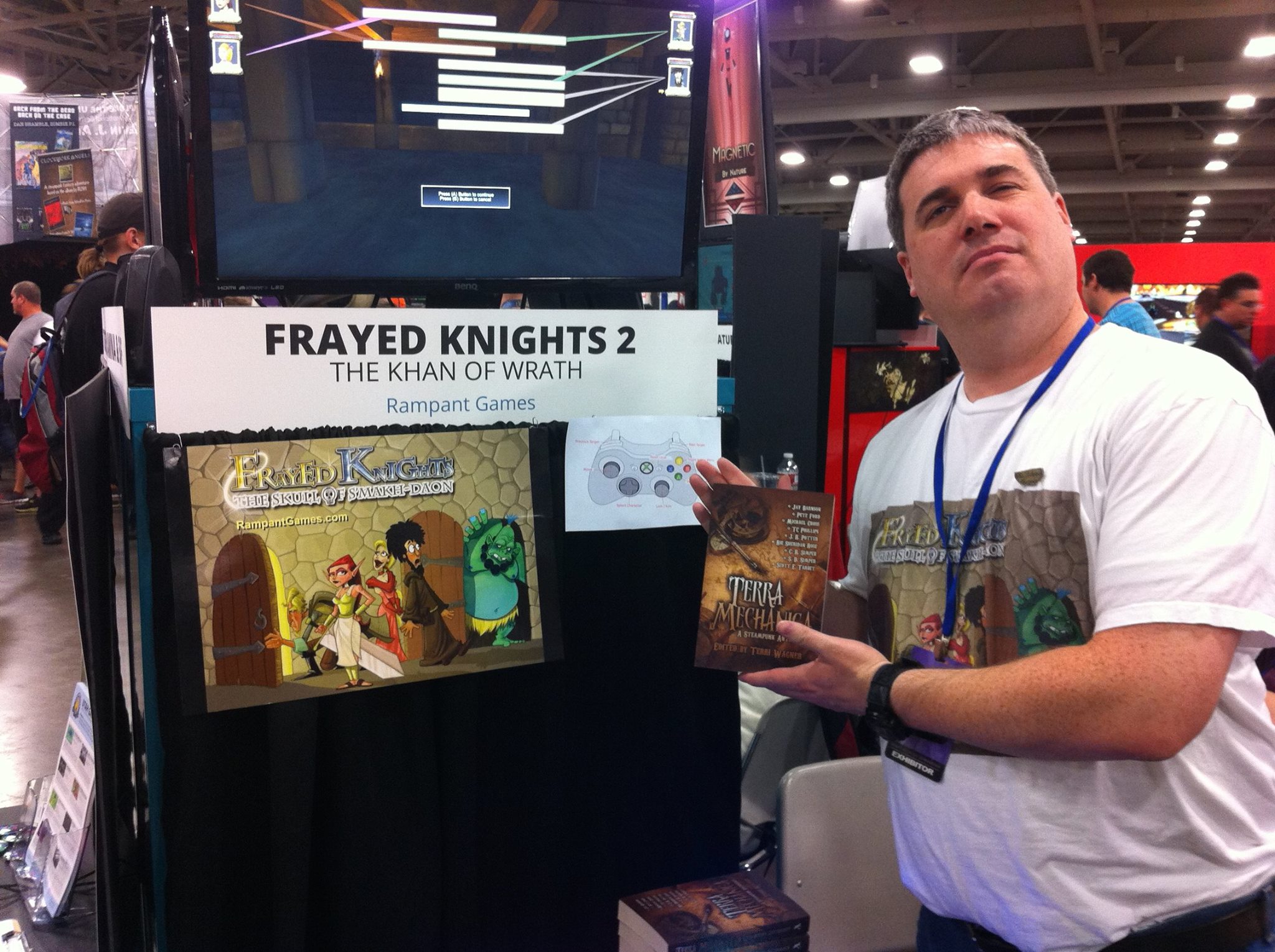 This weekend, Rampant Games was at Salt Lake Comic Con, showing an early alpha build of Frayed Knights 2: The Khan of Wrath. We’d created a special demo particularly for for convention. The idea was to have an adventure that players could experience in about 5 minutes of playing that would give them a taste of the game and the combat system. We also passed out cards with discount codes for the previous game in the series, Frayed Knights: The Skull of S’makh Daon. It has now been 24 hours since it ended, and I’m still collecting my thoughts, though I did take quite a few notes. I’m trying to distill the whole experience into the most valuable take-aways now.
But in the mean time, I thought I’d just compile a few random thoughts and experiences from the show in no particular order for your entertainment and possible edification:
I learned that this kind of event is really a two-person job. My wife had the other exhibitor pass, and she occasionally brought me something to eat or watched over my kiosk while I took a bathroom break, but she was only there for part of the time on Thursday and Friday, and she didn’t really know how to play the game, either. So I soloed it, and I think it hurt things. Also – that meant only the tiniest of breaks. That meant up to 9.5 hours straight of being fully “on”, rarely able to sit for more than 60 seconds at a time, talking people through the demo until my voice was completely hoarse. Plus a half an hour to an hour before the show setting up, preparing a new build, watching over things, and around a half-an-hour to an hour after the show dealing with last-minute visitors, cleaning up, putting stuff away, and trying to record notes.
It was exhausting, and this was all on top of six weeks or so of pretty breakneck development efforts to get things going. But…. it was a memorable experience! I learned a lot.
 ***
***
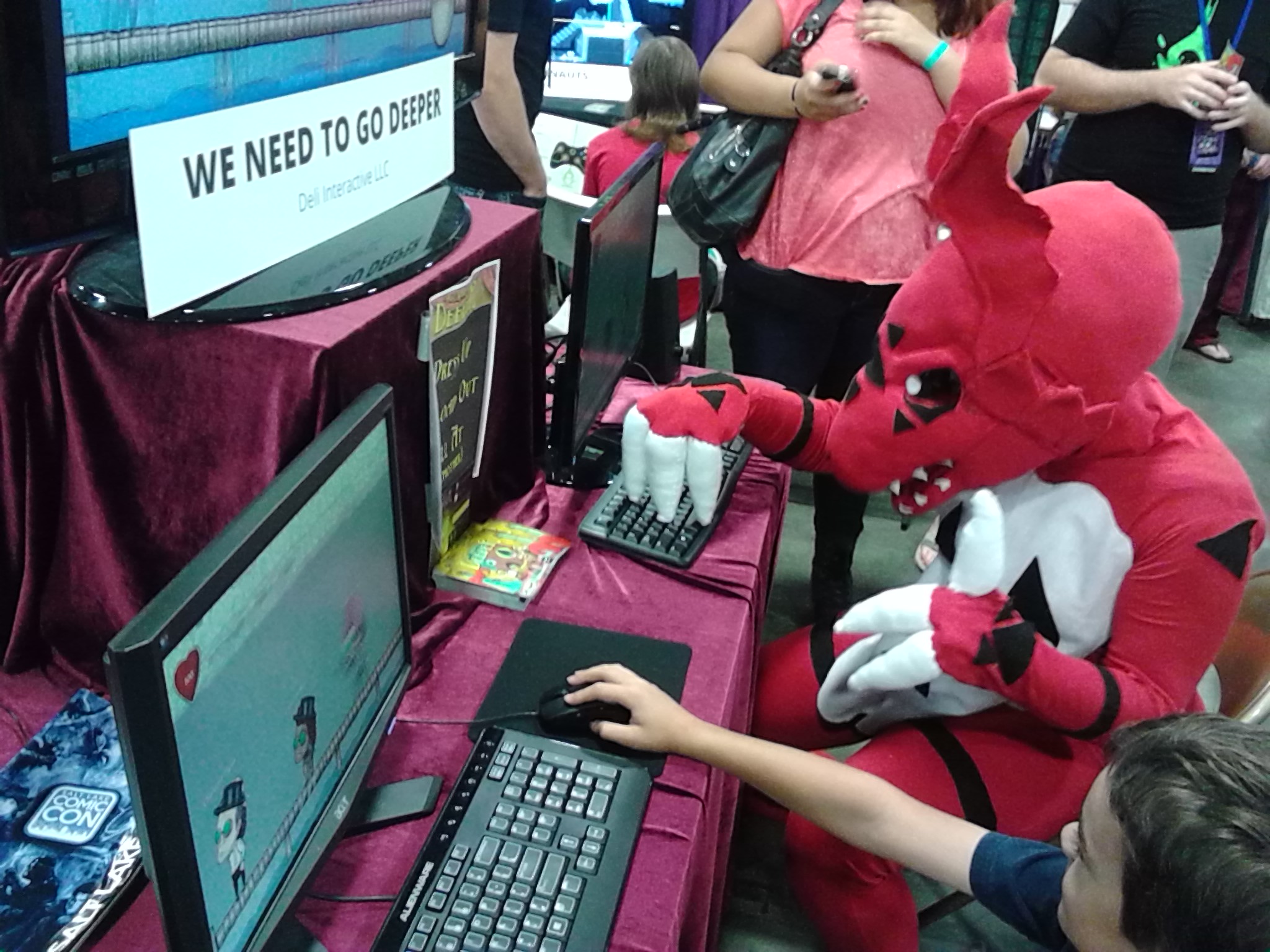
As you can see in the image to the left, there are SOME challenges to demoing games at Comic Con you might not get at PAX or E3…
***
I got 500 special cards made for Comic Con, with a metallic finish and a time-limited discount code on the back for Frayed Knights: The Skull of S’makh-Daon. I love the card, but in retrospect I printed too many. I gave out less than 200, I think. Better too many than too few, I guess.
***
I brought hand sanitizer and a package of wet-wipes used as napkins when I hastily wolfed down something to eat, or to wipe down the game controller. I was feeling a little self-conscious about wiping down the game controller after every few users. I didn’t want to wipe it down right after they were done, because I didn’t want them to get offended that I might be singling THEM out as having really germ-laden hands (although in a few cases, yes, I was). But I didn’t want my controller to be a contributor to Con Crud (TM), so I did what I could.
At one point I was really worried if I was being overly zealous in my efforts. Then I saw a young man walk by who had played my game a couple of hours earlier. He had a finger buried almost to the first knuckle in his nose.
I continued my efforts to wipe down the controller as often as I could.
***
While some players did it by accident, many players were quick to dismiss the dialogs & story bits as quickly as they came up, in an effort to get straight to the “action” — of turn based combat. On at least two occasions, they asked where their weapons were. Obviously, they were FPS players unfamiliar with the genre. I tried not to take their dismissal of the story elements as an indictment of my game in particular, but young gamers at a big convention looking for a quick gaming fix. A lot of them were boys in their early teens or pre-teens, and they seemed to be expecting Shooty McDudebro. They didn’t often seem enthusiastic when they walked away.
I was talking to a fellow game dev Josh Sutphin at our booth the following morning – who had a very successful showing of his SHMUP, Legacy of the Elder Star. He laughed and agreed that it was a genre thing. “This role-playing game would be so much better if it didn’t have all this story getting in the way of the action” is something we have a tough time imagining a genre fan saying. Taking home the idea that story is bad and to be kept as minimal as possible would be the wrong take-away. (And a lot of people genuinely seemed to enjoy the dialogs, even repeating them out loud in their own interpretation of character voices, and laughing).
Nevertheless, interrupting the flow of the game for a non-interactive “cut scene” (which my dialogs sort of act as, I agree) is definitely an issue, and something I need to think about. Even when you see people play and can ask questions, neither you nor they might be able to answer exactly what they want / like / expected / disliked about the game, so it can be a challenge to draw the right conclusions.
***
There were a lot of aspects of showing a game on a crowded expo floor full of geeky sights and sounds that might not apply to the real marketplace. If anything, it was probably an environment more like arcades I grew up in (so I guess the “Utah Games Guild Arcade” was aptly named). The games that showed the best were bright, clear, easy-to-understand, action-packed, and flashy. They drew attention to themselves by the moment-to-moment gameplay, and were easy to “get” even with a short attention span (which describes me well when I’m on the expo floor as an attendee).
However, while these are virtues of certain styles of games that wouldn’t directly translate to others, that doesn’t mean there aren’t broader lessons that can’t be gleaned and applied. Civilization V has a great deal more “curb appeal” than its predecessors, and not necessarily to the detriment of gameplay. (And I’m going to leave that particular argument alone…) And that appeal isn’t limited to drawing attention at trade shows. Just as we learned that different background music could completely change the “feel” and tension of an action sequence, the cosmetics and context within a game can totally improve the emotional appeal without single change to the mechanics. Although that’s not to dismiss the need to tune mechanics to the perfect “feel,” too….
***
I met an old friend / coworker at the NinjaBee side of the booth on the second day. We’d had no idea that we’d been working right behind each other, with only some tables between us, for a whole day. Things were just THAT BUSY. For all of us.
Sadly, I had friends, family, fellow authors from Xchyler Publishing, fellow indies, etc. come by to visit me at the booth, and we could never talk for more than a few seconds before someone would grab the controller and need my attention.
***
I hadn’t put an “attract mode” in Frayed Knights 2 for the demo. In retrospect, I don’t think it would have done anything to attract more visitors to my little kiosk – things were busier than I could handle in the first place – but it might have attracted more of the “right” kind of player, or at least helped prepare interested players for the game they were about to play. There’s something to be said for setting expectations. Especially for the ones expecting an indie version of Call of Duty…
 ***
***
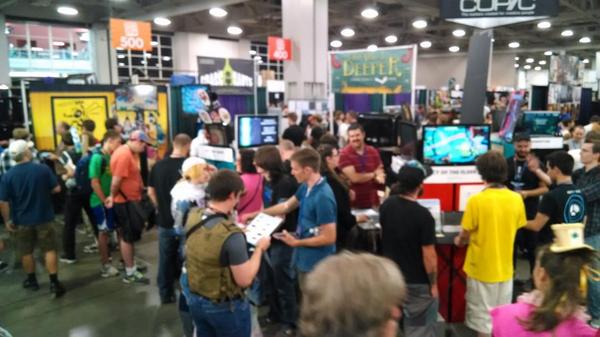
One of my frequent comments about the show – as someone who attended the previous Salt Lake Comic Con and the SLCC “Fan Xperience” convention six months ago – was that I didn’t feel like I was “at” the Con. The con was something that happened around me, but I wasn’t really a part of it. I saw a handful of booths (mostly before the expo floor opened), and saw some bits of swag from other places, but for three days my world rarely extended far beyond my little kiosk. People mentioned all the panels, celebrities, booths, and fun stuff going on. But except for fighting crowds on my way to the restroom, or the awesome costumes that surrounded me, I missed it. Ah, well.
***
I really liked being part of the big Arcade, although I didn’t get to spend nearly as much time networking with my fellow devs as I think I expected. I got to know my immediate neighbors a bit better – the awesome folks from Deli Interactive, and Lyle Cox of Mount Olympus Games. But otherwise – we were all so slammed that we had to fight to get any time to play each others’ games.
What I did see impressed me, though. We’ve got some amazing talent here in the Salt Lake City area. I knew this from our Utah Indie Nights, but seeing it all on display with banners, posters, and polished demos (as far as I was able to see / play) really drove home the point.
***
Besides an attract mode, I wished I’d made the game more self-explanatory, and helped it pitch itself to players and potential players. Really, anything that would help me be more hands-off so I wouldn’t have to devote my full attention to a player … and even leave the booth for a few minutes and feel confident that people could pick up the game and play it and have fun without my assistance … would have made a HUGE difference. I guess I neglected that part to focus on other things because I knew that I’d be there to help people through it… not realizing that I was chaining myself to my kiosk by that decision.
***
Will I do it again?
Maybe. There were things I think I did pretty well with under the circumstances (especially the 5-minute adventure), and some things I realized I could have done better, and would do differently in the future. There are things I could do better to “monetize” the experience, to do a better job of making the whole thing pay for itself and not draining my shoestring marketing budget so hard.
Going with a group booth was definitely the way to go. That made things a lot cheaper, and I think having the whole booth out there, open on three sides full of displays and different games, really helped attract attention and traffic.
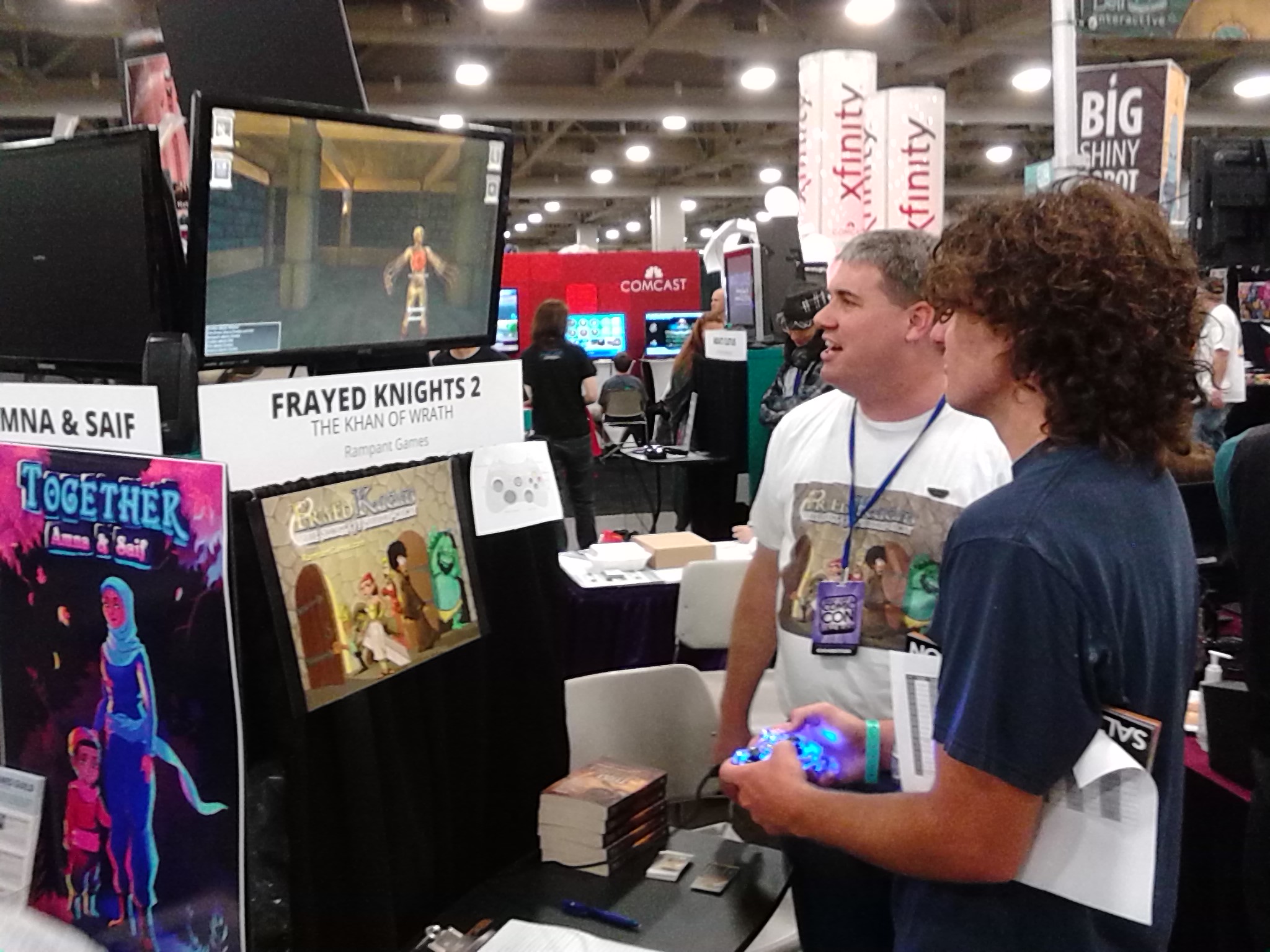
The biggest value from the experience was watching real people playing my game, seeing what worked and didn’t work, and then hearing some of their feedback, enthusiasm, and suggestions. While there are probably cheaper ways of obtaining that kind of information, it was a great cross-section of skill and interest level, this was very, very important.

Filed Under: Frayed Knights, Game Development - Comments: 5 Comments to Read
Day 1 – Can’t Talk Now
Posted by Rampant Coyote on September 5, 2014
Have a lot to say but no time to say it.
Here’s the Utah Games Guild Arcade just before they opened the doors at Comic Con. Unfortunately, my side of the kiosk is opposite this shot:
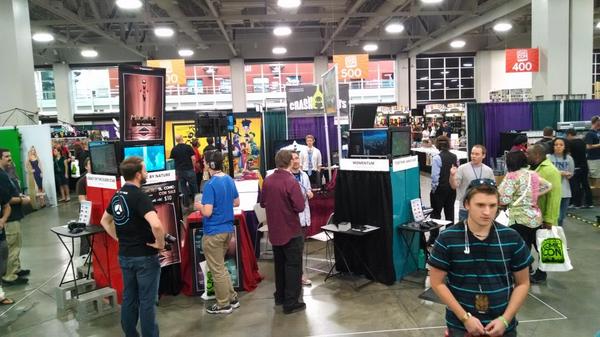 Things started out slowly, thanks to Comic Con’s messed up registration system, but got plenty busy quickly.
I’ll post a lot more soon.
Filed Under: Rampant Games - Comments: Comments are off for this article
Frayed Knights: Why these characters?
Posted by Rampant Coyote on September 4, 2014
 So today, I act like a “real” game developer (I’ve been faking it for almost twenty years) and act as an exhibitor at Salt Lake Comic Con. It’s been a rough several weeks getting this little demo of Frayed Knights 2: The Khan of Wrath ready. It’s felt very much like a release, with all the attendant pressure and stress and crunch. I love making games, but it’s hard work. If nothing else, I’m proud of making a self-contained demo adventure with a complete story (if one that ends in something of a mystery tied into the rest of the game) that can be played inside of about five minutes or so. Trying to encapsulate an RPG experience into something that can be played by a random visitor in the middle of a show floor isn’t easy.
But now – hey! We’re here! And if you are at Salt Lake Comic Con this weekend, come take a look and play! We’re at Booth 521, with a whole bunch of other great games. Come, play, chat, have fun! Especially if you are press, there’s a lot to see!
Okay – on to other things. One question I used to get asked for the first Frayed Knights game that still pops up occasionally is, “Why can’t I make my own characters?” If you’ve played the first game, it’s pretty obvious. It’ll be even more obvious after this second one. To me, it’s kinda like asking the same question of The Witcher, or Planescape: Torment. “Why do I have to play this Nameless One guy? I’d rather play a hot elven maiden. And why can’t I make his own party members too, instead of being stuck with this useless floating skull?”
Not that I think my game really compares to Planescape: Torment in terms of awesomeness. But hey, set your goals high, right?
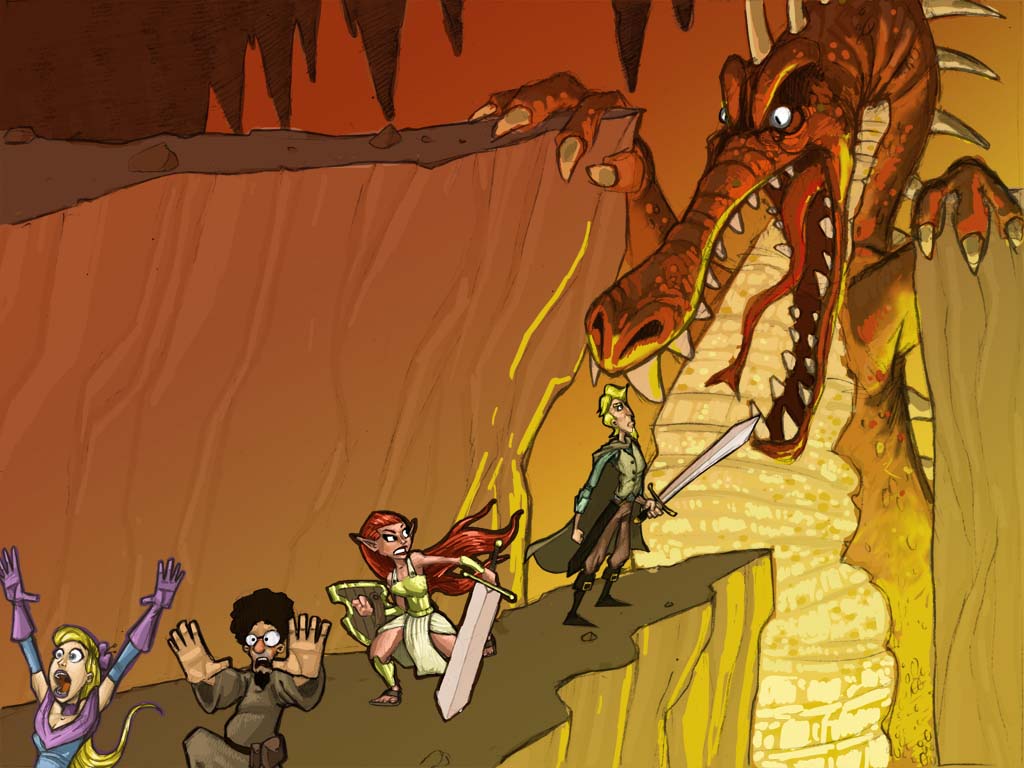
The bottom line is, this is a game ABOUT these particular characters. Their personalities, their roles, their backstories… it’s their game. And it’s a story-heavy game. It’s about a dainty half-elf warrior with a chip on her shoulder, a show-off adrenaline-junkie rogue, a nature priest who chose the nature-worshipping lifestyle to avoid the stress of, say, adventuring, and a ditzy but cute-and-perky sorceress with a scary violent streak.
You can’t change the characters without having a completely different game. You may as well ask, “Why don’t you have randomized dungeons in this game?” Or, “Why isn’t it a science-fiction game set aboard a space ship?” Okay, I guess that if we consider the early Might & Magic games, the latter one *is* possible without fundamentally changing the game. But you see the point. These are great game ideas. I mean, you can play Sword of the Stars: The Pit, and make your own character, play in a sci-fi setting, and have randomized dungeons all at once, and it’s a great game! But it’s very, very different. And I’ve got a couple of ideas for games kicking around in my head that are begging to be made that do involve creating your own characters from scratch (and one involves randomized dungeons), as that’s something I really enjoy, too.
I think that in response to this, I kinda went overboard on the customization options in Frayed Knights: The Skull of S’makh-Daon. I spent a great deal of time and effort making it so that the characters could really expand beyond their roles. In practice – I don’t know that anyone beyond the testers really did much with it. Was it wasted effort? Should that time have been spent in other places to make the experience for the vast majority of players better? I dunno. While I’m not emphasizing that so much with the revamped system in the sequel, it’s still part of the legacy of the series, and there’s still a ton of options for expanding or specializing the role of each of the characters in the party. You can still turn Dirk into a spellcaster if you choose.
One thing I haven’t committed to yet is whether or not you will have any power to customize the other characters that will periodically be a temporary part of your adventuring group over the course of their adventures. But I’ll save the discussion of that one for a later post.
Anyway – in the meantime – COMIC CON!
Have fun!
Filed Under: Frayed Knights - Comments: 3 Comments to Read
The Ten Books Thingie
Posted by Rampant Coyote on September 3, 2014
There’s a little thingie going on right now on Facebook about the ten books that influenced you the most. I’m posting them here because … well, Facebook. And because it is a fun topic for a blog post.
This is a weird question, of course, because a book might have influenced me via the Butterfly Effect. So maybe the book wasn’t much of a direct influence on me internally, but indirectly it caused a small course-change in my life that had long-reaching effect. So a lot of my favorite books (mostly fiction) aren’t really the most influential. I’m totally cool with that. I’m happy with my awesome escapist fantasies not exerting a powerful influence on me…
… except a lot of them did. I can’t vouch for the order, and I expect six of my choices to have changed by tomorrow, but at this particular moment of my life, here are the books that come to mind. And maybe it’s cheating to make so many of them be a series or a collection of books, but in this case, if you ain’t cheatin’, you ain’t tryin’.
1. The scriptures (particularly Bible & Book of Mormon)
2. The Lord of the Rings series
3. Mindset: The New Psychology of Success
4. The House With a Clock In Its Walls
5. The Conan series (particularly but not exclusively the ones penned by Robert E. Howard). This was probably a bigger influence on my love of fantasy that Tolkien.
6. Bullfinch’s Mythology. Before I got into fantasy, I discovered mythology (mainly in the 4th grade) – particularly Greek / Roman – and was fascinated.
7. Advanced Dungeons & Dragons core rulebooks. First edition. Seriously. Where would I be / what would I be doing if I’d never discovered these?
8. The official book of Ultima
9. Hackers: Heroes of the Computer Revolution
10. The Millionaire Next Door
Wow. I feel like I just barely got started on the list, and I’m already up to ten. Like I said, I’ll probably want to replace six of them by tomorrow, but there you go.
Filed Under: Books - Comments: 7 Comments to Read
KHAN! I mean, CON! Come play Frayed Knights 2: The Khan of Wrath at SL Comic Con
Posted by Rampant Coyote on September 2, 2014
I seem to be making up for my lack of convention-going as a kid later in life. This sprint / summer, we’ve been to the Salt Lake Comic Con “Fan Xperience” convention, Steamfest, the Fantasy & Renaissance Festival. We went down to Cedar City to hit a play during the annual Shakespearean Festival. Last weekend I hit two evening shows at the Timpanogos Storytelling Festival. This weekend I’m a vendor at the Salt Lake Comic Con. We deliberately deferred the whole Westercon / FantasyCon thing in July. Even so, it’s been an action-packed six months.
It’s been a little weird for me going from being just an attendee to becoming something of a participant. With Steamfest, I was a panelist and sat at my publisher’s booth (and actually got to sign books!). The “big one” for me is definitely Salt Lake Comic Con, which begins on Thursday. I’ll confess, I’ve been kinda dreading it. Although, as of last night, I think Frayed Knights 2: The Khan of Wrath is finally in something of a demo-able shape, and so I’m feeling less dread (and more of just being plain ol’ tired). Ten hours a day of standing and showing people a functional game? Sure, no problem. As long as the game keeps working…
 It’s been some crazy hours, some changes in direction, and things are not exactly as I’d envisioned them a couple of months ago. But, while far from perfect, we’ve managed to put together a complete, self-contained adventure that people can play within around five minutes. I’m still fixing bugs, editing text, and cleaning up bits (and I’ll probably be doing that even past the last minute, but always keeping what we have as a fallback), but I at least won’t feel embarrassed showing the game this weekend. We made some incredible progress, and a whole bunch of pieces of the game that have been put together one at a time are finally coming together. I’m excited for people to try it out, see what we’re doing, and offer feedback.
And I’ll knock on wood right now lest I attract Murphy’s attention.
Anyway, if you happen to be at Salt Lake Comic Con this weekend, please come visit the Utah Game Guild Arcade. Frayed Knights 2 will be there, as well as many other great indie games from talented folks all over the state. Some of of the games I’ve mentioned in the Utah Indie Night posts will be on display, as well as many others. Come in, kick back, and play some games!
And since I know folks will ask: Yes, eventually I’d like to put this demo up on the web for the general public to check it out. I have to re-enable KB & Mouse control, though. Right now, for the purpose of the demo, it can only be played with an XBox controller. And as the community here is a LOT different from the players at Comic Con, so I’ll probably want to make some customizations. Or – rather, remove some customizations I made for the convention. I’d like to re-enable the inventory system, which will take a lot of work, and there was neither the time nor desire to do that for Comic Con. And before I do ANYTHING, I think I’ll want to get some serious sleep. Right now, sleep sounds very, very nice…
Filed Under: Geek Life - Comments: 3 Comments to Read
Damsels in Distress
Posted by Rampant Coyote on September 1, 2014
Even with my various quibbles over her “Tropes vs. Women” videos, Anita Sarkeesian managed to open my eyes. It’s hard to watch her videos and not feel like we need to do better as an industry. I worry about creating a lens through which you are viewing everything looking for offense (because you will find nothing BUT offense if you do that), but as a male gamer and game developer, it’s easy for me to overlook something that might make women feel less included as a member of the audience. Sarkeesian’s videos do an awesome job of pointing some of those elements out. The compiled videos of some of the worst offenders, pulled from the wide history of gaming (and sadly, usually not obscure titles), can be a little stomach-churning.
Yeah, guys, we can do better. As developers, we can create better. As gamers, we can demand better.
No, not to the point where we forbid large swaths of storytelling possibilities, or where we grade games based on their inclusiveness (okay, someone is certainly welcome to do that, but I’d consider it a useless measure. I’m all for games with niche appeal, but I want a wider representation of niches). I am not a fan of people screeching injustice just because a game doesn’t address the needs of one segment of the market or another. (There’s a difference between complaining about a game not meeting your needs / desires as its potential audience – which I do all the time – and taking it as an offense / affront / wrong. The latter closes minds, the former opens up devs to the marketing / sales potential of addressing a wider audience…)
But it seems to me that there’s a pretty commonsense range between “insensitive” and “oversensitive” and that Sarkeesian’s videos have caused some dialogue and helped move things back from the former direction. If nothing else, as a designer, I’d rather not sin in ignorance. And for that, I thank her for her videos.
Now, one of the points I discussed with a friend of mine many months ago was her “damsels in distress” trope. My friend, something of a literary connoisseur more than he is a gamer, noted that the trope has existed in stories for a very long time as a way to teach boys about the proper use of strength. It’s a basic biological fact that in terms of raw physical power, men have a clear advantage over women, and this has often been used as a tool of oppression. You need look no further than Syria and Iraq today to see how disgusting and barbaric this oppression can really become. While there are some unfortunate side-effects of these stories (treating women as prizes to be won, specifically), the “damsels in distress” trope exists to teach some very basic rules:
The man who kidnaps / imprisons / threatens / forces his will upon a woman through his advantage of might / political power / etc. is the villain. The bad guy. The one who deserves his comeuppance at the end of the story, even to the point of his death at the end of many tales.
It is the responsibility of those of greater strength / power / etc. to use these advantages to protect, defend, and rescue those who are oppressed by such villainy, even to the point of risking their very lives to do so. “With great power comes great responsibility” and all that.
I think with the events over the last couple weeks involving Zoe Quinn and Anita Sarkeesian, it is clear there are many disgusting trolls out there who never learned this lesson. Or perhaps they relish being the villain. Regardless, no matter how much you might disagree with somebody, attempting to silence them via threats, intimidation, force, cyber-bullying, hacking, etc. is not only an act of evil, but also probably means you’ve lost the argument.
Might never did make right. Online harassment is evil. No matter how worthy one might think one’s cause might be, stooping to such disgusting measures only pollutes whatever it touches. If the video-game fan community doesn’t want these wretched sacks of crap to represent us, we need to be intolerant of their views. Yeah, I’m preaching intolerance. Tolerance of evil isn’t a virtue.
Now I’m gonna get back to making and playing games.
Filed Under: Geek Life - Comments: 18 Comments to Read
More Indie Bubble Popping Goodness
Posted by Rampant Coyote on August 29, 2014
This one from Cliffski, and I find his opinion is pretty much the same as mine:
Will the indie games market crash and burn?
Short answer: Yes, depending on your definition.
Longer answer (my interpretation): It’ll be the game developers crashing and burning, not so much the market.
Solution: Go for your dreams, but don’t be stupid about it.
It’s the same story. The gold rush has been going full force, and sooner or later the music will stop. We have way many more players than we have chairs already.
Filed Under: Biz, Indie Evangelism - Comments: 2 Comments to Read
Indie Studio of the Living Dead
Posted by Rampant Coyote on August 28, 2014
While I sometimes wish I could be one of those total coding animals – the ones who can just go for 16+ hours with hardly a break – I don’t know if I’d want the kind of personality that would allow that.
Coming off of an intense 10-hour workday, with a break for dinner, and trying to jump into game development from there is difficult. Especially after many nights of working on this demo for Comic Con. There’s a certain point where all that is left is whatever you can fly on autopilot. It’s hard to get creative and inventive, but if there are mechanical tasks that can be completed by zombie-like plodding and straightforward problem-solving, those can work.
Maybe I should break my task lists up into, “zombie” and “non-zombie” tasks. On those nights where I just don’t have anything left, I can focus on the zombie list.
The problem is that this demo doesn’t have much time left, and we’re behind schedule. And … at the day job… our current projects don’t have much time left, and we’re behind schedule.
When game-making is only a hobby, you don’t need to worry about stuff like this. Even as a second job, there are times you can move things around to keep life on an even keel. But sometimes…
… yeah, sometimes. Exhaustion takes its toll. Lemme tell you… I never imagined I’d be wishing Comic Con was further away, or wishing that it was already over.
Ah, well. I hope we get this all done, and I hope people like it. That’ll make this worthwhile.
Filed Under: Game Development - Comments: 7 Comments to Read
RPG Design: The Positive Potential of Potions
Posted by Rampant Coyote on August 27, 2014
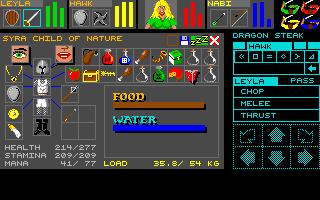 About ten months ago, I wrote about consumable / expendable resources in RPGs. More recently, Matt Barton penned an article about how much he wants to get rid of consumable items altogether in “Down with Pots!”
Well, I’m gonna answer both him and my younger self. At least in part. Actually, I’m gonna write three answers as to why consumable / expendable items are a Good Thing in RPG Design.
Resource Management. It can be fun. No, really!
Early RPGs were all about resource management. That was a major element ever since D&D. You had hit points, you had spells, and you had items. You’d spend the first two and some of the third on every adventure. Note my wording: spend. It’s weird to think of “spending” hit points, but in effect, that’s what you are doing with every encounter.You may not have exact control over how much you spend (or risk), but in a non-trivial fight, the expenditure – potential or realized – is going to happen.
In classic RPG gameplay, managing the “big picture” was, like the Kenny Roger’s song, “The Gambler,” perhaps the greatest point of skill in the game. Random chance did its thing, but if you were careful, you could manage your risk — if not for your own character, than for the party as a whole. The early D&D modules (I’m thinking specifically of the G series – Against the Giants) even had suggestions for the changes that the monsters would make in response to attacks by the players, once the players decided to pull back. It was a constant tug-of-war between pushing your advantage of surprise against an unprepared foe vs. existing supplies. Eventually, you’d be low on spells, potions, scrolls, charges, and “uses per day” and would have to retreat and resupply. And when you came back, the enemies would be ready for you…
I am very disappointed in the modern RPG trend of having (almost) everything replenish over time, once you get a break from combat. Sure, you still have to manage resources – or at least timing – in the middle of a fight. And I of course recognize that there are limits to how much you want to ask a player to be patient in their entertainment choice. But I also believe attrition of longer-term resources (which would include items – consumables) and the associated risk / reward management control the player can exert is a very enjoyable play mechanic – particularly for more experienced players.
Magic Should Be Magical (Or: Not another +1 sword!)
So here’s another argument: For upgrades (magical or otherwise) to really feel like upgrades, they should be noticeable. If a player is hitting 60% of the time for 20 points of damage, a sword that makes them hit 65% of the time for 21 points of damage is not a noticeable upgrade. So you are able to kill an Advanced Fang Beast in an average of 17 rounds instead of 18? Um, yay?
 That’s really what those kinds of upgrades do, in an RPG. They allow you to kill faster. Which means less expenditure of those other resources – your health and endurance / mana / whatever. Combat in RPGs is generally an inverted race to zero hit points. Whoever gets there first loses. Even those items with really cool special abilities – the final, long-range mechanical effect is to allow you to go slower in that inverse race between you and your opponents. It’s better if they have cool effects that require some skill to take advantage of rather than being just another +1 sword.
The thing is … if you want to frequently provide upgrade rewards to players, then one of two things happen. Number one, the players escalate in power very quickly, so that the fights are really not about skill but about Level + Gear. This is sort of the Final Fantasy approach, with characters starting out with single-digit damage values at low level and doing triple-digit damage a couple dozen levels later. The other option is the Diablo approach, where the player is barraged with “junk” items that they must parse through to find the one that is an actual upgrade, ignoring or selling the rest.
I’m not fond of either approach, nor do I want to require too much patience from the player to get their next equipment upgrade.
The answer to this is to have powerful, exciting powers with limited use. Consumables are perfect for this kind of thing. But again – they need to do more than simply provide an “edge” in combat. They should feel like game-changers. Not to the point of being instant-wins, but definitely a major supplement. Healing potions are like that in most games. A couple of well-timed potions will often feel like the difference between a reasonably easy victory and total failure. Forget potions that just give you another +1 in combat. How about a potion that doubles your damage? Or even increases your damage by 50%? I’d be drinking one of those at the start of every single boss encounter! It would be one of my favorite “loot drops.” Yet, while they’d definitely change the dynamics of major fights when I chose to use them, in the context of the whole game, they probably wouldn’t make that big of a difference.
 Lots of Interesting Choices
Choosing a potential equipment upgrade with a permanent effect can be a really interesting decision. Or not. If it’s a difference between a +3 Sword of Smiting and a clearly inferior +1 Sword, it’s not so much a decision as a straight-up reward. But with the more complicated weapon stats of games like the Diablo series, it’s an interesting decision of the kind Sid Meier credits as being the heart of gameplay.
The thing is, this is an interesting decision you make occasionally. Once you get some halfway decent equipment in most RPGs, the choices are trivial and uninteresting – you aren’t going to find upgrade candidates very often. And sometimes, your interesting decision will be to keep what you are already using…. maybe it’s inferior in some ways to the potential upgrade (which made the decision interesting), but overall you felt better about the known advantages of your existing equipment. That’s all good. That’s a fantastic RPG decision right there.
But the problem is that this kind of decision only comes occasionally. With consumable items, you are making a similar decision in every combat. “Do I use this Potion of Rage now, or save it for later?” Or, “Should I use one of my charges on this wand of fireballs now, in a less-than optimal enemy arrangement? Will I ever get a completely optional arrangement?” If the answer is “no,” it simply means that the option remains available for the next fight (or for the next round).
But on the Flip Side…
While these are all desirable features in an RPG, there are trade-offs.
Hoarding is one problem. Players (including me!) are reluctant to use one of those precious charges on that Wand of Fireballs against trash encounters. By the time we realize the item would have been useful, the time to employ it has passed.
A decision forgotten about it is not a decision at all. When players opt not to use an item for so long, they will forget the option even exists. That’s not a good thing, either. That’s why we often end an RPG with backpacks full of stuff that would have made some of the later battles far easier. There have been a couple of times where I finished an RPG with consumable items in my inventory that I was unclear on exactly what the things did.
Another problem is that too many potential decisions can overload the player. Different players have different thresholds, but generally speaking, humans tend to have a tough time with more than two or three viable options, to the point of prematurely dismissing even better options for the sake of simplifying the choice.
These are unquestionably issues with using consumable items in RPGs, and I do not believe there’s any magical design that will make these problems completely go away. But I do suggest that getting rid of consumables entirely in an RPG design is throwing the baby out with the bathwater.
Filed Under: Design - Comments: 11 Comments to Read
Last Year’s Treasure, Today’s Trash
Posted by Rampant Coyote on August 26, 2014
My new computer arrived last Tuesday. In a confession that might lose me geek cred, I’ve been so insanely busy that I didn’t even get it out of the box to test it out until the weekend.
Statwise – it’s got a quad-core Intel i5-4690k (which I admit, doesn’t mean that much to me anymore), an NVidia GTX 750 (more than adequate for playing Wasteland 2), 8 GB of RAM, and two 2-TB hard drives. Yes, I wanted lots of hard drive space. Oh, and it’s running Windows 7, 64-bit edition. I’m still skipping Windows 8.x.
When I say I can’t tell you how awesome it is, it’s because literally I don’t know. I know I’ve run into some memory issues lately, and it’ll be nice having almost twice as much usable hard drive space as my current system. I’m not officially switching over until after Comic Con (which is in a week and a half), so it’s not actually running much right now.
What’s amazing to me is that this whole box actually cost me less than my first Intel-based PC… even before adjusting for inflation (which would increase the cost from over 20 years ago by about +65%). And that was with a free hand-me-down hard drive back then. And putting the machine together myself, in one of those shops in the early / mid 90s that specialized in selling parts and letting you put your machine together there inside the store.
What was that awesome system back then? It was a 16 megahertz 386-SX/16, with 4 megs of RAM (I think the CPU in my new machine has twice that much in just cache), the aforementioned hand-me-down 40 meg hard drive, a VGA card, and a Covox sound card that nobody seemed to support directly (but it was at least compatible with the AdLib cards).
It was good enough to play Wing Commander I. And Ultima V. And a couple of roguelikes. And Turbo C++. And Wolfenstein 3D. That was enough. Although I was really happy to upgrade the hard drive so that I could handle Wing Commander II (which was, if I recall correctly, something like 38 megs fully installed, not including the voice pack if you got it). Yes, these days I sometimes deal with photos or textures that are pushing that size, but back then, it was simply unfathomably huge.
I’m not gonna lie… as much as I loved that era of gaming – the simplicity, the creativity, the newness of it as game developers kept finding new ways of using the ever-expanding technology… like everyone else, I’d not want to go back. It’s a weird thing now that – at least as far as indies are concerned – technology is no longer much of a barrier. The machines are way more powerful than what we have the budgets to take advantage of. But going beyond the technological limitations, it was probably the most difficult platform to use as a gamer. The amount of tweaking and configuring and compatibility issues we had to deal with back then…. sheesh.
It’s just fun looking back sometimes and seeing how far we’ve come.
Filed Under: Geek Life - Comments: 5 Comments to Read
Dark Dungeons: The Movie Takes Us Into Dark Imaginations…
Posted by Rampant Coyote on August 25, 2014
 When I was a kid and first starting to get into Dungeons & Dragons, it was riding a double wave of fad-like popularity and backlash from certain quarters for being dangerous or downright evil – which only added to its popularity. While I didn’t face too much direct opposition from authority-types over playing the game, it was an ever-present threat. We tended to play during lunch in the cafeteria at the school, and we’d heard about schools and districts in the region that had banned the game over fears that it led to teen suicide.
Never mind that the people cited as examples had a history of depression, drug abuse, and a host of other issues long before they tried D&D. Nope, the game was always to blame. After all, it was new and popular. Authoritarians will use any crisis to justify control, and will manufacture one if necessary.
So I grew up pretty defensive about my hobby. Fortunately, the obsession over its imagined danger waned as its popularity declined, but the damage was done. When the second edition of Advanced Dungeons & Dragons was released, it was watered down over concerns for the “angry mother syndrome,” losing any semblance of ad-hoc edginess of the earlier editions. No, in second edition, TSR was so afraid of angry mothers that they didn’t even use the words, “demon” or “devil,” and forced modules into family-friendly guidelines that mandated evil’s incompetence. But that’s another story.
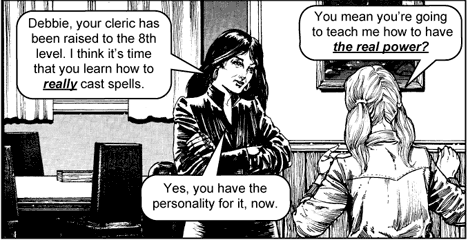 Near the tail-end of this anti-D&D hysteria… the point where it jumped the shark… there was a religious tract called “Dark Dungeons,” which told a story in comic book form of the horrors associated with role-playing games. Oh, yes… occult, witchcraft covens with pentagram floors, teen suicide, it’s all there… with the joyful resolution wherein the heroine tosses her game books into a raging bonfire.
It was completely insane stuff, to the point where gamers actually embraced the tract with ironic glee. I guess it was because it was evidence that those who were most violently opposed to RPGs were living in exactly the nightmarish fantasy world they accused us of being in. My wife and I, years later, would joke about when we’d finally learn the “real power” since we’d hit level eight dozens of times over the years.
Well, some folks decided to make an official movie based on this deranged little world. To his credit, the creator of the tract, Jack Chick, provided the license for free. The movie-makers, partnered with Zombie Orpheus Entertainment (the makers of the excellent movies, “The Gamers”), worked to elaborate on this thirty-year-old comic about the occult evils of D&D.
As it is an officially licensed movie, they play it absolutely straight. I questioned this approach, thinking at first that it would be more of a parody. But really – the original comic strip was an unwitting self-parody. How do you parody that? The answer is, of course, that you don’t. You embrace it, and milk it for all of its unintentional ridiculousness as possible. The result is wonderful and terrible – terrible in that I may have hurt myself from laughing so hard.
So what you’ve got is a deliberately poorly-acted (I know, I’ve seen these people do far better…), over-the-top elaboration of the original comic tract, with some word-for-word dialog and panel-for-panel framing at key points. Yeah, some things have changed… but in a way that one could imagine applying in the creator’s dark imagination where D&D was a phenomenon created by evil witch covens.
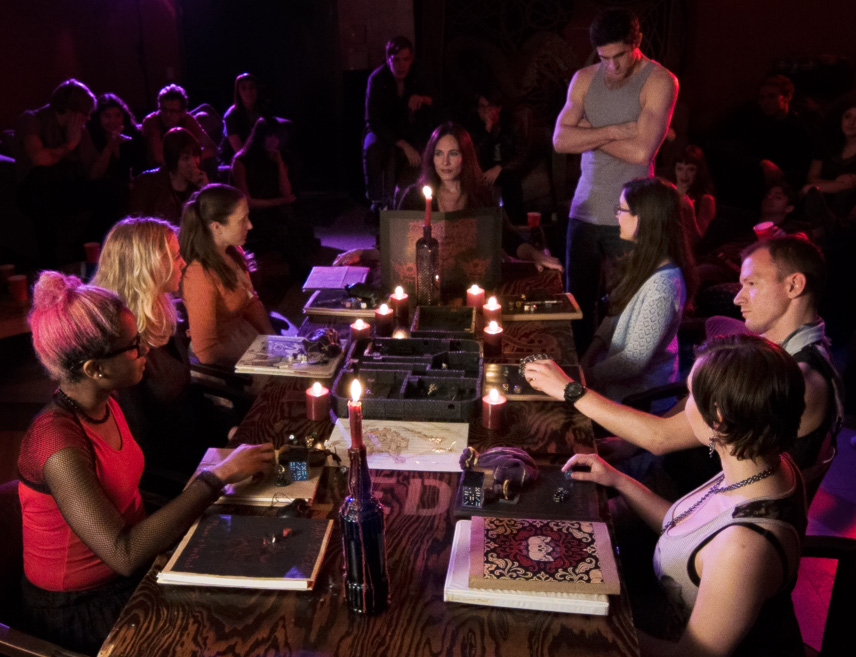 In this world, the cool kids play role-playing games, an activity that has such an overwhelmingly powerful appeal that nobody – NOBODY – who starts playing has ever been able to quit. Helpful senior Mike tried to get them banished from campus but they were just too popular. Frat parties are clearly evil dens of sin and alcohol with predatory overtones (well, okay, maybe that part is legit… 😉 ) with drinking, dancing, and cavorting! But they culminate in the main event that everybody goes to these parties to really enjoy… a role-playing game! Yes! As a spectator sport!
And it gets more awesomely over-the-top from there.
Now, I am actually a pretty religious guy myself. Of course, my own religion has been warned about in Jack Chick tracts as well. So I feel like I’m in good company. Christianity in the movie is pretty true to how it is portrayed as it is in the tract – a good ol’ book-burning bastion against the fiendish legions. In Chick’s world, this faith is about as over-the-top and nightmarish as role-playing games. It’s hard to imagine anybody would take this movie’s depiction of religion, witchcraft, or role-playing games seriously. But the world is full of very strange people, and I’m sure there are those who will take the earnestness of the advertising campaign, mirroring the earnestness of the anti-D&D jihad of the 1980s that made this tract so notorious, at face value.
I guess some of the defensiveness that I used to feel back in the day never really died… that frustration of trying to deal rationally with irrational people who absolutely refuse to get it. In that respect, this film is a little bit cathartic. I’m sure many of the cast – who weren’t even born yet when the tract was first released, or who may have never been gamers themselves – may only get that in a secondhand way. But in its heart, this is a movie by gamers, for gamers, even including some in-jokes for the audience, like attacking the darkness with magic missile, and a battle against a gazebo. The filmmakers got permission from gaming companies to burn their specific products in the bonfire in the end (yes, Pathfinder books go up in smoke! Guess they’ll have to print some more). It’s a delirious delve into a dark fantasy, but not the one the original writer had in mind.
It is a bargain – and DRM free – for a download at only $5. If you have ever played a tabletop role-playing game… or ever wanted to… get this movie!
Filed Under: Geek Life, Movies - Comments: 3 Comments to Read
Maybe the dream job isn’t really dreamy… or even a job…
Posted by Rampant Coyote on August 22, 2014
I always want to post some things without commentary, but I can’t help but comment.
In this case, an article by my friend Lars Doucet, developer for Defender’s Quest. And the guy who did Tourette’s Quest. Warning, this is another one of those, “back to reality” pieces.
Follow Your Dreams!… Or Maybe Don’t…
This could also be called, “Why I haven’t quit my day job.” Of course, I could only dream of selling almost 200k copies of Frayed Knights. Of course, Frayed Knights is probably closer to Doucet’s Secret of the Dragons childhood dream game than it is to Defender’s Quest. So maybe going after that dream game isn’t even the slow track to success. It’s just a way to exorcise some personal demons. At great cost.
This makes me think of some advice long-time veteran (and totally awesome guy) Jeff Tunnell offered in his article, “Five Foundational Steps to Surviving as a Game Developer.” The games industry and indie world was totally different when he wrote that. Yet, mysteriously, almost exactly the same. The technologies and trends keep changing, but the key principles stay pretty consistent.
Jeff also has a fantastic old article called “Five Realistic Steps to Creating a Game Development Company.” I’ve been stuck in step 3 for a long time now, but then, my games have been in development a long time, too. I’ve got friends in all five stages, but mainly 3 and 5. Some have had to go back a step.
What all this boils down to – and I speak mainly from long experience, not from the lofty heights of first-person success, but merely as a guy who has been in and out of the trenches through several industry cycles… is that there are no guarantees, and no long-lasting shortcuts (by the time they are discovered, it’s too late to use them). Go with caution.
Filed Under: Biz, Indie Evangelism - Comments: Read the First Comment
Indie Games and the Gold Rush Mentality
Posted by Rampant Coyote on August 21, 2014
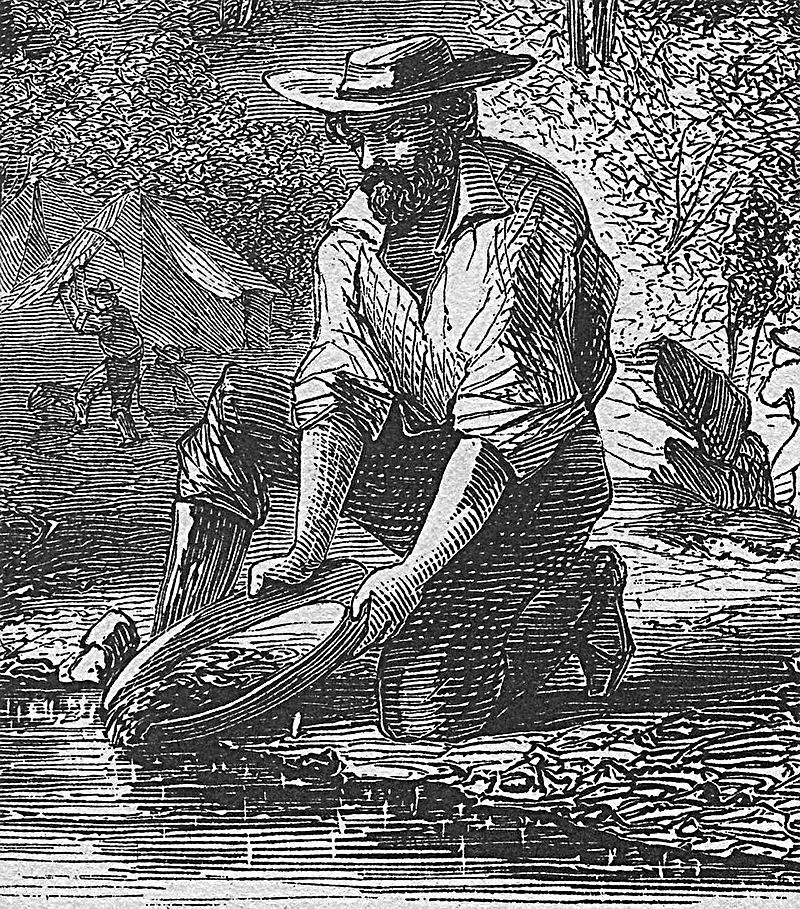 In 1846, San Francisco was a tiny settlement of around 200 people. Then the California Gold Rush happened. The population exploded to 36,000 within six years. Tons of people came to strike it rich. Some did. Most didn’t. Then a few years later, the whole thing petered out. The gold rush ended. Some people left. Others stayed. A lot of businesses that didn’t have anything directly to do with the gold rush prospered. Not all of them, of course. But that ruins my analogy, so I’d rather talk about how the city and surrounding area is now home to about 800,000 people, many of whom are only vaguely (if at all) aware of the history of the city as a boom-town during the gold rush.
I entered the games biz as an eager college grad during one “boom phase” of the gaming industry – one of many “gold rushes” that have occurred in the biz. Video games had recently exceeded Hollywood box office revenues (who remembers when that was an achievement?), which attracted a lot of attention – and money. The kids at id Software – not much older than me – had just taken the world by storm with Doom. The Sega / Nintendo war was in full swing, and nobody knew or suspected that Sony was quietly preparing to shake everything up. The industry was exciting, growing, and everything was awesome.
Well, okay, no, it wasn’t perfectly awesome or anything. But again, it’s my freaking analogy! I’ll overgeneralize and apply rose-colored glasses at my own discretion!
 Everyone wanted to be the next Doom, or the next Sonic, or the next Street Fighter II. Well, things eventually went south, and some investors discovered that it wasn’t the easy path to riches. And the competition was fierce! The thing is… the industry didn’t collapse after that. It shrank, sure. And then grew at a more subdued pace. Until the next boom.
Massively Multiplayer Gaming! Wow. From Ultima Online and Everquest to World of Warcraft, that was the thing. Remember Second Life? (Well, okay, I never actually played it, but for a while it seemed like the thing, too). That part of the industry never really died out, but it sure contracted, didn’t it?
We had a casual game boom. Everybody trying to be the next Bejeweled. Even the guys who made Bejeweled. That eventually tapered off. Lots of companies went bust. But a lot of others are still out there, still cranking out that kind of game.
Mobile! Big boom there! Angry Birds! Only, sure enough, it’s gotten crazy saturated and almost impossible to get noticed. Except for those very few that are. Yet… it keeps going. I can’t imagine it stopping.
More “core” indie games? Becoming the next Braid / Minecraft / Super Meat Boy / etc.? Ditto.
 The cycles keep going. So it has been since the days of Pong and Pac-Man. There’s a boom, way too many people swooping in with dreams of making it big than the boom could possibly sustain. The “bubble” pops, leaving lots of closed businesses and crushed dreams. Yet… the industry keeps growing, keeps expanding, albeit in fits and starts.
Indie gaming – it’s here to stay. Yes, we’re facing (yet again) a bunch of crushed hopes and dreams, as we’ve got a glut of content, a race to the bottom in prices, and a world where a team can invest their life savings and two years of their lives into a title that, in the end, they might have trouble even giving away for free. It sucks, but it’s nothing new.
If you set out with dreams of making the next Minecraft, you are doomed. I don’t think even Notch himself could make the next Minecraft (unless, literally, he sets to work on Minecraft II). But like San Francisco in the 1860s, there’s still room to not only survive, but grow and thrive. It’s not easy. I certainly haven’t figured it out yet, so I’m basing this entirely upon evidence from others. And from history. Maybe one day I’ll be able to talk about how I achieved such great success in spite of the boom & bust cycle, but I’m not there yet. Maybe I never will. But I won’t quit trying.
And that’s the point. You can’t be in it for the gold rush. You can’t be in it for a single game. You can’t depend on that element of luck that determines that game A is going to be a hit while games B,C, and D – all of which are of equal or even better quality – will languish in obscurity. You’ve got to work it and be prepared to capitalize on a hit, sure, but you can’t survive on a business plan that only works if you happen to get lucky.
And ultimately – talking to a lot of writers who are in the same boat with their craft – it really comes down to doing it because it’s in your DNA. Writers write because it’s who they are. Game developers make games, because they can’t help it. In a previous era, they’d have had to find some other outlet to express themselves. I’ve made a living making games in the past, but nowadays I make games because it’s simply what I love to do. It’s pain, frustration, hard work, lost sleep, but also immense satisfaction. I can’t help it.
So I guess I’m like one of those guys who stayed in California after the gold rush was over. I keep at it between booms. Most of the game devs I am friends with are the same. We’re permanent residents of GameDevVille. We’re game developers at heart, and we’ve watched the boom and bust cycle repeat many times. Sure, we keep looking to capitalize on the next big thing. Sure, we want to build up our little businesses so that we’re actually support our game-making habit. And that will be the same after the next big boom. And the next. And the next.
Filed Under: Biz - Comments: Comments are off for this article
Utah Game Jam
Posted by Rampant Coyote on August 20, 2014
On Friday September 12th through Sunday the 14th, game-makers of all stripes in the Salt Lake area are invited to the Utah Indie Game Jam. There’s more information at the site. Note that board game developers are invited as well… it’s not just about game controllers and real-time graphics.
If interested, please register, as space is limited:
Second Annual Utah Indie Game Jam, September 12-14th
I wish I could personally participate, but this entire month is one big game jam for me, and I think my wife would kill me if I took the first free weekend after the Comic Con demo to participate in an optional game jam. It wouldn’t be pretty.
Filed Under: Game Development - Comments: Read the First Comment
Copyright © 2026 Rampant Games | Privacy Policy
Powered by WordPress.
