Making Money Make Games – Part 2 (More History)
Posted by Rampant Coyote on December 10, 2014
 The 1980s
Okay, this is the part of the story where I personally started paying attention and getting involved, if only as a consumer. At this point, especially as things were starting out the decade, there was still a huge question of what kind of industry “video games” were going to be. Like book publishing? Like toys? Consumer electronics, like televisions? Appliances? Rock & Roll? Coin-op amusements? All of the above (and many more approaches) were tried. The industry grew, and stabilized somewhat, especially when the periodic downturns hit and forced consolidation.
Notable games of the era are so numerous I’m not sure where to begin, and I’m going to be leaving off some big ones just to list off the variants. But: Pac-Man, Ultima, Wizardry, Galaga, Dig-Dug, Star Wars, Asteroids, Elite, Pitfall!, Sim City, Commando, R-Type, M.U.L.E., Donkey Kong, Super Mario Brothers, King’s Quest, Jawbreaker, Tetris, Defender, Dragon Warrior, Dragon’s Lair, Final Fantasy, Street Fighter, Legend of Zelda, John Madden Football, etc. etc. etc.
Platforms included arcade machines (often with programmable hardware rather than custom solutions), consoles (Colecovision, Intellivision, Vectrex, Atari 7200, ), handheld (custom hardware galore, the “Game & Watch”, the ultra-popular Nintendo Gameboy, and Atari Lynx), and Computers (VIC-20, TRS-80 Color Computer, Commodore 64, Sinclair Zx80 / ZX81, TI-994a, Amstrad, Apple Macintosh, etc…), and the platforms of the 1970s that hadn’t yet been discontinued. But the decade ended with a strong finish with the Nintendo Entertainment System (NES), the Sega Master System, and the Sega Genesis.
Development team sizes ran the gamut at this point, from one programmer and an artist to a moderately-sized (by today’s standard) teams and subcontractors. While the big publishers were taking over the scene, the beginning of the era was dominated by small teams and small publishers selling games however they could – including mail order. That model hadn’t completely disappeared at the close of the decade. A new term was devised in an era of dial-up networking and “sneakernet” (floppy disks delivered by somebody wearing sneakers) that allowed grassroots distribution: Shareware.
 The 1990s
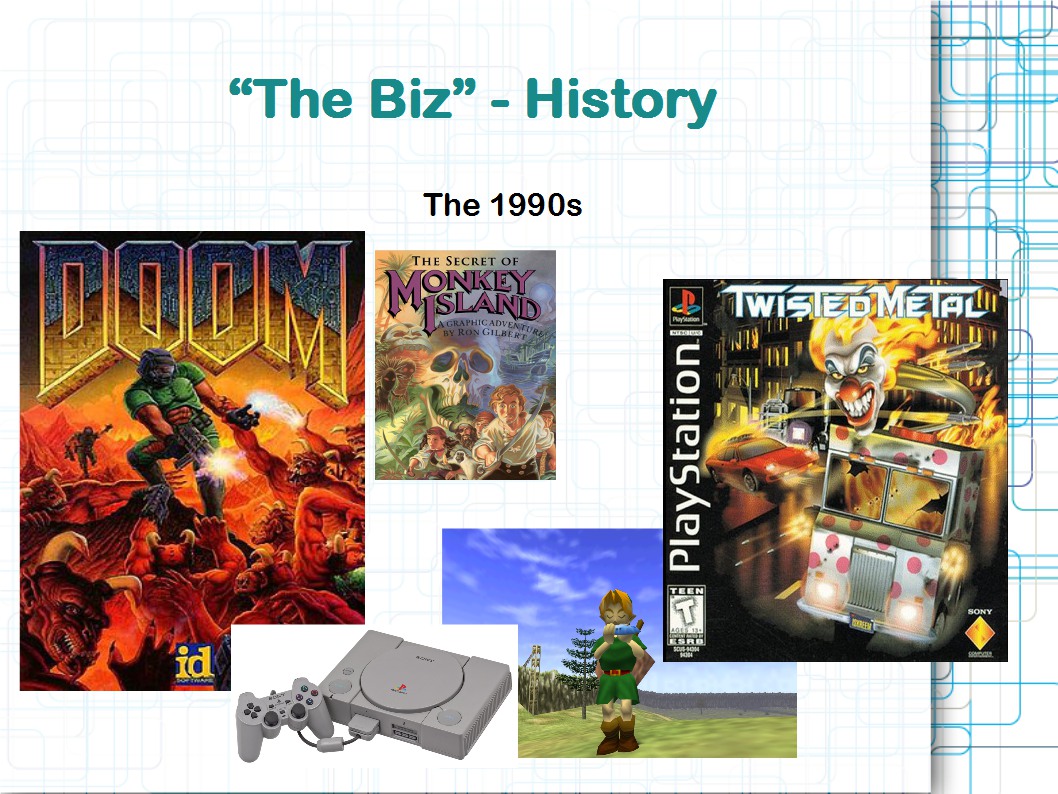
Now, my heart may always belong in the arcade of the 1980s, but honestly, if I were to pick a “golden age” of gaming, it would be the early to mid 1990s. Like, 1990 to 1996 or so. However, if you were to ask the games biz what sort of industry it was like around the middle of the decade – or at least what industry it wanted to be like, there’d be one answer an order of magnitude more common than any other: HOLLYWOOD! The games industry wanted to be like Hollywood, but (IMO) it tried to cherry-pick the “best” parts of Hollywood (from the corporate perspective), not realizing that a lot of bad came with the good.
Notable games from this era were plentiful and awesome. I’m gonna just note Twisted Metal, Warhawk, and Jet Moto for the record, because while they were only moderate hits, in my little biased world they dominate my memories of the era. So there. 🙂 Many of the big names were continuations of series from the earlier decade (Mario, Ultima, Legend of Zelda, Final Fantasy, Metal Gear, Street Fighter), but there were some fresh games and new series here as well that met with critical and / or commercial success: Doom, The Secret of Monkey Island, Links, Wing Commander, Warcraft, Oddworld, Quake, Diablo, Goldeneye 007, Crash Bandicoot, Master of Orion, Chrono Trigger, Fallout, Resident Evil, Unreal, Baldur’s Gate, Virtua Fighter, Panzer Dragoon, Smash TV, Mortal Kombat, Pokemon, Starcraft, Sonic the Hedgehog, Age of Empires, Gran Turismo, Grand Theft Auto, Half-Life, Spyro the Dragon, Roller Coaster Tycoon, Tomb Raider, Myst, X-Com, The Sims, and the list goes on and on…
The PC gradually became standardized (especially under Windows 95+), and came into its own as a great gaming platform, especially once 3D hardware caught on. The arcades and arcade games diminished significantly during the course of the decade, but were still a force. On the home console front, the big entries (at least in these parts) were the Super NES (AKA Super Famicom), Sega Saturn, Sega Dreamcast, Sony Playstation, Atari Jaguar, and the Nintendo 64. On the handheld side of things, notable entries included the Nintendo Gameboy Color, and Sega GameGear.
Throughout this era, most game studios grew to medium-sized to large teams. The publishers ruled the world. Exceptions existed, but even the successful smaller teams that kicked serious butt doing “shareware” titles grew to a much larger size over time. It was a time of massive growth — and, in my opinion, the origin of the indie “push back.” And boy, did they push back.
 The 2000s and beyond
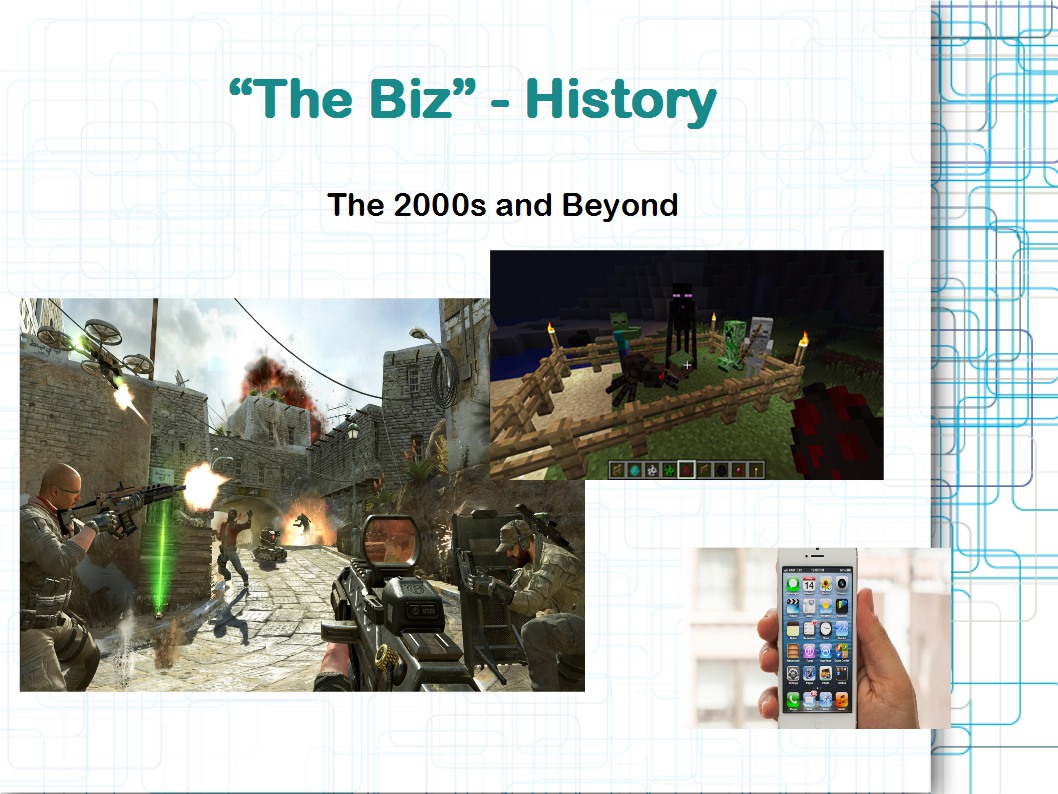
For the first half of the new millennium, things continued as one would predict from the 1990s. But then everything started to change. The era of the big publishers and ever-increasing budgets began to crumble. Where there was once something of a monolithic “games industry” of a few major warring publishers, things went really, really fuzzy. Digital distribution – via any number of mechanisms – fueled this change.
Notable games of the last fifteen years? Where do I begin?!?!? The names range from massive major studio productions down to tiny single-person development teams (or at least started there). Halo. Minecraft. Bejeweled. Bioshock. Call of Duty. Farmville. Angry Birds. Flappy Bird. And of course, plenty of older series from previous decades continue to be mined for value – from Legend of Zelda and Mario to Sim City and Grand Theft Auto.
Platforms become increasingly diverse in this era. You still have personal computers (running whatever flavor of Windows / Linux / Macintosh you want), and consoles (notably Playstation 2, 3, and 4, the Xbox series, the Nintendo Gamecube, Wii, and Wii-U), and tons of dedicated game handhelds (Gameboy Advance, DS, DS3, Sony PSP, Vita, etc.). But now you have things like browser-based and mobile gaming. And so-called “microconsoles” and virtual reality and “wearable computing” may yet be a thing.
And game development? It’s all over the board. Lone wolf developers may compete directly against giant 100+ member development teams with budgets into the hundreds of millions.
Common Threads
The rest of this series will be about the common threads running through all of these eras. At first glance, things seem like they’ve changed so much and the industry has redefined itself so many times there’s no way you can possibly nail down any sort of consistency.
But they are there. One thing that I’d like to note – as I’m still something of an “indie evangelist” – is that throughout all these eras, there’s been an indie contingent. From the hobbyists of the 1960s and 1970s to the mail-order guys of the 1980s to the shareware folks of the 1990s through the “indie revolution” of today – “indies” by any other name have been a constant.
Filed Under: Biz, Game Development, Retro - Comments: Comments are off for this article
Making Money Making Games – Part 1 (History)
Posted by Rampant Coyote on December 9, 2014
I gave a presentation at BYU for their game development club a few weeks ago called “Making Money Making Games – a Historical Perspective.” I didn’t do my best job ever on it, and ran out of time for the “important stuff” at the end, so I kinda breezed through the end. So I thought I’d post it here this week, as I’ll be in Japan and need some prepared posts. I’ve adapted it for the blog, and hope you’ll find it interesting.
How do you make money making video games? I’m not talking about getting rich or anything, a different topic for which I clearly haven’t found an answer yet. I’m not even talking about making a living. I managed to do that successfully for several years as a full-time employee developing games. That’s the ideal, right? Make enough that we don’t have to take on another job to finance our game-making habit.
But I’m talking about the whole concept. Whether it’s an indie like me scraping by enough part-time to be able to afford to keep making games, or how the entire industry builds and sells the games that we want to play, I want to talk about how that’s been addressed in the past, present, and maybe how it will be addressed in the future.
Some people may consider it a gauche topic, but it’s critical to how we make and play games. Even if you don’t intend to ever make a game for any kind of profit, or even make games at all, it’s important. It has to do with how we all, as players, pay for these games to be made. We may find some ways acceptable and some – not so much.
Of course, a big part of my objective here in this series is to illustrate how many things have changed and continue to change (which means – opportunity!), and how many things are tried-and-true principles that are a foundation for everything else. If you are an aspiring or beginning game developer, you need to pay attention to both!
Historical Perspective on the “Industry”
First off, how has the games biz – when there was one – considered games? How did they try and turn this hobby into an industry with actual budgets and stuff?
 The 1960s
Ah, the 1960s. The era of the Beatles, the space race, and… video games. Actually, one of the candidates for the very first video game is Tennis for Two, which actually came out in 1958, but I didn’t want to devote an entire decade to one game, so I’ll lump it in here. It’s sparse enough as it is.
In this era, there was no industry – no biz to speak of. Video games were little more than diversions for engineering students, or “gee whiz” displays for visitors. Teams were extremely small – often individual tinkerers who would make changes to the code or spawn off new versions.
Notable games of the era (besides Tennis for Two) include little programs that played Tic-Tac-Toe, Chess, and of course Spacewar!
The platforms of the era pretty much dictated the market (or the lack thereof) – big mainframes or “minicomputers” (which only took up a wall, not an entire room) costing tens or hundreds of thousands of dollars. This wasn’t consumer technology, and so the games were freely distributed to those institutions that had the machines.
But some people were already getting some ideas of turning these things into a commercial venture. It was only a matter of time… and for the price of the hardware to get low enough that consumers might get their hands on it in one way or another.
 The 1970s
In the 1970s, we finally had the video game and computer game era take off. You still had the freely-distributed (and often deleted & lost forever) games on the big university and business systems, but you also had Nolan Bushnell – who had seen Spacewar! in action at the University of Utah and wanted to bring it to the masses – in the form of an arcade kiosk.
And so the video game industry had its beginnings. You had the first arcade games by Nolan Bushnell, with expensive dedicated hardware that would finance itself by selling gameplay at a quarter per session. And you had the first game console by Ralph Baer, an expensive bit of consumer electronics that would plug into televisions (light gun sold seperately). And the beginnings of purely digital games (no electronic hardware required) for early consumer computers. Even then, there were a few different business approaches.
Notable games of the era were Computer Space, Pong (and tons of variations), the Colossal Cave Adventure (under various names), Star Trek (AKA Trek), Hunt the Wumpus, Oregon Trail, Zork, Space Invaders, Galaxian, Scott Adam’s early adventures (Adventureland!, Pirate Adventure, and Secret Mission), the original (limited) release of Akalabeth: World of Doom, and MUD (the first massively multiplayer online RPG – well, for very small values of “massively”).
Platforms exploded in this era. You had several consoles – the Odyssey, Odyssey2, the Atari 2600 (AKA VCS), the Apple II, numerous arcade platforms (many with dedicated hardware), the TRS-80, and – squeaking in at the tail end of 1979 – the Atari 400 and Atari 800 computers. And more.
At this point, games were still developed by small teams or individuals. It was a time of entrepreneurs, trying wild ideas that were as “indie” as anything we see today. You had video games as site-based amusements that were paid for a session at a time. You had freeware at universities. You games as an integral part of stand-alone consumer electronics. You had games as a separate but critical component of consumer electronics that you bought individually. You had mail-order game businesses. You had games sold in computer stores in plastic baggies. Games as a mail-order business.
But the explosion had only begun.
To be continued in Part 2…
Filed Under: Biz, Game Development, Retro - Comments: Comments are off for this article
Dead State is Alive
Posted by Rampant Coyote on December 8, 2014
 Dead State has been released.
I wish I could give you a detailed run-down of how awesome this game is, but I avoided playing it during the pre-release, and it hit full release just as I was hitting a convention and getting ready to travel out of the country AND had my editor demanding some significant (but much-needed) changes to a short story. So… triple whammy. It was force of will to avoid playing the crap out of it so I could get all my necessary things done.
Anyway… I’ve been waiting for Dead State for a long time. Long before the Kickstarter. Part of me is terrified that after such a long wait, it’s not going to live up to my expectations. And… I’m hearing some rumblings that there have been some bad hiccups / glitches on release, so maybe it’s good that I wait a few more days (probably not until I return from my business trip) before playing.
The concept is thrilling. It’s a “zombie game,” which was popular when the game was first announced, but has gotten pretty stale since then. However, the real focus is on survival and dealing with human enemies, as opposed to the zombies, which are supposed to be more of an environmental force.
I guess folks can tell me how awesome (or not) it is while I’m away. Go ahead. 🙂 For me, it’s one of those things that truly represents the “indie revolution” and its effect on one of my favorite genres, the RPG. This is not something I can easily see being made back in the old studio / publisher system. Maybe with the popularity of zombie games a few years ago it might have been possible, but… not likely. Especially not a more cerebral, turn-based, party-based, base-building RPG like this one promises to be.
Anyway, it’s a long time coming. Glad to see it has finally made it to release!
Filed Under: Game Announcements - Comments: 3 Comments to Read
Game Dev Quote of the Week: Gygax vs. Meier Edition
Posted by Rampant Coyote on December 5, 2014
 From the world of both dice & paper gaming and computer gaming:
“Designing games for Gary Gygax was certainly very inspiring, but I’d have to say that working with Sid Meier at MicroProse was even more influential. Gary taught me how to make complicated games; Sid taught me how to make simple ones.” — Lawrence Schick
Taken from “Reminiscing About White Plume Mountain” at nerdragenews.com.
I could probably use some lessons from Sid Meier. Honestly, so much of my formative years and thoughts on gaming came from the works of Dave Arneson and Gary Gygax, the books derived from their rules, or games inspired by them. I’ve no doubt it’s given me a permanent bias in my design approach, in spite of years of experience pushing me in different directions.
I really do tend to over-complicate things. Part of it is that I love digging into intricate systems and futzing with all the moving parts and seeing how I can leverage the interactions. And part of it is because I really dig the simulation side of things. This isn’t always a good thing. While it can be great for a game to have verisimilitude, and it can be great for a game to have a strong narrative, we can’t ever lose sight of the fact that games must be allowed to be games.
Though I’d encourage you to read the whole interview. It’s not long. But I want to include one extra quote, because it’s awesome:
“If you want to become a game designer for video games, study tabletop board games and RPGs, because their game mechanics are all right there on the surface; you can see all their systems, tinker with variations, and analyze what works and what doesn’t.“
So there you have it, aspiring game designers. Go beyond studying other video games!
Filed Under: Quote of the Week - Comments: Comments are off for this article
Twenty Years of Kicking Butt and Making Games
Posted by Rampant Coyote on December 4, 2014
 The original Sony Playstation is twenty years old now. At least if you count its Japanese release.
I suddenly feel old.
I got my first professional game development job in October 1994. My studio, SingleTrac, was a new startup (I was employee #16!) under contract with Sony to produce a couple of new games for their upcoming console. Back then, when I was allowed to tell people I was making games for the Playstation (after it launched in Japan?), they’d look at me and say, “What’s that?”
When I explained it was a new game console, they’d ask (even if I’d said it was by Sony), “Is that one from Nintendo or Sega?”
Twenty. Frickin’. Years.
I remember riding on the bus to a Microsoft event at GDC (called CGDC back then) a year or so later and hearing a conversation behind me with a guy who had made games for the Atari 2600 back in 1980. I thought, “Wow, that was fifteen years ago! How incredible that he worked on those ancient games!” Now my first games are even more ancient than the Atari games were back then. Well, some of them.
Amusingly, back then I was the “game guy” surrounded by a bunch of people who came from the simulator industry. Now? I’m the guy (well, one of the guys) from the video game world in a simulator company.
Working on the PS1 was a joy. Seriously. It had some excellent tools for the time. The tools were all C / C++ based, which was actually a step up for developers who were used to dealing with 8-bit or 16-bit systems (or so I have been told). It was designed to be 3D, although its 2D capabilities were certainly up to the task. It got away from the cartridge system, which made duplication & distribution a lot simpler, and with the CD-ROM could provide video (often used to terrible effect, including from us…) and play high-quality redbook audio music – a major step up for video game audio.
And at the time, before 3D cards became a thing, it was capable of displaying graphics superior to what was available on the PC at the time.
It’s hard to say looking back how much I’ve changed, and how much the games biz has changed. I mean, the whole indie thing has happened. That’s HUGE. And the consoles are no longer the only game in town. Not only do they still have to contend with the PC, which while no longer in the heyday it was in the early 90s but is still a consistently popular platform, but they’ve got to deal with handhelds, with mobile devices, with web-based gaming, upstart microconsoles, and quite possibly (in the near future) VR systems and wearable computers. I think that represents a healthy, if highly competitive, ecosystem.
Making games remains hard. At least, making good, competitive-quality games is hard. As it has gotten easier to actually do the coding and development of games and better tools have made asset creation easier, there’s been a corresponding increase in competition. Thus, you could argue that the difficulty has stayed almost constant.
Twenty years is a very long time in the tech world, and in video games it is positively ancient. It seems that the details, tools, platforms, technology, and the hot trends may change (a lot) over time, but the fundamentals seem to be the same now as they were 20 years ago… or even 32 years ago, when I first started making hobbyist games as a kid.
Filed Under: Game Development, Geek Life, Retro - Comments: 2 Comments to Read
AFK 2 weeks…
Posted by Rampant Coyote on December 3, 2014
I’m going to be out of the country for the next couple of weeks, starting Monday. I hope to still have regularly posted articles (at least small ones) during that time, but I can’t make any guarantees at this point, nor can I guarantee a quick turn-around on responding to comments or emails. Sorry about that.
In theory, it shouldn’t be a big problem… I’m going to be in Japan rather than a third-world country this time, and (again, in theory) ideally I won’t be working super-long hours, so I should be able to keep up. But… crap happens. Just a heads up. And then when I get back, we leave in to visit in-laws for Christmas. December is just gonna be one of those months.
For those interested, I’ll be in Toyohashi. I’ve never been outside the Narita airport in Japan before, so I hope it’ll be a fun experience.
Filed Under: General - Comments: 4 Comments to Read
Why did the Avatar of Virtue screw up everything s/he touched?
Posted by Rampant Coyote on December 2, 2014
 I was amused by PC Gamer’s article by Richard Cobbett, “Ultima: The Legacy of the Avatar.” (Hat tip to RPGWatch for the link). He doesn’t present anything all that new, although he does drive home the idea that the Avatar’s efforts to save Britannia ultimately led to its doom. Actually, not even saving Britannia. Just trying to be a nice guy and exemplify virtues in Ultima IV. It sets off a number of escalating, horrible events.
It all starts going wrong with Ultima V, which was a brilliant bit of storytelling for its day. Flash forward a couple hundred years, and see what has happened to what was once a system of ideals. Now, they’ve been mandated, regulated, and the “spirit of the law” has become completely lost or corrupted. What was once a beautiful and noble has become a system to enslave the people. Then in Ultima VI you learn that your actions of the past doomed an entire underground race and brought them up to the surface to war against humanity. Oh, and all those daemons / balrons you battled in the earlier games? They were just Gargoyles, really, and you assumed incorrectly that they were just pure evil. Okay, maybe we’ll say the ones you killed were evil and aggressive, but still…
And then in Ultima VII, you find an entire cult has been formed that has subverted the virtues for their own nefarious ends. And it is led by a shadowy extra-dimensional being who is really your evil twin created when you … wait for it… completed the Quest of the Avatar in Ultima IV. And of course, he’s causing all kinda of harm and destruction. Although the original storyline was supposed to be that the Shadowlords were actually the “dark half” of the Avatar, and the Guardian was actually their essences combined after the Avatar banishes them in Ultima V. (I like this explanation better).
Although in my view, Lord British (the character) is more to blame than the Avatar for this stuff. It was his failure to perform due diligence when he set the Avatar out on the quest in the first place. 🙂 Typical of government, he’s completely blindsided by the Law of Unintended Consequences, and just acts stupid when the repercussions hit.
But I want to take a different tack for a minute. This is something that makes me pause and reflect a little bit as an RPG developer. Richard Garriott sort of famously re-built the technology for each Ultima from scratch. This is why Serpent Isle was “Ultima VII part 2” not “Ultima VIII” Based on my understanding of his development process (which is derived mainly from a few interviews and having read Shay Addams “Complete Book of Ultima” a zillion times), the storyline was mainly generated from scratch each time. I really doubt they thought beyond the next game in the series as they were developing each game. And, especially in the last installment of the series, the storyline often changed – sometimes radically – during development.
My personal belief is that Richard Garriott had already done the “save the world” story three times with new characters – the Girlfriend of the Big Bad, and the Computer-Child of the Big Bad – in Ultima I – III. Ultima IV was a departure from that, and a much celebrated one at that. From that point further, however, there was the problem of putting the world back in peril so the Avatar was needed. But then there’s also the concern about how that world ever lasted past five generations without the Avatar’s help, because it’s constantly in peril (well, every 200 years or so).
The natural answer, when starting anew with an old property, is to build the new peril off of what has already come before. In other words, instead of a brand-new earth-shattering event, it’s more of a revision or evolution of a peril that had come before. Since the games left very few “loose ends” at the end of each one, a new game had to tug some new ones loose to be tied into the narrative.
Garriott was also very careful to make each installment a stand-alone game. So while he could pull story and world elements from one game to the next, he couldn’t leave major plot threads hanging, or depend on the audience to have played the previous games. But – a good chunk of his audience had played the previous games, and so he couldn’t just start over completely from scratch and ignore what had happened before.
The result of this is that much of the Avatar’s hard work from the previous game was undone or subverted for the next game(s). It wasn’t a plan going forward. It was just the result of trying not to have a totally new Disaster of the Year befalling the world. I believe the Guardian was created to be a major recurring villain that might be defeated rather than destroyed for a while.
At one point, the plan was to abandon Britannia and have all the new games after The Black Gate happen in different worlds. I guess this was a viable alternative – instead of Britannia suffering new world-shattering disasters with each installment, the series could be about the Avatar racing to a different place to stop The Guardian or whomever from doing their Great Evil upon another world. I wonder if this plan wasn’t partly in place and experimented with in the Worlds of Ultima games (based on the Ultima VI engine). But for the fans, Ultima meant Britannia as much as it meant the Avatar. While we permitted some excursions by our world-hopping alter ego, we wanted the same world, only different.
And so, accidentally I suppose, everything the Avatar had done to make the world a better place had to be undone, retroactively if necessary.
Is there a lesson here for RPG developers? There sure are a lot more of us these days than in the old days. There aren’t many of us who’ve had to make a series nearly as long-lived as the Ultima series, though, and have had to keep going back to the well of ideas to make a sequel “the same but different.”
I know in my case, while a LOT has changed between Frayed Knights game 1 and game 2, I’ve had a pretty good idea of where the entire game was going since day 1 (I even stupidly believed for a while that I could fit it all inside one game). I also deliberately didn’t have my heroes saving the entire world. Or even the kingdom (that comes later). I figure their goals could get bigger with each game, but couldn’t really get smaller. That way I’m not backed into the corner of having had them save the universe and then… NOW WHAT?
But we’re not always in situations where we can plan for sequels. I don’t know if Jeff Vogel planned out an entire series for Nethergate, but I’m sure he considered the option while it was in development. If the game had turned out to outsell his previous titles, I guarantee we would have had at least a Nethergate 2 and Nethergate 3. But… it didn’t, and so the game stands alone with only a major update (an expanded edition).
Stuff to think about, I s’pose.
Filed Under: Design, Retro - Comments: 5 Comments to Read
Indie Gala Every Monday Bundle
Posted by Rampant Coyote on December 1, 2014
 So… I think I’ll get practically nothing out of this, but… Frayed Knights: The Skull of S’makh-Daon is available for mega-cheap in this bundle:
Indie Gala Every Monday Bundle
If you are seeing this next week, it’ll probably be linked to a different bundle. They raise the minimum price every day, so if you were waiting until it was dirt-cheap to get it… this would be the day to do it.
And hey, it’s bundled with a Doctor Who game! So I’m in good company!
Filed Under: Deals, Frayed Knights - Comments: Read the First Comment
RPG Pacing
Posted by Rampant Coyote on November 28, 2014
I should keep a collection of weird (but sometimes insightful) ideas that I get when I’m busy working on my game after midnight. It seems that the combo of fatigue and focus in the late hours on the nuts and bolts of RPG development cause some strange “thinky thoughts” (as my wife sometimes calls it). If nothing else, they are blogfodder.
I’m constantly contrasting the concepts in “modern RPGs” (think Bioware) with older, classic RPGs (pre-1996, let’s say). I do that a lot on this blog. That really isn’t intended to say “older is universally better.” Maybe some really hard-core fans of the classic CRPG era say that, but I remember complaining about some of the problems with CRPGs to friends back in the early 1990s, and applauded the changes and pushes that came since. I just didn’t know they were going to go so far – or that elements that I really did enjoy (or enjoyed in moderation) of these older, classic RPGs were going to get all but eliminated from the genre until the indie era resurrected them.
That’s really what I’m about – not a complete rejection of the new in favor of the old, but being willing to question the modern “evolution” and explore some babies that might have been thrown out with the bathwater in the never-ending quest for the ill-defined, shifting and ever larger mass market.
One aspect I was pondering in kind of the “too-tired to think about this” way was RPG pacing. In the old days – I guess I could say, “There was no such thing,” but really, it was completely in the player’s hands. It depends upon the game, but following the tabletop D&D model, the gameplay consisted of a number of player-directed pushes into dangerous territory. Maybe it was exploration from a home city out into the wilderness, or from the Edge of Town into the deep dungeon, or whatever, but the player drove their own pacing. The rise in tension depended on player choice, but it looked something like this:

Those are dumb names at the bottom, but on a scale from 0-10 of tension (I’m a programmer, we start counting at 0), you have the stages of “delving deeper”. First they are in a place of relative safety – no tension. This is important. Just as Shakespeare wrote comic relief into his tragedies, people need a chance to re-center their emotional levels. The tension can’t keep rising forever or it just tops out for a while, and then causes fatigue, and will actually drop after a while. That’s a problem in some horror games, I’ve noticed.
After that, the player chooses to leave the area of safety to a “danger area” – like a dungeon, or the wilderness. At the beginning of the game, this may be a high-threat area – they don’t go too far before they have to retreat back to safety. Later, this area presents little threat beyond the use of resources, and it’s more of a case of trying to be efficient than being in mortal danger. That first step represents some small amount of tension, but you are rarely attacked immediately as you step outside the front gate. But the deeper you go, the further you are from safety, and even areas of low to moderate threat – like previously explored areas of a dungeon – represent a rising danger and tension level. Then you get to the new, scary, fun, exciting areas. This represents a serious threat (and serious fun), as you may not know what to expect, and may be facing unfamiliar threats (new monsters, etc.).
At some point – possibly as you are about to face the “level boss” or just find yourself barely surviving some encounters – you have to make a go / no-go decision. At some point, you realize the threat is too great, and you are either already or about to get into some serious trouble, and you have to retreat back to at least relative safety. In classic RPGs, this was maybe unsatisfying from a storytelling standpoint (you defeat the uber end-level boss only to have to keep fighting his minions on the way to the exit), and frustrating when you failed, but it was still an exciting part of the story. This was in some ways a “chase scene” – you were out of resources and unable to sustain many (or any) serious fights. Maybe even what was only a moderate threat on your way in represents a serious threat in your weakened condition on the way out. However, the closer you got to safety, the less tension there was. Finally you made it home (not necessarily the same “home” you left) safe, rested and resupplied, and the tension began again. This might represent a really good save point (in a few games, it was the only “save point”).
There is an interesting point worth mentioning here.Modern games have significantly reduced the concept of long-term resources in RPGs. In the older games, the push through explored territories (and possible encounters) was pretty much low-quality content and a “tax” on the previous decision to retreat, a constant depletion of resources that represents the strength of the party. It also means that, except for newly-discovered equipment / supplies found on the way or level-up events that occurred during the excursion, the party is never stronger than the moment they leave their safety area, and they are never weaker than the moment they re-enter. So it’s not that the tension rises necessarily because the players’ obstacles grow in threat, but because the players are (temporarily) depleted. It’s admittedly not as great from a storytelling perspective that a party that just mopped the floor with fifty minions and their boss overlord are now forced to flee from a small group of minions because they’ve used up all their resources (think “ammo and supplies”), but it works just fine as a game mechanic.
 While modern games often give you the opportunity to cancel the curve early to return and resupply (or just sell stuff), the tension curve is more narrative-driven (or, if you will, designer-driven). You enter a section of the story (subquest, whatever), and it’s intended to play to completion along the standard dramatic structure from start to finish. Many modern RPGs more-or-less force you into this structure, with no real way to return to safety except to go through the other side. That can be an exciting change of pace, but it can get pretty exhausting if used exclusively. There’s nothing inherently wrong with this traditional dramatic template. It’s a classic structure that obviously appeals to gamers as well as readers. It allows designers to craft a story. Kind of.
The downside is that a game isn’t a passive medium, and one size doesn’t fit all. When you are an active participant rather than a passive audience, you deal with the tension differently. And then you’ve got this awesome ability of games to be interactive and to tailor themselves to the player’s individual preferences, but instead they are getting pushed through at what the designers and testers thought was appropriate pacing.
For me, personally, I’d like to see things a little more mixed. I don’t just mean giving the player the ability to bail and come back in a more plot-driven structure, and I don’t just mean alternating between the two styles, either. I am certain it’s been explored in many games – maybe not exactly in these terms, but I know pacing and interactivity are a regular point of discussion in design meetings for story-heavy games (at least the good ones). I’m not talking about anything revolutionary here. Just a different way of thinking about it, and a reminder that there really was something to the old-school RPG way of doing things that was both comfortable and compelling.
Filed Under: Design - Comments: 2 Comments to Read
Happy Thanksgiving!
Posted by Rampant Coyote on November 27, 2014
For readers in the U.S., Happy Thanksgiving!
For everyone else, Happy Thursday!
This one will be a little weird, as it’s the first time in almost twenty years our eldest daughter won’t be with us. She’s serving a mission for the Church of Jesus Christ of Latter Day Saints in South Carolina. It’ll be weirder having Christmas without her.
We have a tradition with our group of friends to turn the 4-day weekend into a gaming holiday. When we were in college, far from home, and couldn’t afford plane tickets for just the weekend, we’d get together with other friends in the same boat and turned what was previously far from my favorite holiday into a total party. We’d be known to start a game after dinner on Thursday (when we’d all bring stuff for a great dinner), go until midnight, then play from noon to midnight for the next two days. Believe it or not, we actually got sick of playing D&D by the end of the weekend, which is why we’re not quite so bold anymore. That, and we now have family close, and Thursday gets to be spent more with them.
But we’re still playing a bunch of Pathfinder this weekend. And we’re going to watch the Rifftraxed version of Hawk the Slayer tomorrow night. It’s a-gonna be awesome!
Filed Under: Geek Life - Comments: 3 Comments to Read
Unity 4.6
Posted by Rampant Coyote on November 26, 2014
The long-awaited UI system is here for Unity!
I’m pretty used to using NGUI by now (and the creator of NGUI helped work on this new UI system), so I’m not sure how much I’ll want / need to mix ‘n match. But it’s nice to have that option, and worth investigating. I’m still in UI hell right now … of course, I say that having not touched code in three or four days because of story editing.
I’m pleased that the source code is available and modifiable for the UI system. That is sure to create some nice, interesting offshoots.
So now I have to ask myself if I want to dare upgrading this (extended) weekend. That’s always sure to bring joy…
Filed Under: Programming - Comments: Comments are off for this article
The arcade games of my dreams. Literally.
Posted by Rampant Coyote on November 25, 2014
I had another dream about a “lost” arcade game the other night.
I have these dreams periodically. I don’t know why, especially since the whole “age of the arcades” was a relatively brief chapter of my life by this point. Maybe they are repressed memories of my playing Polybius that are trying to break to the surface. Or maybe, as a designer, my quest to dig out the gems of gameplay out of classic games that may have been forgotten in the modern era appears in my subconscious. Perhaps it is the fact that we’re living in the indie era, and I’m feeling overwhelmed with more games than I have time to play, and I know that some of these unplayed titles – many of which are getting pretty old – will prove to be just fantastic fun.
Or maybe it’s something Freudian. Who knows?
Whatever the case, what usually happens in these dreams is that I discover a place that still has these old classic arcade games. Either they are an old traditional venue like an arcade or restaurant (yes, kids, the more low-brow restaurants of my choice and budget often had arcade machines running in a corner, right by the coin-op candy dispensers). Or maybe it’s some special event, like a convention display or a special museum showcase. Anyway, as I’m browsing some of my old favorites, I see a game that I’ve either never seen or heard of before, or a game that I had completely forgotten about over the years, but on playing the game, I suddenly remember how amazing it was for its time, possibly even showing up more modern games in their scope. Yeah, like that’s gonna happen, but hey, my dreams force the issue.
In my dream the other night, it was a previously unknown sequel to the 1983 Star Wars arcade game. Borrowing from real life, it was called TIE Fighter. Hey, the PC game was pretty amazing, so why not its imaginary arcade precursor?
Sadly, I can’t remember a ton of details about this game, other than it was also vector-graphics based, and while it was certainly a richer, more detailed universe with a lot more interesting gameplay, it didn’t seem as polished as Star Wars. Was it a project that failed to hit a minimum quality and thus was canceled just before it went to manufacturing? Or was it an unlicensed title back back in the day when such things were kinda fast and loose, but its distribution was halted by the lawyers before it could reach mainstream distribution? Both ideas occurred to me in my dream, believe it or not.
Usually, in these dreams, I discover that these old games have incredibly full worlds to explore that were somehow hidden inside the old 16k memory chips. I know that was an old childhood fantasy / urban legend, but I have a tough time understanding how that still resonates inside my subconscious mind.
Weird, huh?
Filed Under: Geek Life - Comments: Read the First Comment
A Brief History of (Video Game) Graphics
Posted by Rampant Coyote on November 24, 2014
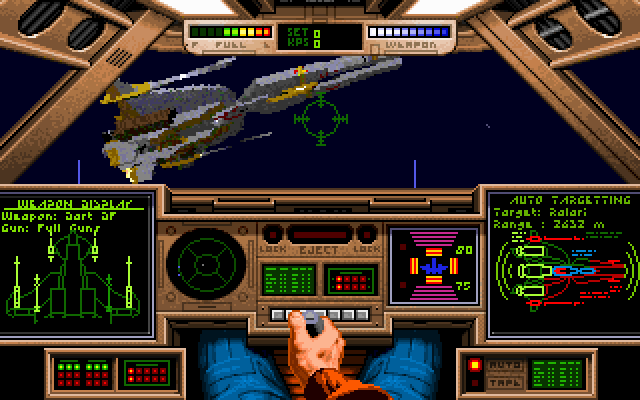 These are fun to watch as either a gamer or as a game developer, this is a five-part series of short videos explaining the major revolutions / trends / milestones in video game graphics over the years. From vector graphics to bloom effects, it’s a pretty entertaining little set of videos. For us old-school fans, it’s just awesome seeing classic games that we remember so well as being representative of the effects touted here.
I had something of a belated self-discovery when watching these videos. There were a few arcade games that I remember friends gushing over that I just didn’t “get.” I tried playing them many times to see what everyone else thought was so awesome, but in at least one case (Turbo), the game left me cold. In another (Moon Patrol), I thought the game was reasonably well-executed and fun to play, but I didn’t get its popularity. Watching the videos, I note that both games were pioneering in graphical effects.
So it would seem that my being less impressed by graphics than by gameplay has been with me for a long time. That’s hardly 100% – I can get wowed by the shiny just like anybody else, and probably hold more nostalgia than I should for the original Unreal than I should for that very reason. And hey, I dug lens flares that overwhelmed 3D games in the 1990s (the “light bloom effect” of that era). But I was also one of the minority of people who thought Quake was something of a failure next to Duke Nukem 3D. While being less impressive technologically, I thought Duke had far more interesting weaponry and tools for the player (and certainly a more interesting, um, attitude). And I was never a big fan of bloom effects.
As a game developer, unfortunately, this means I’ve got a blind spot for graphics, and I need help in that department. I can get so focused on gameplay that I don’t always recognize the line between “acceptable” and “unacceptable” on the visual front. Even as an indies with retro-style graphics, there can be a huge difference in quality. If you actually play (or watch a video of) Thomas was Alone, you can see there is some real artistry in the animation and presentation of the game even in such minimalist graphics.
Filed Under: Art - Comments: 2 Comments to Read
Creating Worlds
Posted by Rampant Coyote on November 21, 2014
 Back in its heyday, Origin’s motto was, “We create worlds.”
When I think about why I love games and why I love making games, that’s the key. As much as I do appreciate these “little” games with the single, focused game mechanic – as much as I used to love the arcade machines in the past – they aren’t the things I dream about. Maybe it’s a hold-over from my childhood steeped in science fiction books about visiting other planets and cultures, but I want entire worlds to explore. Even back in the arcade days, I was the kid who always wanted to discover that there were entire, larger game-worlds hidden inside these simple shooters.
No, I never actually believed that you could drive your tank to the volcano and find a castle inside, as was rumored in Battlezone. Or that you could break out of the maze in the teleport tunnel to find a new maze in Pac-Man. Even then, I understood that while Easter Eggs might exist, nobody was gonna hide the bulk of their game away so that very few players would ever experience them.
But then, I soon had far bigger games. Ultima III, to me, was something of a revelation. I think it predated Origin’s “We create worlds” motto, but it was certainly the kind of thing they were thinking of when they coined it. It was the first game I ever played with that kind of scale, and it was incredibly satisfying. While not a “sandbox game” as we currently understand it, it was a big, open world, with tons to do and explore.
 Fortunately, it was only the beginning. Games like Frontier (aka Elite II) were just as thrilling to me as a gamer. Really big, procedural worlds – like Daggerfall – were awesome. The huge, heavily detailed, highly interactive world of Ultima 7? Brilliant. Absolutely brilliant.
But just being big and interactive isn’t enough. One of my all-time favorite games was Falcon 4.0. What really thrilled me about that game was that it was dynamic and interactive. There was a virtual wargame being played in the campaign mode. The AI had certain starting points and priorities, but after that, things (in theory at least) flowed organically. As the head of your squadron, your actions could be highly influential in the conflict – critical, by definition. But while you might be the queen of the chessboard, you were still just one of the pieces. But you could deviate from your “official” tasking to set your own missions. Were you suffering too many attacks from a nearby enemy airfield? Re-task a mission to level the airfield. You might not put it out of commission long, but you might get 24 hours of reduced airstrikes. In the most difficult campaign, the winning strategy was to ignore whatever tasking the AI gave you at first, and to set up strikes against bridges to slow the enemy advance until your reinforcements arrived.
 One of the coolest things was returning from an engagement and just passing by a pitched ground battle taking place. You could see it happening, especially at night, because of the smoke and explosions flashing all over the landscape. It felt great if you had some left over ordnance to “swing by” and held out your guys by shooting a maverick or two at enemy tanks.
The cool thing was that the game responded to you. “Dynamic” didn’t mean random – it meant that you were interacting with the world, and the world would respond accordingly. You weren’t going to “cheat” by taking an approach the predefined scenario hadn’t considered (a trick I sometimes used in many other flight sims). If you lingered overlong (I learned to my detriment) in an area, you’d find yourself fighting a pitched battle against enemy planes which had been vectored into your area.
While it had its bugs (lots and lots of bugs), that helped define in my mind what a true, “dynamic world” should be. Not just interactive, not just detailed, but responsive to your actions on a fully integrated level – not just a few “decision points” in the plot. And yeah, “simulation-esque.” I think about how that would be in a role-playing game, like a roguelike. I haven’t played one that has come close, yet, but Soldak Entertainment’s titles have made some very impressive strides in that direction.
So if someone asks me what game I’d be making if I had unlimited budget and time… something like that. A kingdom simulator RPG where there are wonderful and terrible plots and subplots, and the player character(s) grow from being nobodies with almost no impact on the events of the world to being powerful, key players in everything they touch. It’d be cool.
Fortunately, as an indie, there’s no requirement for these kinds of things having huge budgets or being big productions. Nothing says I can’t start on something like that today, and let it grow organically, a la Dwarf Fortress or something like that. Well, nothing but the colossal, nagging feeling of guilt because Frayed Knights 2 is already late. But hey, if you ever wonder what kind of direction I’d like to wander as an indie – if I didn’t have any kind of concern about ever being able to afford to finance my little hobby – that’s the gist of it.
I’d just like to create worlds. Is that too much to ask?
Filed Under: Design - Comments: 12 Comments to Read
Elite: Dangerous Demonstrates Some Dangers of Crowdfunding
Posted by Rampant Coyote on November 20, 2014
 As “failures” go, it’s fairly minor. Elite: Dangerous is nearing completion, and will be shipping next month. YAY!
Or not.
It will be shipping without offline support. Which to many people (including me) is kinda head-scratching. It’s not an MMO – at least I never thought of it as an MMO and kinda missed the part where they said it was an MMO, but now suddenly they are saying, according to the latest newsletter, that they always considered it to be an MMO.
I actively avoid MMOs these days. Oh, I still take occasional excursions from time to time, but for me, MMOs have become synonymous with time-wasting (to slow the consumption of content by the most dedicated players) and getting annoyed by strangers (either because they are deliberate douchebags, way more skilled than you, or way less skilled than you and kinda clueless). So… calling a game “multiplayer only” causes me to immediately lose interest.
That’s not exactly what’s going on here, I don’t think. Which is why I haven’t canceled my pre-order yet. There’s still a single-player mode, apparently, but you still have to be online. It sounds like it is more of a case that the awesome dynamic procedurally-generated universe of the game needs an actual human staff at the helm to keep it working. Or something.
To me, that means that when the game quits making them money or they lose interest, the game disappears. Literally. Sure, they can make promises about releasing the server code to the public, and they probably will, but just like promises of an offline mode, those are not guarantees. I can go back and play the original game today, 30 years later. I have doubts I’ll be able to say the same about Elite: Dangerous even 10 years from now. Maybe it doesn’t matter, but considering how many games I am playing now that are several years old, it’s an issue I consider. And I also don’t like the idea of not being able to play when my Internet is down. That’s what I *do* when my connection is down. I play games.
And I just don’t like having my ownership and use of a game being so totally dependent on a third party being there and willing / able to “approve” of my playing.
Of course, there’s a little bit of a crapstorm going on now from people who backed what they thought was a true sequel to the old games – an offline, single-player sandbox experience in a procedurally-generated universe. The Kickstarter money is already spent. Pre-orders are another story altogether. And the refund policy has been… hazy, and not necessarily fair.
Now, overall… I’ll say it again, as “failures” go, this is pretty minor. We’ll see what the final product is like. If it’s a buggy unplayable mess (like I remember Frontier: First Encounters to be, way back in the day…), then that’s bad. But while the online requirement sucks, this would still be a pretty successful project. Game development is not an exact science, and things change. It’s more a PR disaster than a project disaster. They should have managed expectations better.
But as I have also often said – even as someone who might try to take advantage of crowd-funding in the future – beware! Seriously. There are no guarantees. It’s not just pre-ordering with extra bennies. Back it because you believe in the vision and the team behind it, and be willing to suck it up if the end result isn’t what you’d hoped for (or is nothing at all).
As for me – I’m gonna go dream of the game that I thought Elite: Dangerous might be, that I no longer hope Star Citizen could be, and that X: Rebirth was supposed to be. And I’ll go back to playing X3: Albion Prelude and maybe dust off my copy of Evochron Mercenary. And who knows? If I don’t cancel my pre-order, I may have a lot of fun with Elite: Dangerous until they turn the lights off on it.
Filed Under: General - Comments: 7 Comments to Read
The Dog Ate My Homework
Posted by Rampant Coyote on November 19, 2014
I had a gigantic post full of links and really timely, relevant material that was something of a stretch for me (and had me dealing with a very difficult topic).
Unfortunately, when WordPress logged me off in the second paragraph and re-logged me in, it didn’t *actually* re-log me on. It insisted that everything was normal and that my draft was being saved properly. It wasn’t until I ran into problems attempting to publish it that I discovered that nothing after that second paragraph had been saved. Since I’d spent about 2 or 3 hours on this post (it was a doozie!), I…
Well, I didn’t decide to give up posting altogether. Although that particular post may never, ever see the light of day. It was too painful to write the first time. (Yeah, I’m telling a fish story here, but honestly – it was a rough one to write).
It’s done that to me a couple of times in the past, and I’d gotten into the paranoid habit of copying-and-pasting everything offline if I even smelled anything out of the ordinary. It hadn’t happened in a long time, so I’d gotten out of that habit. My bad.
Anyway, my apologies for the lack of content today.
Filed Under: General - Comments: 4 Comments to Read
Copyright © 2026 Rampant Games | Privacy Policy
Powered by WordPress.
