Utah Indie Night, January 2014
Posted by Rampant Coyote on January 30, 2014
The first Utah Indie meet-up for 2014 was held at the Wahoo / NinjaBee offices. This is the first time I’ve been able to attend at their offices since they moved to new ones. (Long-time readers may remember that I used to work for them).
Spencer Buchanan started out the evening (once pizza was obtained) with a talk on mHealth and games. He – and other game developers – have been teaming up with doctors and nurse practitioners to create games to help people learn about and cope with serious health problems. It’s a pretty interesting new way to partner up with an industry, gain distribution opportunities, and help people, all at once. He talked about the benefits as well as the pitfalls, particularly working with some doctors who know a lot about medicine but not a lot about game design, other than having grown up playing video games.
It was a great talk, not that I’m considering making games for the healthcare industry, but for other elements it brought to light, and suggesting some areas where gaming can go to provide education as well as entertainment, and how partnering with industry partners can increase distribution and visibility.
And that underscored what may have been two themes I heard repeatedly over the evening from various attendees:
1. Discoverability is now king
2. Kickstarter FEVAH!
We had lots of discussion about some other things, like VR technology, SteamOS, the Ouya, etc. But those two themes kept popping up. In a nutshell – the whole report about how the cost of acquiring new users in mobile gaming exceeding the amount they will ever pay has really shaken up the biz. Mobile gaming is desperately overcrowded now, and the quality of the game now has very little to do with its popularity. And on the crowdfunding front – it seems everybody and their cousin has plans to launch a Kickstarter campaign now. It’s The Thing.
I should note that the contrarian in me sez that when this has happened, the boom is fixin’ to bust.
I showed my WIP (which should be done in another evening or so) for the One Game a Month and Candy Jam entry. It’s dumb but amusing. It was really a tiny project I used to learn Game Maker which I actually turned into a complete and themed game. It’s not going to set the world on fire.
I played Califer Games new puzzle-based title, Spirits of Elduurn, which was a very interesting twist on the ideas and universe of Siphon Spirit. It’s kind of a yin / yang thing… you control dual linked spirits with the same controls, but they have different abilities and respond to the environment differently. The first minute I played, I was thinking, “WTF?” The next minute, I was thinking, “Oh, this is kinda clever.” The next several minutes I had totally fallen out of critical thinking mode and was trying to figure out how to beat each level. I think it may be the most intriguing game Peter Anderson and Curtis Mirci have done yet.
 The only other game I played (and I played a lot of it) was Eric Wiggins’ “Saga Heroes,” based on the world of Saga (which I worked on back when I worked at NinjaBee). Eric has actually been maintaining that MMORTS solo for the last several years, and knows what he’s doing. And yes, he’s planning a Kickstarter. And yes, in spite of my Kickstarter grumbling, he’s an old friend and coworker with a track record, so *yes* I will be talking about it. While the game is currently a little rough around the edges, it’s kinda of a Zelda-Meets-Diablo thing which is really kinda cool. And it’s for the Ouya, which needs more good games.
Most of my night was spent just chatting and chillin’ with friends new and old, talking about games (and TV shows), swapping stories, sharing advice, etc. Even as some of the discussion revolved around how much harder it is to get noticed and sell games, it was pretty motivational for me. Sometimes that feels like the truest benefit of these meet-ups: You get motivated to make your game ‘ready to show’ for indie night, and then you come away with an enthusiasm to work harder and make great games.
Filed Under: Utah Indie Game Night - Comments: Comments are off for this article
What Does a Beginner Need to Start Making Games?
Posted by Rampant Coyote on January 29, 2014
 Courtesy of a Steam Sale, I found myself in possession of GameMaker Studio Pro edition for the bargain price of 25 bucks a few weeks ago. I’d actually considered taking a good, hard look at it after some comments on game development after considering some comments on one of the posts here (I think it was this one – about 3D), and the software came up for sale either that night or a day or so later.
The issue is – for me – a concern that beginners need an easier path to get started in game development. I knew that GameMaker began life as an educational tool for use in teaching students game development, and a lot of cool commercial games have been made with it. I’d heard plenty of reports but never had first-hand experience making a game with it. So I tried it, and made a game out of it (my One Game a Month entry, and also my Candy Jam entry), so I could give a more informed opinion about it. I’ll be sharing the details of learning the system – as well as the game – in a few days (although the experience may make up a few posts over the course of several days).
Going through this learning process yet again with a new “engine,” with an eye towards recommending it for beginners, drove a few points home for me. I will probably comment on several, but here’s a biggie:
I can’t think like a beginner anymore.
One of the complaints about my “Game in a Week” article many years ago was that sure, it was a game in a week, following years of experience as a game developer. While I recognized that was an issue, I didn’t think it was a big one. After all, I was learning to use a completely new game development “engine” (well, library).
This time around, however, particularly with the multi-featured, fairly complex beast that Game Maker Studio is, I recognized how I was learning to use the game system. Even though it was a completely different engine and suite of tools than I had used before (and I have worked with many in my career, including several custom in-house game engines), I was taking all kinds of shortcuts to learn and use the system. I relied on very few tutorials. With a brief introduction to the overall architecture (not a whole lot more than the introduction and overview in the documentation), I had a pretty good idea for how it worked, and had my head around things. A little bit of fiddling around to learn how to create events and actions, and I was up and running.
From that point on, I was able to take an educated guess as to what I needed, and then hunt it down in the docs pretty quickly. I knew what I needed – from collision handling to spawning an instance of an object, to drawing a sprite with the built-in editor. There have been a few questions that I had to look up on the Internet or ask one of my buddies who is experienced with the software, but things started coming together, and I was able to cobble up a simple game with it. I probably did some things “wrong” but they work.
This is totally NOT how a beginner would approach it. I was making assumptions and jumping to conclusions that more often than not turned out to be correct. I knew what I was looking for. A beginner would have no basis to make those assumptions in the first place. Really, the only way I’d see doing it would be starting out with some simple tutorials (yeah, I know, BORING) and working their way up to more complex ones.
Here’s another issue I ran into:
I have a programmer’s perspective to game development, not that of an artist or a designer.
 When I think of how I learned to make a game, I think of the old days of programming in Basic. I think of using abstract graphics to represent balls and walls and aliens, and that the first stages of making a game should be the equivalent of writing a “Hello World” in four lines of code or less. I think of… well, Moosader’s SDL tutorials. While she can do many things, she’s also got the mind and approach of a programmer.
Now, I believe that experienced game developers of all stripes eventually converge on some levels of commonality. Even though my mindset is more on the problem-solving and step-by-step approach of programming, I’m always thinking about the art pipeline and quality, design issues, and so forth. But I’m still rooted in that programmer mentality. When I come across a problem, I tend to immediately think of how to solve it with code before considering other options, like just hiding the problem with art, or changing the game design to make the problem go away.
So with my programmer bias trying to imagine learning to make games, I immediately think of having easy access to stand-in content, being able to get at everything via code very quickly, having simple functions to initialize and get things running very quickly, and also having a very rich, deep library of additional functions to go beyond the basics when those are no longer adequate. I want great documentation and example code, lots of tutorials covering every aspect of using the engine, and very useful debugging / scripting tools to help me find and root out the problems. But when I think of how I get things in the game to interact, I think in terms of code…
Coming at game development as a beginner from a programmer’s mindset is probably pretty different from that of an artist. As an artist, I would probably be first concerned with creating graphical content and getting it to display and move inside the game. Ease of the content pipeline would be paramount. I would look at avoiding code as much as possible until I was ready, and would prefer off-the-shelf behaviors that I could just plug in and set loose to see how things look.
 As a designer – well, designers are always a weird bunch. Who knows what they want? 🙂 I have my own bias – I imagine that as a kid, I started as a designer, with big ideas, and I learned to program to make those things happen. So “design” was really more of my gateway drug. But I jokingly refer to designers as people who aren’t good at either coding or art yet, but who are passionate about making games. From that perspective, I imagine a rich toolset is key, with plenty of stand-in content (which the programmers like) and canned behaviors (which the artists like).
And then when you get past the learning stage and want to use the engine for actual, commercial-quality game construction, you have a ton of additional needs. And this is everybody. You get worried about content pipelines, content / code versioning, workflow, ease of creating builds, multi-platform development, localization, integration with additional third-party libraries, monetization, the quality of support for the product (you don’t want to be in late alpha and discover a game-wrecking bug inherent in the engine which cannot / will not be fixed), metrics / statistics / profiling, debugging tools, licensing costs, and a whole lot more.
Unfortunately, the real game engines that cater to all these approaches have the side-effect that they are pretty daunting and complex. It’s the cost of providing all this stuff that everybody needs. So I guess this whole post is an excuse to explain why I am not the best judge of a game engine / studio as an introductory tool for beginners. I have some ideas of what they would need, but the very feature-rich nature of any tool that would provide all of that might make it overwhelming. I’m still of the belief that you’d want something small and simple to get you started… but that isn’t something that would “grow with you” as you learn your chops.
There are a lot of options out there. It’s a little overwhelming. I imagine a true beginner, aspiring to make great games, might be a little befuddled about where to start.
But I guess, compared to what we had back in the 8-bit era when we not only had no clue but also not many options, these are the right kinds of problems to have.
Filed Under: Game Development - Comments: 10 Comments to Read
Wizardry Online: So long, and thanks for all the death, or something
Posted by Rampant Coyote on January 28, 2014
Looks like Wizardry Online didn’t last long. At least not in North America. Sony Online Entertainment is shuttering four MMOs this year, and that’s one of them…
It was a pretty hardcore online game featuring permadeath, no auto-healing, and server-wide PVP. While my own history comes from somewhat more hardcore role-playing games, this always sounded a bit much for me to get interested in, so I never got that interested. On top of that, the videos showed that it was very manga-style (which isn’t a problem in my book, just a major disconnect from what really “feels” like Wizardry in my book) and … very action hack-and-slashy.
So, while it’s demise is still a ways off… when I think “hardcore MMORPG”, PVP and permadeath isn’t what I usually think of. I’m sure that’s what it means for some folk, especially those who played a bunch of MMOS in the late 90s and early 2000s. And of course, the hardcore roguelike players will definitely be comfortable with permadeath. But for me – and I freely admit I’m not nearly as much of a hardcore gamer as I was in my younger years (when you kinda had to be) – I think of something totally different. I think more in terms of a deep rule set, admittedly difficult progression, and challenging combat (generally turn-based).
Arguably, that’s already been done, and can be used to describe several games already out on the market – especially the deep rule sets. Turn-based is a bit more rare, but there are smaller MMOs that use it.
So if you were to identify the pieces that make up a “hardcore” MMORPG, what would they be? Would permadeath be part of it?
Filed Under: Biz - Comments: 4 Comments to Read
The King.com “Saga” gets funnier and funnier
Posted by Rampant Coyote on January 27, 2014
 So you know how King.com was claiming that their efforts to trademark (and monopolize) the words “Candy” and “Saga” for videogames were supposedly to protect themselves from evil cloners just trying to cash in on their IP rights?
Well, they weren’t wrong. There are some unethical, despicable douchebags who will blatantly do that, and worse, daring any other company to call them on it. Like…
Like themselves. King.com is one of the prime offenders.
The story is pretty bad, if you didn’t check out the link. When a potential partner pulled their game to go with another partner, King.com just out-and-out copied their game, only with far more blatantly “borrowed” content from Pac-Man.
 Of course, since this announcement came out, and in light of the furor over their “trademark-trolling,” King.com has now removed their cloned game, “Pac-Avoid,” from their virtual arcade, in a lame attempt to either hide the evidence or demonstrate their newfound respect for IP rights. Or both.
And then there’s the whole “The Banner Saga” thing. Remember how their PR claimed that they weren’t trying to prevent The Banner Saga from using the name, and also explaining that no, they aren’t making any claim that Stoic was trying to horn in on their IP or capitalize on their success?
Well, um, about that…
They are lying. Their legal paperwork says otherwise.
Especially when it claims that the title is “deceptively similar” their own.
Like I said last week – these folks (and people like them) are evil. I don’t know another word for it. I know – these days, that’s a word we tend to reserve exclusively for scenery-chewing movie villains, mass murderers, and politicians we disagree with. But if I were to open up the ol’ D&D books and pick an alignment for ’em, it would have to be somewhere in the “evil” third of the chart. They unethically, immorally, and arguably illegally flaunted their ability to get away with abusing others (and their customers, IMO, but that’s just me). Then, once they built up enough of an empire doing so, they turned around and attempted to subvert the law they so often violated (in spirit if not in letter, but certainly outside the bounds of enforcement for those without money) and stomp on the freedom of other game makers. Those with less money but more scruples are the worst hurt.
I am definitely in favor of protecting IP rights (although I do recognize that perhaps the laws in most countries granting those protections are… weird, difficult to enforce, and too often subverted to favor the moneyed). Those who craft with words, images, music, etc. deserve the same kind of protection – and the ability to make a living from their labors – as those who build with metal, wood, plastic, silicon, and so forth. But when copyright is too weak and unenforceable to offer much protection for anybody, and trademark can be applied so broadly by those with deep pockets, I think the existing body of law is failing in the digital age.
Filed Under: Biz, Politics - Comments: 8 Comments to Read
“Just Another”
Posted by Rampant Coyote on January 24, 2014
 This last week, I bought “just another” indie RPG and “bullet hell” shooter.
Why? Good question. I have a zillion games now, and don’t have time to play them all. So why pick up a couple of mediocre-sounding titles?
Well, in the case of the indie RPG… I like to support the indie RPG community. And I like to at least “graze” the crop of indie RPGs to get an idea of what other people are coming out with. I can’t even come close to playing them all, let alone playing them to “completion”. In the case of the shooter – it was really cheap. The kinda money I’d put into an arcade machine back in the day in a single afternoon (before adjusting for inflation). I’ll do that, but it’s kind of random. If I get an hour of fun out of it over the course of a month, I consider it money well spent.
But I may be a little bit of an aberration.
Sometimes these games turn out to be gems. They look like nothing special on the outside – sometimes because the developer just doesn’t know how to market their games – and it turns out to have some really cool ideas, or a really compelling story. But usually, no, it’s “just another” genre game – a “me, too” product that may still be interesting enough to play it for a while, but doesn’t really have anything special to recommend it.
 Sometimes they are just novice works, freshman or sophomore releases from new developers still learning their chops. It makes me happy to support these guys. They’ve got big dreams, big ideas, but their games end up kind of … mediocre. Or worse. And there’s not only sympathy / empathy at work there, ‘cuz I know that I’m far, FAR from perfect myself, and I have to struggle to exceed mediocrity (or worse) in everything I do.
Sometimes, it is really is just a potboiler. And yeah, the indie world is full of ’em, just as much as the AAA mainstream gaming industry. As much as “indie” now has the faintest trappings of being “hip” or “cool,” (can you believe that?!?!? I can’t), there’s still an awful lot of Pablum crap out there being foisted off on the public, no matter how well-funded or mainstream the developers are. More than ever, in fact. That means that even more potential gems are getting lost in the crowd.
 I hope developers – even first-time devs – can try harder to avoid creating “just another” RPG, or adventure game. The true indies – the ones putting their heart and soul into a game because they love it, not because they’re just milking the formula on iPhone or Facebook – are putting their hearts and souls into a game. They may lack the skills (and, certainly, the budgets) to really make the final product as awesome as they originally envisioned. That’s okay.
But guys and gals – and I’ve said this many times before – don’t be average. Don’t be “just another” genre game. Don’t be normal. There’s got to be something more than, “Cool, we’re making an RPG!” that gets you excited about it. Magnify whatever it is that makes your game stand out in your minds and your hearts, and make it blindingly obvious to your potential customers. Make it pop. No matter your experience or budget, you can do something really cool and interesting that can set your game apart at least from the masses of competitors. It’s not enough to be an “old-school style RPG” anymore…. that’s almost everything these days. Even graphic adventure games – once all but buried – have been making a fantastic comeback to the point of things actually feeling crowded there again. It’s awesome, but it means you cannot just appeal to nostalgia and rarity anymore.
 I’m still going to pick up the occasional “just another” indie game, especially RPGs, because I’m one of those guys. I may even play them beyond the first half-hour. But I’m not normal. You owe it to your game to really find the “heart” of the thing, and make it special, and help your audience see it.
* * *
(Just a note on the pics – these are from some of the stand-out indie RPGs that stood out a lot in my mind – three of many that I could have included. The Real Texas, with its unusual style, setting, and characters; Drox Operative – a space-combat action-roguelike with the fantastic real-time / evolving storylines that are hallmarks for Soldak’s games, and the upcoming Age of Decadence, with an incredible focus on freedom of choice and alternatives … not to mention a very interesting world that is based more on ancient Rome than medieval Europe. While their non-generic focus may mean that they don’t appeal to everybody, they are interesting and seem relatively unique).
Filed Under: Indie Evangelism - Comments: 4 Comments to Read
Game Dev Quote of the Week: The Not-So-Secret Formula For Success Edition
Posted by Rampant Coyote on January 23, 2014
From a bunch of excellent advice from the article, “What Triple-A Developers Could Learn From Indies“:
“With such a great track record of repeated successful titles, the most common question that I get is ‘What is your formula?’ Really it is very simple. Pick a target market that you know well. Understand what they are interested in or what excites them. Then come up with a title that focuses on ONLY those things eliminating as much ‘noise’ as possible. By doing this we are able to make products very cheaply that our fans love. In addition, the things that ARE important we can spend lots of energy focusing on.” – Thomas Steinke, DigitalDNA Games
 I have a quote on my wall in my office from Antoine de Saint-Exupery that reads, “Perfect is achieved, not when there is nothing left to add, but when there is nothing left to take away.” I learned it from Steve Taylor of NinjaBee / Wahoo Games. It’s a great quote, and one that I should heed more often. It’s not perfectly aligned with Steinke’s quote, but there’s a lot there to consider. It’s not as easy to take out the unimportant stuff as it sounds, sometimes. For one thing, we may not even think of it as being a separable feature anymore – it’s so ingrained into our understanding of the game style. It can require some forced out-of-the-box thinking. For another thing – for every “unimportant” feature you want to rip out, there will be a contingent of your target audience for whom that really is a major feature. Each part you rip out may potentially shrink your target audience. Will you rip out so much that there’s not much audience left? Or will the people who value that feature still be happy with your game in spite of that? While it’s not as easy to follow that simple “formula” as it might sound, it’s good advice. It’s all about focus.
Filed Under: Quote of the Week - Comments: 5 Comments to Read
The Trademark Bullies Strike Again
Posted by Rampant Coyote on January 22, 2014
When I heard that the Candy Crush Saga creators actually hired gambling industry experts as consultants to help them extract the maximum amount of money from their players, I thought they were real scumbuckets.
Apparently, that comparison was completely unfair to actual scumbuckets.
Now they have gone and trademarks words commonly used by games.
Yes, ladies and gentlemen, if your game has the word “candy” in it (at least in the title), you may be screwed.
Of course, they claim that it’s only to protect themselves from obvious attempts by unscrupulous developers to fool customers into getting the wrong game on the app store. Yeah. Nice try. I can feel their pain, and almost be understanding, but it appears they are relentlessly going on the attack.
And then… they also grabbed the word “Saga.” And went on the attack. The really cool recently-released indie RPG “The Banner Saga“? While it’s laughable that they could claim that this strategy RPG based on Norse mythology could be confused with a colorful puzzle game about candy, this is no joke. This happened.
During my years of “indie evangelism” (back when nobody knew what “indie” was), I’d frequently take the big publishers to task for acting like soulless organizations of suits. When EA spokespeople brag about how the rising cost of making games for next-gen machines makes it impossible for indies to compete against them ever again (yeah, that was LAST gen), it’s great fun to see them hoisted by their own petard. We still make lots of jokes about them, even though they are no longer quite the gatekeepers they once were.
But with few exceptions, I really don’t consider the big publishers “evil.” I know too many publishers – or rather, the people who work for publishers. Yeah, I’ve known some real douchebags who were in important positions at publishers, and some real clueless people at the top sometimes, but as a whole, they are still often staffed by people who do love games and have at least some level of enlightened self-interested care for their customers. Some folks who are dang passionate about gaming, and really know their stuff, and try to work within the system to make quality stuff.
To me, as an indie, they are – at worst – an obstacle. If that. Sometimes even a (distant) ally. Not an enemy.
Until they start pulling crap like this. Maybe I was too quick to turn a blind eye on Bethesda and the “Scrolls” crap, but this has got to stop. As indies, we don’t have much in the way of the primary weapon in this war – MONEY. And sadly, in a straight-up fight, even if the bad guys lose, the only winners are the lawyers.
But… we do have our own little forms of protest.
Like this. I am so doing this:
It’s a game jam (we love game jams!) with a theme of …. CANDY! With bonus points for all the other common words these evil schmucks are trying to monopolize via trademark.
The rules are simple: Make a game involving candies.
There’s really not a whole lot of point, other than to turn rage and frustration into something productive, and maybe draw a tiny bit of attention to the serious problem the hobby and industry are facing. It may be too late to save “Candy.” Or “Saga.”As one of the creators of the event, Laurent Raymond, states at The Escapist, “I have little ambition about the whole thing. We’re going to enjoy coding silly things, mock them, change a few minds and then everyone will forget the event as soon as it ends. I wish it would mean something but this is not the first time that it’s happened, and most of the time it’s handled by just letting the rage pass. We’ll just add fun to that rage for once.”
I’m also worried about an avalanche of common words getting trademarked. This is ridiculous, and gamers and game developers both are getting screwed here. How soon until every noun and verb in the English language is monopolized?
I am planning on participating in this event.
And if there’s anything else you can think of to raise awareness of this issue, to get the government to stop issuing these kinds of monopolies, please do so. This must stop.
Filed Under: Biz, Indie Evangelism, Politics - Comments: 5 Comments to Read
Learning to Make Games: Putting in the Time
Posted by Rampant Coyote on January 21, 2014
 My dad used to joke about how he’d bought all this exercise equipment but it hadn’t helped him one bit. Then he’d say something like, “I’m going to try using some of it now, and see if that makes a difference.”
Yeah, it was a lame joke. But I sometimes get into that mentality, too. Even as a game developer. Ever get a bunch of cool new tools and books, imagining that they’ll magically improve your productivity just by virtue of sitting on your hard drive or bookshelf? I’ve done that. Okay, no, I didn’t really consciously think they’d do anything to help me if I didn’t use ’em… but I kept getting them.
I was thinking about this last night when I was considering the songs I’d really like to see in Rocksmith 2014. I’ve got a lot of favorites … mostly some 80s songs by groups like Journey. Dire Straits’ Sultans of Swing remains my all-time favorite song. And we need some ZZ Top. And Van Halen. And… and… and…
Nevermind the fact that between the old game and the new edition, and the DLC I have picked up, I have a good 200 songs or so already in my digital library for RS 2014. I haven’t tried all of them yet – not even my favorites (although at this point, the ones I haven’t gotten to are mainly the ones with different guitar tunings. I tend to do those in batches). Seriously – if I could master half of those songs, there’d really be nothing stopping me from playing anything. Ever. But if I really wanted more “digitally assisted songbooks,” I still have something like 150 songs or so in Rock Band 3 Pro, and the real guitar with the midi output for that one still works just fine. And then the ol’ songbooks I’ve accumulated over the years for music I was not capable of playing at the time.
I guess something is working, with all the practicing I’ve been putting in lately, ‘cuz they don’t seem so out of my league now. Okay, the Yngwie Malmsteen sheet music I picked up when I was seventeen years old in a fit of ambition is still quite a ways out. But man, I do miss the shred.
I have a few books lying around from various hobbies I’ve attempted over the years, some of which I’ve only barely scanned.
The thing is – while accumulation of “book knowledge” and having some good tools can certainly assist you, they are at best a multiplier to your own ability. I could have automobile tools that rival that of a commercial mechanic, but if I don’t know much about auto maintenance, they won’t do me much good. There is simply no substitute for putting in the time. The “ten thousand hour rule” – as oversimplified as it is – still holds true.
Okay, all this sounds like super-obvious stuff. And it is. But it’s funny how easy it is to forget when you are looking for shortcuts.
It can be deceptive. When you are first starting out, those tools and books and online advice and tutorials and starter projects and stuff can be really, really helpful in getting you jump-started. They give you a boost up that steep learning curve, and it feels awesome. But at some point, the curve levels out, and you just have to put in a lot of work to improve. Since all those doodads were helpful early in the process, it’s easy to think that you can accumulate more of those items to help you resume the kind of gains you were making in the beginning. That’s why you tend find a lot more books geared for beginners in any field or hobby or skill than for intermediate and advanced students – and the latter tend to be very specific and targeted for sub-skills. They can still be helpful, but not nearly as helpful as they were in the early days.
 All this comes back around to game development in one way:
If you be a great game developer, there’s only one true path: Make games.
To that end, I’d like to remind everyone that there is a Global Game Jam this weekend, January 24th through the 26th. See if it’s happening anywhere near you.
Also – in addition or instead of this, there’s also One Game a Month. I’m struggling with a new (to me) engine right now for educational purposes to get a little game out for January. These kinds of games don’t need to be huge. Look at Cactus’s page for some ideas of what can be done in a few hours or a few days. (I think Chris Hecker once joked that Cactus falls asleep at his desk, and when he wakes up he discovers he’s created a new game.)
But seriously, ya gotta start somewhere, if you haven’t already. Start as small as you need to. Make a Pong or something if you have to. Release it via the One Game a Month website or something. It’s part of the practice, putting in the time. Make a game out of making the game. How quickly can you build Pong? Or can you do something really cool with it inside the allotted time that nobody has done before?
The journey of ten thousand hours begins with the first hour. But even if you are nine thousand hours in, you still gotta put in the time.
Filed Under: Game Development, Geek Life, Music, Production - Comments: Read the First Comment
Steam Dev Days Reports
Posted by Rampant Coyote on January 20, 2014
I can’t comment on the details, as I wasn’t there. But here are some of the bits coming out of Valve’s big (industry-only) developer conference:
Cliff Harris: Steam Dev Days Afterthoughts
Gamasutra: Steam Dev Days Tweets, Day 1
Gamasutra: Steam Dev Days Tweets, Day 2
Valve’s Michael Abrash shares his Steam Dev Days VR slides and talk
SteamDB Steam Dev Days Day 1 Highlights
SteamDB Steam Dev Days Day 2 Highlights
Lars Doucet on playing Defender’s Quest with the new Steam Game Controller
I’d like to know more. Sounds like a heck of a lot is of value to me, as a tiny indie developer. My own reactions to some key bits, based on what is being reported:
1. Linux gaming. It is going to be a big deal. Makes me happy I’m now working with a truly cross-platform engine.
2. Virtual Reality is “coming.” It’s been “coming” for twenty years already, so I’m not holding my breath. But I’d be lying if I said I wasn’t at all geeked out by the possibilities.
3. Steam Box – they are bagging the weird button layout in the center in favor of a more traditional button layout; they *will* have exclusive content, and … well, they aim to be a player. But for me, the primary difference between console gaming and PC gaming is the controller and playing it on the desktop instead of on the couch. So to me, this is just another console (another 3DO?). When you play it with a controller instead of mouse and keyboard, and on a TV instead of on an HD monitor, you are playing a console, no matter what the hardware underneath. And aren’t the PS4 and XBone also just PCs on the inside? The XBone is even running a stripped-down version of Windows underneath. So… I’m still not sure how the Steam Box will compete. But I’ll still cheer it on.
4. Microtransactions – I’ve never been opposed to these, I’ve just always thought they’ve been done “wrong.” I like that this seems to be Valve’s attitude as well.
5. And, as they keep promising – Greenlight will one day be obsolete. But they just haven’t gotten something better. It’ll probably happen the day my game finally goes to the top of the list for being greenlit.
6. Finally, if you haven’t figured it out by now – Valve / Steam *IS* the 800 pound gorilla in the indie space and PC space. While I have my doubts on the Steam Box, I think as a company they are well-suited to go toe-to-toe against Microsoft, Sony, and Nintendo.
Filed Under: Biz - Comments: Read the First Comment
Game Development Quote of the Week – On How to Measure Success
Posted by Rampant Coyote on January 17, 2014
This one comes from over twenty years ago, from the pages of Compute! Magazine. This was in an era when video games (particularly computer games) were almost but not quite the big business they are today, and were still being made by small teams that would often be considered “indie” today.
“You can’t concern yourselves with what will be a hit or what will be commercial, because that will kill your art. You have to care about what you yourself care about and enjoy in a game, and then create a game that embodies that.
“Just because you aren’t as rich as some other gamewright doesn’t mean you’ve failed. That’s the way Bill Gates keeps score, not the way artists keep score. You have to measure your success by the way your audience responds to your games. No matter how small that audience is, it’s yours. Your game is part of the lives and memories of these people in the way that WordPefect or Lotus 1-2-3 or Windows can never be.” – Orson Scott Card, Compute! Magazine, October 1992.
Funny how dated the references are to WordPerfect and Lotus 1-2-3, yet many of us here remember Card’s contributions to The Secret of Monkey Island (the insult sword fighting) quite well. (“You fight like a dairy farmer!”) It’s equally funny (in a sad way) how the mainstream games industry seems to have rejected this message completely, until the indies started shocking them with “niche” success.
But indies are no less immune to the pressures of the marketplace. We all need to eat and pay rent / mortgage. Even as a part-time indie who doesn’t depend on game sales for my livelihood, it’s a pressure. I mean, let’s face it… I think it would be nice to be able to drive a car that wasn’t built in the last millennium. Maybe one day, if my next game sells a lot better… 🙂 Having a better budget on the next game highly desirable.
But why do we do this? If it was really for the money, I’d do far better off picking up a part-time gig at McDonald’s. Minimum wage sounds awfully nice these days for supplemental income. But ultimately, I do it because I love games. I love playing them, I love making them, and I love sharing what I make with others. That’s gotta be what it’s about in the end. We gotta make the games we wanna make, not the ones that are most like the “indie darlings” or what’s hot in the marketplace right now. And yeah, that means sometimes we’re gonna make a game that’s near and dear to our heart, and very few people are going to “get it.” Sales will disappoint. But the game, if we put our passion and best effort into it, need never do so.
Filed Under: Game Development, Quote of the Week - Comments: 5 Comments to Read
Game Development: Looking at Hard Numbers is Hard
Posted by Rampant Coyote on January 16, 2014
How much does it cost to make a mainstream video game?
Kataku mines out a few numbers.
I remember being told that our games at Singletrac cost closer to $1.5 million to make… but that may have been in the Twisted Metal 2 era. Jaffe would know better than me, as he was one of the producers.
 Even for a mainstream game development studio, it can be difficult to calculate exactly how much a game cost to make, especially when it is not working on just one project at a time. Where does the office manager’s salary come from? Or the HR / Financial controller? The company Christmas party? I’m sure there are accountants who have standard procedures and practices for all that stuff, and so maybe somebody somewhere could give an exact value for any one given company. But that’s a level of detail most people don’t deal with.
Your average producer probably has numbers for how much they paid in advances & milestone payments to the developer, how much marketing budget the game had, some fuzzy figure for “additional overhead” and ballpark figure for “cost of goods sold” for all the duplication and distribution costs. That’s good enough, unless they forget to add in a number when they are quoting budgets. These days, from what I hear, the marketing budget for the major releases can greatly exceed development costs.
Anyway – as implied by the article, take the numbers with a grain of salt. You aren’t always comparing apples to apples here.
How much does an indie game cost to make?
Ha ha ha ha ha!
Comparing apples to apples can be even harder with indie games, because some indies don’t pay themselves a salary, or include a “deferred salary” into the price of the game. Numbers are all over the board. And if you don’t have to account for the hours put into making a game (because there are no salaries to pay accordingly), it can be easy to lose track of even how much time went into the development of the game to provide a decent estimate.
And if you think figuring out how much a game cost to make is bad, try figuring out sales!
Back in the Singletrac days, I was explained the difference between “Sell In” and “Sell Through.” To my mind, the “Sell Through” was the important number – that’s the number of games that landed in the hands of gamers. Unfortunately, that number is more likely to be estimated, and the information goes through a couple of layers of indirection. You can know the sell-in numbers – how many games have shipped to the stores – but not how many the stores have actually sold. If they are all re-ordering more copies, you can estimate that the sell-through number is pretty close to the sell-in number. But after that… how knows?
For indie games, you’d think it would be easier, but it’s often not. If you are only selling games from your own site, then yeah – you can have that data available, no problem. But when you start distributing through third parties – especially as part of bundles and so forth – things can get fuzzy really fast. You may not have access to all the numbers. And even if you did have the number, it can get deceptive these days. I own two or three copies of several indie games due to bundle deals or whatnot. While technically, that’s two or three separate sales of the game, it’s not like I’m doing anything with the extra copies (unless I have the option to give them away). It’s not the same as selling them to two or three unique customers.
A lot of the successful indies I know don’t really know exactly how many copies of their game they have sold. They may not even track exactly how much the game has made – at least not as a regular activity. They do track the monthly income, however. Like a hawk.
That’s the bottom line. That’s the part that counts when you are trying to keep your head above water and keep making games.
Filed Under: Biz, Production - Comments: 3 Comments to Read
Is Broken Age Telling the Story of Gaming Independence?
Posted by Rampant Coyote on January 15, 2014
Yesterday, two hotly anticipated Kickstarter-funded games were released… or at least “beta” released. It was a busy day, so I haven’t had a chance to play as much as I would like, not play The Banner Saga at all. In fact, by the time I managed to wrestle my key from servers that seemed to decide to roll over and play dead during the launch, it was getting pretty late.
But I did get to play some of the game that effectively launched the crowdfunding gold-rush – the Double Fine old-school adventure game, Broken Age. This is , by the looks of it, kinda like two different adventure games squished together with parallel stories that – I can only imagine and hope – dovetail together in a literal or symbolic form at the end. I gotta say… I am impressed. It feels right. It feels like a Tim Schafer adventure game from the good ol’ days.
And… it’s dark. I mostly played the Vella story. But… wow. They are trying to deal with a story about human sacrifice here with a relatively light touch. It’s tricky, but I think they pulled it off. This isn’t too surprising – Grim Fandango, which I consider Schafer’s masterpiece, was all about death and the afterlife, and early on has the player “reaping” a mass poisoning. Dark topics dealt with humor and a light touch.
The theme is a timeless (and timely) one. The animation and art style wasn’t (and probably isn’t) my favorite, but it grew on me in the couse of 45 minutes of playing. And it looks and plays much better on screen than in videos.
Shay’s story, of which I only played a few minutes (you can switch seamlessly between the stories with the press of a button), is a thematic echo of Vella’s. His story builds more slowly, without the sense of impending doom, but there’s still an inevitable battle coming up between the character coming of age and carving out his own destiny, and a paternalistic authority that clearly doesn’t “know best.”
Unfortunately, there have been hiccups. First of all – from what I understand – this is only half the game. “Act 1.” The other half comes later. Or maybe it’s half of two games. I’m okay with episodic content, so this might not be a problem. I guess I’ll see. Then there was Double Fine stumbling over release details. They tried to limit access to the trailers, to embargo reviews – old-school approaches done by publishers which worked okay in the Brick & Mortar era, but not something that is reasonable or enforceable when your “private audience” of backers is tens of thousands strong, and many of them writers / bloggers / journalists / YouTube “personalities.”
But something interesting occurred to me as I considered all the growing pains that Double Fine seems to be undergoing while leaving their old-school, brick-and-mortar, publisher-ruled world behind.
In a way, you can draw a whole parallel here between the two stories, and Double Fine’s own story of making this game. They are all stories about fighting the authority. Double Fine’s own adventure with this crowdfunding experiment was to finally push off in uncharted territory, fleeing “the system” that has cheerfully destroyed many promising studios for “the greater good” (of the publishers). It’s particularly disturbing how the other girls cheerfully embrace their fate, competing against each other for who will be the first to be devoured by the beast.

This strikes a few chords with me. I don’t know if this was a conscious or subconscious inclusion by Tim Schaffer and his team as they fought for their own survival to flee “the system” that seemed bound and determined to kill them either way. But coming from both the traditional publishing model and as an indie game developer… it does sound like some symbolism.
Maybe I’m just reading too much into it. I dunno.
Having not played much of Shay’s story, I can’t comment. But you have a bored teenager being subjected to the same old meals, the same infantile “entertainment” that used to make him happy. The entire environment treats life – and his make-believe “missions” – as one giant tutorial that applauds his smallest success. It’s safe. It’s repetitive. It’s boring. He’s clearly no longer happy, but doesn’t have any other choice. Until… he finds another way.

Does that parallel anything else in the world of gaming with traditional, mainstream publishing to you?
Maybe it was conscious, subconscious, or just me interjecting my own chip on my shoulder. And maybe as I play more (especially once Act 2 is released), I’ll see that I was completely off-base. Maybe they discover the maiden-eating Mog Chothra really uses a cute-and-fluffy kangaroo pouch and takes the maidens to a wonderful place where they can pursue their hopes and dreams. Maybe the attempt to overcome the ship ends in only death and despair.
I guess we’ll see. Or I’ll see, as I play Act I to its conclusion and discover that I’m already off the reservation.
Filed Under: Adventure Games, Biz - Comments: 3 Comments to Read
So if AAA is screwed and mobile is screwed, what’s left?
Posted by Rampant Coyote on January 14, 2014
These are an interesting (in the Chinese curse kind of way) pair of articles, if true…
First off, mobile is in trouble. The cost of acquiring a customer ($2.75) has officially exceeded the amount by which the average customer will actually ever pay ($1.93).
Funny (yet, completely unsurprising), considering how mobile was seen as such a goldmine not so long ago…
And on the flip side… according to Capcom, mainstream game development – the AAA stuff – is in for a world of hurt on the new console generation. While they are pulling out the stops to take advantage of every kind of procedural and automated system to offload some of cost of developing competitive content for the new systems, the work required (and, thus, cost) has increased by almost an order of magnitude.
Capcom: Next gen development is “eight to ten times” more work
The cost of AAA development on the previous generation of systems – in the mid-eight digits in USD – was already melting the industry. The number of AAA developers has fallen drastically over the last few years… but the team size has grown so much that it’s not been a drastic impact on the number of jobs in the AAA world (from what I have been told). It has just meant fewer games. While on the low-end mobile side, the market’s been flooded.
And in both, we’re seeing a massive rise in in-game purchasing to encourage players to spend more money on the game, to help offset the costs of development. It’s hard to sell a AAA game for more than $60, but with good DLC, the average cost of ownership might be doubled.
And of course, there’s squeezing the middle, as the low-end and the high-end dev shops move towards the always-economically-challenging mid-tier range. Meanwhile, the mid-tier folks desperately try and find a way to get noticed in an increasingly crowded field.
“May you live in interesting times” goes the Chinese curse. Or so I have been told. For game developers, it looks like times are certainly getting interesting. Indies are no exception. The Flipify guys have some thoughts on the challenge ahead for indie developers to actually, you know, make money in this brave, new world.
Ah, well. Who ever said it would be easy?
Filed Under: Biz - Comments: 6 Comments to Read
That New Oculus Rift Thing…
Posted by Rampant Coyote on January 13, 2014
Many years ago, I went to a short-lived “Virtual Reality Arcade” and played Dactyl Nightmare against some of my coworkers. The framerate was horrible, and the visor could cause a headache without even being turned on, and the vertigo was vomit-inducing. However, for all those problems, it was kinda cool.
 Last year, I got to play (briefly) with the original developer release of the Oculus Rift. It was far better technology, although I still felt sick after ten minutes. But while cool, I guess I’m getting old and set in my ways. The complete replacement of sound and vision with “Virtual Reality” doesn’t sound like such a fabulous thing anymore. Maybe it’s just no longer novel. Maybe I’ve just lowered my standards and convinced myself that I’m perfectly happy staring at an HD display for my gaming needs. Or maybe I just feel sick too dang easily.
But the newest prototype, dubbed “Crystal Cove,” sounds pretty exciting. It sounds like they are addressing most of the issues I had with the original. Positional tracking is something that might seem unimportant until you’ve actually tried the thing. That might be part of the nausea reflex – when your brain is getting fooled by the complete replacement of visual stimuli, it expects the virtual world to behave a particular way based on your actions. When there’s a disconnect, it’s jarring on both a conscious and subconscious level.
Higher visual quality and greater responsiveness are, of course, huge wins as well.
I’m kind of ambivalent. Supporting the device really means more than just calling their API. To take advantage of it, games need to be built around it. Fully playable without taking your hands off the controls is key. You can’t look down to see if your finger is over the right button. And, ideally, your game should be short and quick, as long sessions with the headset on can be really rough on people.
But then I think of walking down a fully immersive dungeon corridor, sword and shield in hand, hearing the heavy breathing of some great monster around the corner, and daring to peek around the corner…
So what are your thoughts on this? Is this the next great breakthrough of gaming technology? Are you planning on getting one? If you are interested in the device and could have one wish for a current or upcoming game to support it, what would it be (older games w/ graphic overhauls are allowed)? If you really aren’t interested in it, why not?
Filed Under: Tech - Comments: 11 Comments to Read
Sixty Days of Rocksmith 2014
Posted by Rampant Coyote on January 10, 2014
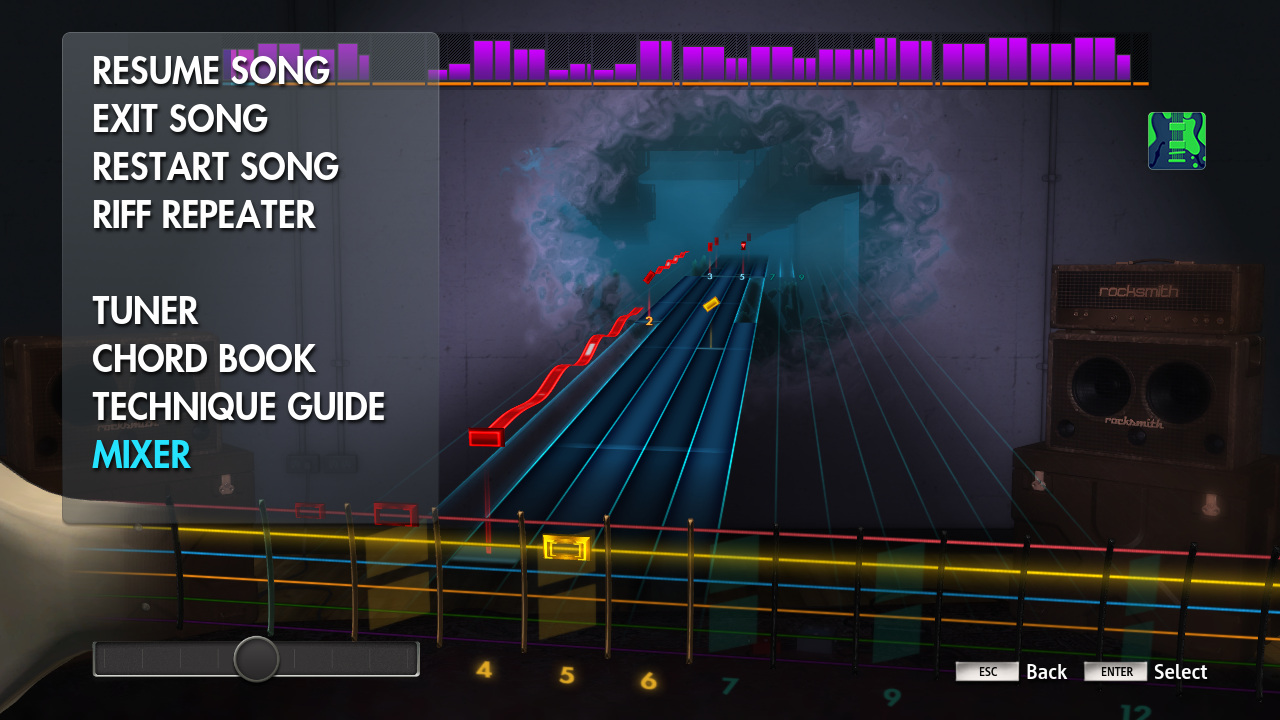 I didn’t exactly sign up for the Rocksmith 60-day challenge or anything like that. But it’s been a little over 60 days since I first started playing with Rocksmith 2014. If I was truly disciplined, and learning to really play the guitar was of greater importance to me, I’d have been playing 4+ hours per day. But I have other priorities. Like making games. I haven’t quite clocked in an hour a day, though I have been supplementing my experience with some offline practicing (often with an acoustic guitar) – although half the time I’m offline I am practicing riffs from the game. So given that I haven’t been the model student for two months, have I improved since November 4th?
Yes. Big time.
It’s not like I am ready to take the stage or anything. But I can look back at some of the seemingly insurmountable obstacles and plateaus that I had been unable to clear for months (or in some cases, years – even decades), and they seem kind of trivial now. The boost to confidence alone has been a big deal. Most of what I’m going to say here may be a reiteration from my “Quick Take” post after I’d only been playing with it a couple of days. My opinions haven’t changed much (having experience with the original Rocksmith and Rock Band 3 Pro Mode probably helped me make an informed one), but I thought some of you might appreciate an update from a couple of months of hindsight.
Planning for this post, I went back and played the original Rocksmith – something I haven’t done even once since getting the 2014 edition. It crashed the first time I tried to run it. Typical. But I finally got the thing running, and went through the painful menu navigation, and “rehearsed” a song. It’s hard to tell how much something has improved when you only look forward — looking back gives you a better perspective.
In just over two months, I have clocked almost as much time on the successor as I did the original game over the course of slightly more than a year. 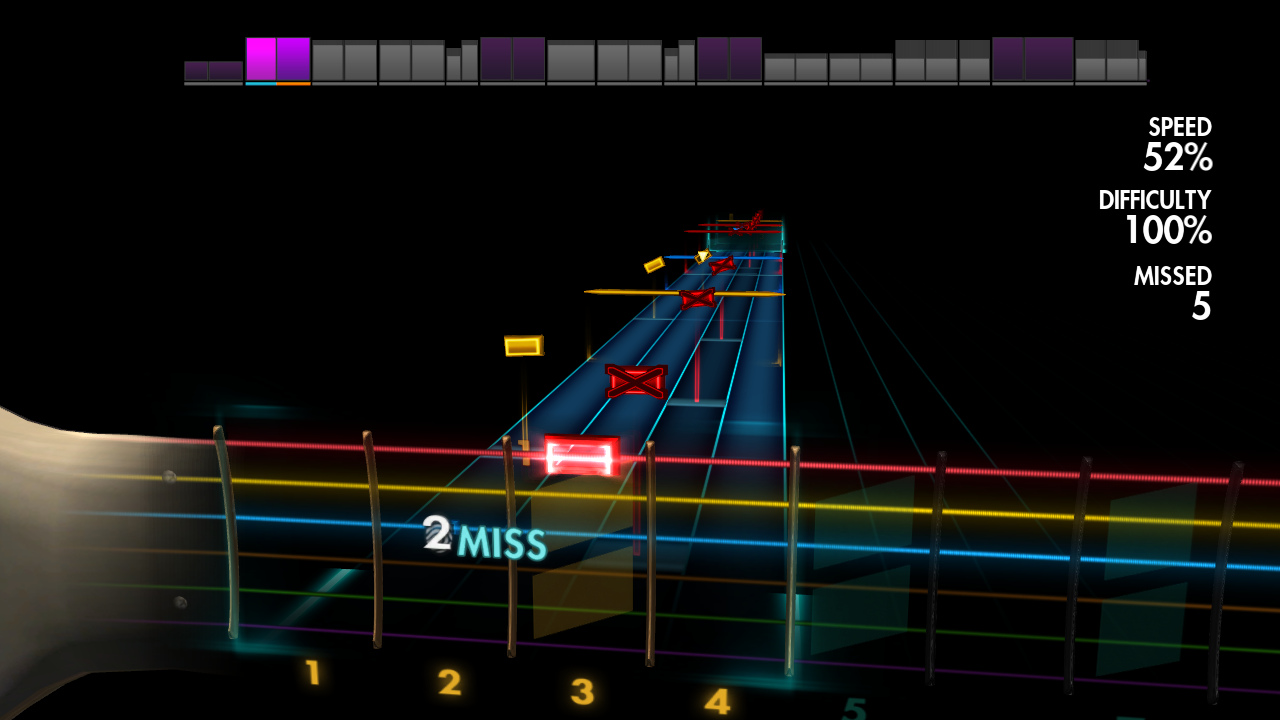 It was fascinating to see how I’d become dependent upon many of Rocksmith 2014‘s new features to help me understand what is going on in the song, how well I’m doing, and what I should be doing next. The more primitive guidance in the original was annoying to me at this stage. In fact, it was bad enough that it convinced me to shelled out $10 for the “Disc Import Tool” on Steam to move all the songs from the original game to the sequel, and prepared to delete the old Rocksmith from my hard drive. I have no reason to ever go back. I should note that all the DLC purchased for the first game was already available for the sequel, automatically.
Now, two months later, I have nice calluses and improved skills. There are some favorite songs that I thought (for years) were far beyond me. Now, I’m playing them – in some cases at 100% difficulty across all sections. I’m still not up to full speed, I still make mistakes, and if I play the songs outside of the game I frequently mess up on timing or forget parts. But note the important phrase here: When I play the songs outside of the game.
That is the point of Rocksmith 2014. And that has worked. Maybe in a couple more months, I’ll have them down perfectly (the easier ones are getting pretty close – at least playing rhythm), but in the meantime, I’m still playing guitar. People are jumping in and singing when I’m trying to play “Don’t Fear the Reaper” on my acoustic (sans solo, ‘cuz the fretboard doesn’t go that high). It’s recognizable, and it’s paying off. After a couple of decades of being stuck as a “perma-beginner” (well, somewhere between beginner and intermediate), I feel like I’m back to doing some real playing. I haven’t felt like that since I was seventeen years old.
Just as interesting as being able to play full-fledged versions of songs is discovering how quickly I can pick up new songs now. For simpler songs – particularly songs I’m familiar with – I only need a couple of play-throughs before the game has ramped up the difficulty in certain less-technical sections to maximum – the full note-for-note rendition. I make plenty of mistakes and may have trouble keeping up, but it’s still cool to know that I’m no longer working on a simplified “beginner” version of the accompaniment.
The “Riff Repeater” has definitely become an awesome tool to help learn a song. It’s kind of amazing to me now how useless and inconvenient the equivalent tools in Rocksmith and Rock Band 3 Pro were by comparison. It’s still not perfect. If I’m just trying to get a very short riff down, it’s often best to just go back to the main menu (which kind of acts like an amp) and practice it – or bits of it – over and over at my own pace. But as a tool to help learn a section of a song and get it up to speed, it’s been my number one tool.
At Christmas, I pulled out the guitar, tuned it to the piano being played by my daughter, and we both played accompaniment for the family singing Christmas songs. Now, many of the chords were simple ones that I’ve been able to play for years, and I had to simplify in some cases where the changes were still too fast, but I had the confidence to play along – without ever having practiced playing the song before. Yes, I figure this is kind of basic guitar playing 101 kind of stuff here, but it’s just not something I’ve ever felt confident enough to do before. Now I wonder why I didn’t try earlier. It seems so simple now…

Return to Castle Chordead
For some of this stuff, I’m becoming more and more fond of the Guitarcade section of the game – particularly the technique games. Learning some songs can be great for motivation and for some skill development. But for general skill – like just learning to react quickly and make those chord changes, or to have the scales just come naturally to your fingers, or to perform slides or control the volume with absolute precision – the Guitarcade is about making those practice drills fun. Some are more fun than others, but they’ve gone all out, with worldwide leaderboards and everything else to try and make it as interesting as possible. I kind of ignored these in the original Rocksmith, and didn’t mess around with them too much at first with RS 2014 (although they are much improved), but the more I play, the more I’m finding them valuable.
There are a few other features which I feel I should note:
Rocksmith 2014 offers a lot of songs with non-standard tuning… either different tunings (Drop D, E Flat, etc.) or slightly sharp or flat versions of standard E tunings. In a game like Rock Band with a midi guitar, this didn’t matter. But when you are playing along with the actual song, you need to be in tune with the other instruments. It’s really cool that they did this, but I find myself avoiding songs that don’t have E Standard tuning. If I do decide to tackle a song in a different tuning, I’ll stick with other songs in the same tuning for a while, just to avoid having to re-tune my guitar. I think the point they wanted to drive home was for players to get used to re-tuning their guitar so that it is no big deal. While I’m glad that the songs are there (some of my favorite songs are in a different tuning!), I still don’t like retuning my guitar, especially if I don’t want to skip a song in “Nonstop Play” mode.
I don’t feel like I’m really taking full advantage of “Session Mode” yet, though the experienced guitarists who play this game often swear by it, from what I’ve seen. I still feel like I am “working up to it,” though it’s so open-ended that it’s really nothing a beginner can’t use. If nothing else, you can just set up a metronome and practice your scales here. But at it’s best, it’s a really cool multi-instrument virtual improvisational jam session.
“Score attacks” are a lot of fun (they can be accessed via a song, or in the Guitarcade section) if you want some “old-school” Guitar Hero type fun. It gives you three skill levels you can play a song (plus a “master” skill level where there are no notes on the screen, and you must accompany the music completely from memory). This can give you a better idea of how much you are improving on a song than the percentage score from the main “Learn a song” menu – and also a chance of failure. When you get to the point where you are just practicing a song over and over, this can be a fun way to keep it interesting. I don’t use it often, but I do get a kick out of it when I do (assuming I don’t screw up so bad that I fail out of a song).
Another thing that’s really worth mentioning (again) is the list of suggestions generated by the game before you practice any song. Some are just goals for you to work on – new targets to strive for. Others suggest reviewing a chord or a lesson. There are also suggestions that take you directly to a Guitarcade game to work on a technique, or the Riff Repeater to work on a problem section until you nail it. While this initially interested me, for most of the last two months I ignored it. It was pretty obvious to me what I needed to work on. Now that I’m hitting performance levels in the high 80s and 90s, however, this section has become useful again. It’s no longer as obvious where I’m struggling, and it’s cool that the game can point out the places where I need more work. Personalized instruction!
So… yeah. While it’s still relatively early (maybe I should check back in with another report in 2-4 months?), I can say that even with a fairly casual commitment, the game *works* as a training tool. Quite well, particularly in comparison to its predecessors – which, in spite of their flaws, were still helpful.
In fact, I actually brought up Rock Band 3 the other day, with my Pro guitar. I hadn’t used it in months. There are still a lot of songs I bought for the game that I never really tried! Emboldened by my success in Rocksmith 2014, I brought up one of the easier songs at the highest difficulty level (something I never felt capable of handling a couple of years ago), and began to practice a section. Fifteen minutes later, I was able to play the section at full speed with no mistakes (at least once). Then I pulled out a regular guitar, and played it without accompaniment.
I thought it sounded pretty respectable.
Filed Under: Geek Life, Guitar Games - Comments: 13 Comments to Read
Game Dev Quote of the Week – New Year’s Resolution Edition
Posted by Rampant Coyote on January 9, 2014
I thought I’d deliver a triple whammy this week for quotes, in the spirit of the New Year – some comments from game developers not necessarily specific to making games, but in the motivational / New Year’s Resolution theme.
First up, from Cliff “Cliffski” Harris, of Positech Games, in an article entitled, “What’s Holding You Back?”
The new dividing line between the talented, the capable, and the employable will not be related to their background, their school, or their parents wealth. This is becoming *less* relevant. The difference is going to be motivation, confidence, and a willingness to work. The reason you don’t understand quantum physics, is you haven’t bothered to investigate it. There is simply no other answer. I have no excuse for any gap in my knowledge, and I know it. I don’t blame anyone but me. And tools? if you are a software developer or artist there are a crazy amount of free tools. In short, a lot of the excuses I might have thrown around as a kid for not achieving what i wanted to just do not apply, at least in the IT world.
Next up, Josh Sutphin, lead designer of Starhawk (among other games) offers this advice for breaking into the video games industry (as well as explaining why much of the “traditional wisdom” about how to get a job in the games biz is wrong):
Two words: “MAKE GAMES”.
It’s really that simple. Once you’ve made a game, there’s no question whether you know what you’re doing: you’ve already done it. After that, getting a game design job is no different from getting a job at your local Wendy’s.
I’m speaking from experience: shortly after high school I built Gem Feeder, a mod for Unreal Tournament 2004, as well as a handful of levels for the same game. Those projects got me my first game design job. (Interestingly enough, they also got me my second, despite now having professional experience on my resume.)
Finally, Tobiah Marks, a Game Evangelist at Microsoft (yes, that’s a real job title) and indie game developer offers a suggestion on the best time to learn to make games (and were you expecting anything other than the words, “Right now?”) and more importantly, some reasons and motivations. In particular – and reminiscent of Cliff’s advice above – he brings up another answer to “What’s holding you back?”
What’s the worst case? What horrible fate will befall you if you choose to become indie and aren’t as successful as you’ve dreamed?
You will:
- Make exactly how much you’re making from your games now (aka: none)
- Have learned a ton and gained practical experience with programming, art, design, and business.
- Have created a portfolio of finished content and the ability to put “entrepreneur” on your résumé.
- Have spent your time doing something you [hopefully] enjoyed doing, and are now able to proudly say you took a shot at your dreams.
Yeah, those risks are there. I won’t argue that. The way I see it, even if your worst fears come true and you “fail” you still come away with much to show for your time and effort.
It’s never too late to come up with New Year’s Resolutions. Well, okay, maybe in August you should call them something other than “New Year’s Resolutions” and just call them “Resolutions” or “Goals” or something.
Now yeah, it’s one thing to get all pumped up with goals and plans and a “can-do” attitude when you jump in. It’s a lot harder to sustain that fire and enthusiasm as the first day, first week, first month, and even first year go by. Turning a goal into a habit and lifestyle is not easy – at least for me, anyway. But one way to look at it is that you can’t fail if you don’t give up… you simply haven’t yet succeeded.
Anyway, good luck with all your endeavors, whether you take on game development or anything else.
Filed Under: Quote of the Week - Comments: 4 Comments to Read
Copyright © 2026 Rampant Games | Privacy Policy
Powered by WordPress.
