Progressive Pre-Order Pricing
Posted by Rampant Coyote on November 16, 2010
I’ve noticed a trend among indie game devs towards this whole pre-release “Buy now at reduced price, and we’ll let you play the version in development” thing. (Sorry, Craig, your announcement was what triggered this post.)
I’m not saying this is bad or anything. If anything, I find it praiseworthy. And I’ve pre-ordered a couple of games myself, and played the early development versions. Indie game developers need to always consider different ways of monetizing what they do, because it’s dang hard to make any money at it as it is. Just breaking even on out-of-pocket expenses can be tough enough, but compared to the opportunity cost of putting those hours into a minimum-wage job… Yeah. Any ethical innovation to give indies a better chance of surviving to make more games is okay in my book.
Plus, it gets people to pay to be beta testers, which is a totally bizarro concept in my mind, but one I’d happily get behind. It’s tough enough to get people to beta test for free…
But it’s kind of amusing how this trend is catching on. I first became aware of it with the release of Mount & Blade. As the game came closer to release, the “pre-release” price gradually increased.
And it worked. There’s a weird cultural effect (that maybe isn’t so weird, if I analyzed it enough, but to my brain it seems weird) of how hype for a game can build for months – even years – before it is released, and then disappear quickly after its release. Even when the game is being consistently maintained and improved post-release.
It also seems to me that the idea works better for certain games than others. For a game like Frayed Knights, which is pretty story-heavy with a clear ending, lacks tons of replayability, I don’t know that it would work out so well. My concern would be that people would play through the buggy, broken version a couple of times, but then never bother to experience the game in all it’s cleaned-up final-release glory. Whereas, in a game like Minecraft — well, that game never really comes to a conclusion. It’s okay for someone to keep playing the game as it evolves. No biggy.
(TANGENT ALERT: This is one more reason why story-based RPGs are an an absolutely terrible genre for indies to make. We’re pretty much screwed no matter what we do, so we may as well just enjoy the ride, right? 🙂 Actually, I do think we have some aces in the hole we could pull out. But that’s another story. )
Another issue with the progressive pricing model is that I don’t see it working for everybody. Unless a developer has a track record I can trust (which usually means a history of released games I liked), I won’t throw money at an unfinished game. I am painfully aware of the failure rate of first-time indies. If the game is fully playable and worth the price RIGHT NOW, then okay. Fine. But I won’t spend money on the promise of an unproven stranger.
There are a couple other concerns I’d have with the model, too. First off, I really do not have a clue how much pre-orders might rob from release purchases. Secondly, I would worry that broken pre-release versions could generate some negativity from the core base of gamers that would have been your first, most vocal fans. I’m sure most gamers willing to fork over the cash to play a pre-release version, but there’s always that worry.
There’s also the pain of supporting what is effectively a public release – making sure it is distribution-ready, etc. But that’s a headache you are going to have sooner or later anyway, assuming you intend to support your game post-release (and DUH! You’d better be!). So that’s not a big headache.
So do the benefits outweigh the problems? Considering how popular this is becoming, I can only assume so.
Filed Under: Biz, Indie Evangelism - Comments: 8 Comments to Read
Telepath RPG Pre-Order Available Soon.
Posted by Rampant Coyote on
I got an email from Craig of Sinister Design that he will be accepting pre-orders soon for Telepath RPG: Servants of God. Pre-orders give you a 20% discount on the full price of the game, and allows you access to development builds.
I’m kinda amused by that last part, as I’m always a little embarrassed to have people play a work-in-progress. I hate apologizing for missing or broken pieces. But some people are better developers than me, I guess…
Filed Under: Indie Evangelism - Comments: Comments are off for this article
The Ultimate CRPG* Available Soon (*For the Commodore 64)
Posted by Rampant Coyote on November 15, 2010
 Okay, news of the simultaneously goofy and AWESOME… Ultimate Newcomer is going gold. This is a massive, sprawling CRPG that has been twenty years in the making. It will be available soon for your Commodore 64!
Protovision’s Ultimate Newcomer
What? You don’t have a C-64? Me neither. I hope it’ll run in my emulator (I use CCS64). The C-64 was my computer back in the 1980’s. I loved it. But I think the last time I touched a real one was around 1992 or so. We were at a friends’ apartment, and we played a four-player game of M.U.L.E. on it. We had a fabulous time.
Sigh. Okay. Nostalgia geeking. Done now.
 Anyway – this game. Was totally off my radar until I heard about it on Rock Paper Shotgun, RPGWatch, and a couple of tweets. Apparently it has been through a couple of previously-available iterations. RPS has a way of putting weird stuff on everyone’s radar.
The game promises 180+ NPCs you can interact with, and ten or more that may join you in a party of up to six characters. 180,000 + words of text. Let’s see, at an average of 5 characters per word, one byte per character… that’s a mere 879 K – almost a full meg of text data alone. On the “real” C-64, that would have taken up about six floppy disks all by itself. Yeesh. I expect those screens like the one above for the intro and outro are about 32K each, using up a whole disk in 5 screens or so.
Yeah. A company would have gone bankrupt trying to sell this game in the old days. Distribution costs would have topped $100 in 1985 dollars. It may be old tech, but it’s something that simply could not have been done back then for practical, commercial reasons.
It’s a funky, weird thing, making a game for a (mostly) long-dead platform. But cool.
I am definitely playing this one. Probably not to completion, but there’s no way I could let this one pass by without giving it a try. After all, this was the machine which introduced me to CRPGs – via Telengard, Ultima III and IV, The Bard’s Tale, and others. I may as well give it another test-drive for old times’ sake and one last hurrah.
Filed Under: Indie Evangelism, Retro - Comments: 8 Comments to Read
A Free Book to Help You Learn to Write Games in Python
Posted by Rampant Coyote on
This isn’t exactly a new book or anything, but it’s free. And cool. And can teach you to program games in Python. Booyah!
Invent Your Own Computer Games With Python, 2nd Edition
Based on my browsing, there are a few things to note:
First of all, it is written for total beginners to programming. If you’ve always wanted to write games but don’t know anything about programming, this could be one place to start. It seems to be more oriented towards teaching you to program in Python first, and to make games second. But it teaches you to program through games, which I think is the best way to learn.
Secondly – it really teaches you the way I learned to program. Using PyGame with graphics and sound isn’t tackled until the end of the book. The games it has you write could have come right our of Basic Computer Games from 1978, and then ported to Python. It may not be too far from the truth, as the author says he modeled it after a book he used to learn programming when he was nine years old. This approach may annoy people who really want to jump straight to the flash, but if that’s your approach I’d recommend, uh, Flash. Or something like that.
Anyway, having only skimmed through it I can’t really give a full review or recommendation or anything – I can just suggest it as a resource.
Filed Under: Programming - Comments: 12 Comments to Read
Frayed Knights: Cheating Luck
Posted by Rampant Coyote on November 12, 2010
Time for another update on Frayed Knights, the indie computer role-playing game in development that all the cool kids would be playing right now if only it were released already. I’m sure of it.
Torqued Off
Okay – first order of business: The closure of TorquePowered. Yes, Frayed Knights runs on a highly modified version of the Torque Game Engine. Someone asked on Twitter if that was going to stop Frayed Knights development. Absolutely not. In theory, their closure should have zero effect on the game’s development. First of all, the engine I am using was already sunset and dropped official support while I was already in development many moons ago. If there was a time for me to freak out and change engines, it would have been then.
However, I have been relying upon the still-active community and the enormous wealth of searchable documentation and years of related questions-and-answers on the forums on their website from time to time, and it’s been kind of a safety net for me. If I am forced to operate without a net… well, so be it. It’s a little hairier, but I’m a grown-up programmer with source code and a valid license. I remain dangerous.
Fool’s Luck
So onto some game design ruminations. Fool’s Luck.
During the pilot episode of Frayed Knights, released oh-so-long-ago, I really didn’t put the Drama Stars very front-and-center. Part of this was presentation (and incomplete code), but part of it was deliberate. I wanted to make sure the rest of the game worked. I haven’t focused on them too much during development, because in theory all drama stars really do is act like a substitute for reloading a saved game. There should be very little impact on game balance.
 Should.
Okay, for those new to the discussion, here’s what drama stars are about: Whenever you do something interesting (make a decision, fight a monster, etc.), you get one or more drama points. These gradually fill in some stars at the top of the screen. The stars begin by getting filled in with bronze points, then they gradually become silver, and then gold. You can then “spend” these points on an effect that changes the game, even up to restoring the entire party to life (well, non-disabled condition) with almost full health and stamina.
The trick is that any time you reload the game, the drama stars are reset back to empty. The idea is that you can play Frayed Knights like many people (including me) normally do – reloading when things go poorly (and you remembered to save at the right place), or you can stick with it and get similar results through spending drama stars. Was a character was incapacitated in the boss battle? If you have enough drama points, you can bring ’em back immediately. Even in the middle of the fight. Or you can reload and fight the battle again and try to not lose anybody. Your call.
It’s basically legalizing cheating.
One of the most basic powers of the drama stars is called “Fool’s Luck.” In testing, it’s been bugging me, but it really shouldn’t. But it causes me to fight some psychological barriers that are probably based on years of playing pen-and-paper RPGs.
I try to provide interesting choices in Frayed Knights, and allow players to brute-force their way into things if that’s just how they roll. While Frayed Knights does have its share of locked doors constructed out of indestructible plotonium, I try to have at least equal number where I am merely encouraging – not forcing – the user to perform a designer-approved activity to get it open. But I make them very difficult. It’s an old Dungeon Master’s trick. You want all my work I put into having you find the key, and just pick the lock instead. Fine. Get ready to fail a lot and fight some wandering monsters and guards! Hah! That ought to show you!
Okay. The problem with that is that, if it’s left to chance, there’s always a chance the player will succeed on the first or second try, anyway. And if you are in a CRPG, the player may just keep reloading until he gets it right without incident. D’oh!
And then there’s the Fool’s Luck ability. Fool’s Luck gives the player a huge bonus to tasks for a brief time, not quite guaranteeing success, but close enough. It’s the equivalent of reloading the game several times to re-try a task. In practice, it means that those challenging locks I throw into the game to encourage the player to do things my way are easily bypassed with the drama points earned from a mere handful of encounters.
The old Dungeon Master in me balks at this idea. But I try and look at it this way: I’ve now given the player some potential for interesting choices. Locked plotonium doors provide none. Which makes for a better, more satisfying game?
Filed Under: Frayed Knights - Comments: 4 Comments to Read
GarageGames / InstantAction / TorquePowered Closing Doors?
Posted by Rampant Coyote on November 11, 2010
Looks like InstantAction – including The Company Formerly Known As GarageGames – is now shuttered and looking for buyers. Don’t think I can afford it. 🙂
InstantAction Ceasing Operations, Looking For a Buyer…
Dang. Kind of a bummer, but not totally surprising. I blame Unity. That sucker is pretty much taking over indie development (the part that wasn’t consumed by Flash, at least).
I guess I should quit holding my breath for a new improved version of Torque 2D, now, huh?
Filed Under: Biz, Indie Evangelism - Comments: 13 Comments to Read
Zombie Ultima
Posted by Rampant Coyote on
Confession time, here. My secret shame. I’ve been playing… Lord of Ultima. I don’t know why. I guess I’ve always been a strategy game fan, especially the more “builder” oriented ones, and I’ve even been a developer on an indie “MMORTS” where we did something similar (but with much more interesting combat, IMO, and probably with a smaller budget than these guys…). So I have kind of an interest in these sorts of games. I’m too busy to invest much time (or, really, any money) into them. But I figured I could check it out. And I’ve been playing for a while.
I knew it wasn’t Ultima. I knew it had nothing to do with Ultima other than some names and a few scattered paragraphs where they tried to rebrand an otherwise generic game into an old and much-beloved franchise. I signed up out of curiosity when it launched, and managed to build up a few cities, fend off some attacks, join up with a powerful alliance (in the top ten!) which has since been gutted, and even “leveled up” to the rank of emperor. I never invested much time (nor any money) into the thing, however, which is probably why it fell flat for me, and isn’t much more than a medieval SimCity for me. But hey, I always liked SimCity. Why did I play this one instead of the zillions of others? Well, it was probably the name, “Ultima.” In spite of all I knew, I went willingly in the hope of seeing some glimmer of the past glory that was the game series.

In some monster shows featuring people getting turned into mindless zombies or bloodthirsty vampires, there’s usually a protagonist who has trouble accepting that this creature wearing the form of former friend or family member isn’t really their loved one. There’s a turning point in the movie where they finally come to realize that the person they once knew and trusted is gone, and that this monster only wears the form, or maybe also wields the memories as a weapon. Or, maybe, if a shadow of their old friend remains, it has only enough strength to become an ally to sacrifice itself to help the hero destroy the monster they had become.
For me, that moment came with the big updates. They decided to name the updates after the subtitles of the classic game series. “Serpent Isle.” “Ascension.” “Forge of Virtue.”
Yes. I’m not kidding, here. And while I knew better, there was this stupid little glimmer of hope that maybe, MAYBE these expansions would actually bring a little of Ultima’s history and flavor into this game. And maybe even a tiny bit of the old series’ gameplay? I mean, you send armies to these dungeons and against the boss monsters and stuff, maybe that could be expanded on, given a little bit more RPG flavor?
Yeah, right. Dumb. There was nothing like that, as far as I can tell. These were actually good updates, the latest adding whole new areas of advancement for veteran players to make attacking each others’ cities less predictable. If the game was called, “Massively Multiplayer Slow-Paced Medieval Domination Game” or something, it would be decent stuff. But I’d never have played it.
But for me, invoking the names of the old games of the series was really just a twist of the knife. An ugly reminder that Ultima – the real Ultima – was dead. And this wasn’t even the undead shell of a husk of the old series – it was just some zombie with a nametag on it saying, “Hi, My Name Is: Ultima,” written in magic marker. The pointlessness of it hit me. I thought, “You are not worthy to wear that title.” The brief amusement I’d experienced playing it – before recognizing that I needed to invest more than just a few minutes a day and real cash to be able to participate as anything more than a slow-moving target for other players hit me – died.
Ultima is dead. If I want to enjoy a glimmer of its past glory, I just need to run Exult and run the REAL Serpent Isle. It may be almost twenty years old and I may have already played most of it already, but it’s still a far better experience than its fake modern spin-off.
Filed Under: Free Games, Retro - Comments: 6 Comments to Read
DLC – It Sells Games…
Posted by Rampant Coyote on November 10, 2010
Cliff Harris has a very frank discussion about the role downloadable content (DLC) has played in his latest hit indie game, Gratuitous Space Battles…
Ad Stats, and Why People Make DLC
I know I kinda miss the days where games just had “expansions” and “sequels.” But while the bite-sized chunks of additional gameplay DLC often offers is often less satisfying than a full-fledged expansion, it still serves the same purpose. As long as it is appropriately priced and does NOT seem like an attempt to force customers to pay extra for content that should have been in the game in the first place, I don’t mind. In fact, I’m kind of a fan. Though I did wait until I got a combined pack when I bought Gratuitous Space Battles…
Patches serve the same purpose, but tend to have a negative connotation… even when they are adding additional features.
There’s yet another role that DLC can play, which Cliff doesn’t mention. But Brad Wardell of Stardock has suggested in the past — making piracy less convenient. Especially when free add-ons are available only to registered customers. Sure, it will eventually be pirated anyway, but it seems that pirates tend to have a lower attention span for maintaining non-new games than customers.
Of course, the big topic of the article is how difficult it is to attribute success to online ads. Sounds like buying general-purpose ad space on the web is wasted unless you go really, really big. It sounds like it would be better to target a few sites that cater to the needs of your audience…
Filed Under: Biz - Comments: 5 Comments to Read
Weapon Stats in RPGs
Posted by Rampant Coyote on November 9, 2010
My education on medieval weaponry began with the Dungeons & Dragons weapons tables. My education on modern weapons began with the Twilight: 2000 weapons tables and supplements. I say began, as since then I’ve come to own quite a few medieval weapons of my own, study books on weaponry and warfare throughout the ages, and fired several more-or-less modern firearms.
I mean, okay, maybe the M1 Garand, a World War II era rifle, isn’t exactly modern, but it was very instructive to fire a weapon of that caliber. And between firing a 12-gauge shotgun and the M1, lemme tell you: The M1 has significantly more power and recoil. Ouch.
The thing is, D&D’s weapon tables kinda-sorta made sense in terms of the abstract, wargame-y combat system from which it was derived. A combat round represented a full minute of fighting and represented multiple attacks. Gygax even suggested that weapon damage might not even represent actual injury so much as “near misses” representing the defender’s luck running out. (The abstraction went even further afield with armor reducing the chance to hit, rather than reducing damage on a hit).
But of course, players usually treated it as literal damage. And later games did the same. And while a big ol’ bastard sword might represent a bigger threat than a dagger over the course of a long fight, an individual hit is a different thing. With any lethal weapon, damage comes down more to being where it hit than the size of the weapon. Whether it’s a .45 bullet or a crowbill hit to the head, the lethality chance is pretty dang high. And then there’s the whole added factor of how people (and animals) can continue to fight or function after being mortally wounded. Even in a life-or-death struggle, it is about taking the fight out of the opponent rather than causing instant death.
R Talsorian made a valiant effort in the late 80s to create a weapon damage system for various firearms based on bullet force over various ranges. The end result was kinda messy, complicated, and still didn’t make for very interesting combat in the original release of Cyberpunk. When they revised it to make Cyberpunk 2020, they dropped the “Friday Night Firefight” system for one that was much simpler. And more fun. And which, surprisingly, actually felt more realistic.
Over the years, the colliding influences of real-world knowledge and expectations with the absurdity of trying to reflect that too carefully in RPG combat systems has eventually resolved itself into a pretty mellow attitude towards realism in combat systems and weapon stats. Yes, I expect a 5.56 N round to do more damage and penetrate armor better than a 9mm bullet. I expect a pike to be far more unwieldy to use than a shortsword. I get miffed when game designers make handguns do significantly more damage than a battle axe. And I just have to grin and bear it when some games (jRPGs, I’m looking at you) have swords made of valuable metals that do orders of magnitude more damage than their cheaper cousins in the starting village.
But within those generous realism constraints, I’ve really gotten to the point where I really just care about interesting gameplay. Meaning:
1. At least somewhat believable constraints, as mentioned above.
2. An interesting progression of items – I should be able to “upgrade” over the course of the game. (Why? Because it’s fun!)
3. Strengths and weaknesses of different weapons to make weapon choice and upgrade decisions non-trivial (for example, is it worth losing the stun effect to hit 10% faster?) This is another area where realism can provide a hint, but otherwise get out of a way. Exaggerating otherwise minimal design differences to provide real gameplay advantages can make the choice interesting.
4. No late-game surprises that cripple earlier weapon specialization choices. For example, making almost all late-game enemies immune to bullets when I’ve specialized in firearms, or providing no higher-level axe upgrades for my axe specialist. It’s okay to have specialization be an occasional handicap (that’s the sacrifice you make when you don’t remain a generalist), but it should not neuter your character for an extended period, especially if that’s “the last 25% of the game.”
Now, some RPGs may not provide any real weapon / inventory system at all – it’s common, but not mandatory – but if it does, these are the kinds of things I look for.
Filed Under: Design - Comments: 9 Comments to Read
Cryoburn
Posted by Rampant Coyote on November 8, 2010
I’m gonna shift gears for this post from games to another form of high-quality geekly entertainment, science fiction novels. I just finished Cryoburn this weekend, by Lois McMaster Bujold, and was quite impressed. I felt like sharing.
I feel that one of the main purposes (if any be needed) of science fiction and fantasy is to hold a mirror up to ourselves with enough of a fanciful disguise that we can think about aspects of “real life” more objectively. And the really good fiction, in my opinion, withholds overt judgment so that the reader can be allowed to make his or her own at the end of the journey. Lois McMaster Bujold writes extremely good science fiction. (I intend to read her fantasy, too, as I’ve been told its just as awesome).
Cryoburn is her latest novel in the always entertaining series about a universe that contains one nearly unstoppable Miles Vorkosigan. The setting is a world where cryonics – the freezing of people to be resuscitated at a much later date (ostensibly when medicine has advanced to the point where their life can be extended) – has become a central fixture of their culture over several generations. In that, the book explores issues of sustainability, hot in the news while it was being authored, but also touches on issues of mortality, death, and the whole cycle of life in several ways. All in a high-action detective thriller filled with comedic moments that had me literally laughing out loud (dangerous when I was reading late at night when the rest of the family was asleep).
I loved how Bujold took a central concept and really exploded it to explore – if briefly – so many ramifications of the technology. One minor character is a man who was revived to discover he was penniless, friendless, out of his own time, and discovered that no cure had been found for his condition. There’s mention of neighborhoods catering to people born in a particular era, where at least they’ll “get each others’ jokes.” There are explorations of the legal, political, social, and even religious aspects of a society where the elderly rarely die to make way for the younger generation. What happens when people’s lives are suspended indefinitely in a state that is neither dead nor alive? What about their rights as people?
Carried forward over centuries, things get interesting. And “unsustainable.” What happens when those who are indefinitely not-dead-but-not-alive outnumber the living? What about their property rights — if there’s no inheritance because the currently-not-breathing fully intend to retake possession of their property upon their revival? What of their rights as human beings? What about voting rights? What parties benefit from a Ponzi scheme of byzantine legal constructs founded upon their control of the rights of a silent population utterly incapable of protest? And to what lengths will they go to maintain the status quo even when it has become clear that the end is inevitable – albeit capable of being postponed, much like the deaths of those in their charge?
And that’s where Miles Vorkosigan, the physically deformed, hyperactive Imperial Auditor, comes in. He’s been sent by the Emperor Gregor to investigate the expansion of the massive cryonics industry of the planet Kibou-Daini into the empire. And those familiar with the novels know that his brand of investigation involves causing lots of chaos to bring the truth up to the surface – which really pisses off the bad guys. The book should be pretty accessible if you haven’t read the other books in the series.
But if you’ve never read any previous books in the series, do yourself a favor and borrow The Warrior’s Apprentice, by Lois McMaster Bujold, from a friend or the local library. It’s a “quick read” in the best meaning of the term. I “accidentally” re-read it earlier this year when I intended to just look something up in it. It’s the first book in the series in which Miles is the main character, and it’s good old-fashioned space opera with a lightly comedic touch.
Filed Under: Books - Comments: 6 Comments to Read
Game Design Evolution – Yeah, That’s About The Size of It…
Posted by Rampant Coyote on November 7, 2010
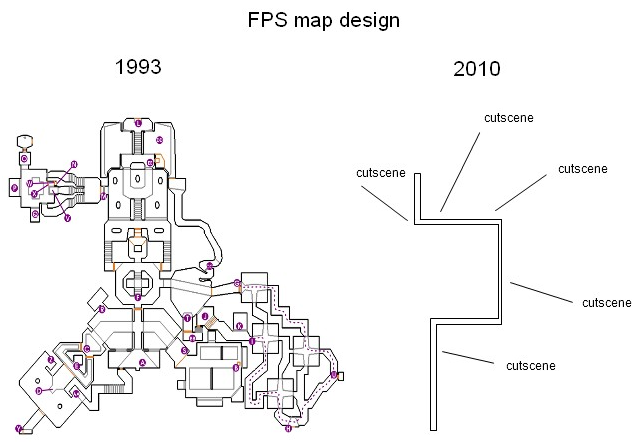
I don’t know who is originally responsible for this image, but it pretty much sums everything up nicely, and not just for first-person shooters or map design:
Filed Under: Design - Comments: 54 Comments to Read
Killing XBox Indie Games, Slowly…
Posted by Rampant Coyote on November 5, 2010
Some alarming articles about Microsoft’s landmark indie games offering for its console:
Microsoft Slowly Euthanizes XBox Indie Games
Commentary by former XNA / XBLIG developer
Well, I say “alarming” but I can’t really say “surprising.” It does illustrate why my preference is for truly open platforms, but the crappy state of downloadable indie games on those platforms kinda underscores a problem of conflicting issues:
#1 – Gatekeepers help maintain the quality and security that customers demand
#2 – Inevitably gatekeepers make decisions that are (apparently) not in the best best interest of customers OR developers.
In this case, what really seems to be happening to my eyes with Microsoft tightening the leash on indie developers is that they are trying to keep it a hobbyist venue, as opposed to a truly viable, sustainable commercial one. If you want to make REAL money as a REAL business making XBox games, you need to jump that giant barrier (to a very small indie) to becoming a true XBLA developer. That’s the feeling I got from the get-go, and these latest developments and “evolution” of the platform only seem to confirm it.
Filed Under: Biz, Indie Evangelism - Comments: Read the First Comment
Making Games: Adding Role-Playing to Computer Role-Playing Games
Posted by Rampant Coyote on November 4, 2010
Continuing from yesterday’s discussion, I thought I’d provide a concrete example of how process might be applied to a creative endeavor (like a game). While I’m really talking about the general idea, I figured I’d focus on a specific trait near-and-dear to many CRPG fans’ black hearts, role-playing.
One point repeated from The CRPG Addict’s GIMLET system is opportunities for role-playing – in combat, scripted encounters, and NPC interaction. Now, I’m one who tends to sneer at the idea of “role-playing” in single-player CRPGs. I mean, I’ve been doing the tabletop RPG thing for (shudder) decades now, and was active in theater in high school, and have even done the live-action medievalist thing, so I have a particular idea of what role-playing entails. But that’s not the same thing as what he tends to describe.
For the purpose of the GIMLET system, it sounds as though role-playing is defined more as having multiple solutions to a problem, none of which are inherently superior, but which differ primarily in the player’s chosen style or assumed personality or ethics of their character. This is something I can totally get behind.
As a personal note, I tend to prefer it when the game does NOT attempt to assign some kind of ethical judgment on these decisions. Just because I choose a non-violent means of defeating the bandits doesn’t mean I’m some kind of altruistic do-gooder. My rogue may very well intend to get in on a piece of that acti0n later. But that’s me. And, unless I change my mind or have some cool idea to the contrary, that’s how my games will be.
Okay – so these are things that I value in an RPG. But – as I have discovered repeatedly while making Frayed Knights – these kinds of things don’t appear by accident. Well, okay, yes, they actually totally do. I have crap like that all over the place in the game, but it wasn’t part of any kind of master plan. As I’m working on the design of the next games, however, I’m trying to apply a bit more process to it so things will happen more consistently. Because I don’t want to rely on accidents.
So – for example – in my master list for designing each “adventure” ( adventure / dungeon / major subquest / etc.), I’m adding a required feature as part of my process: “Must have at least one role-playing encounter.” This rule is intentionally left vague, and in fact might not apply in all situations. Exceptions could exist – for example, if the entire map is one giant role-playing encounter, or in the case of really tiny dungeon levels.
Now one of the problems with the industry in general, IMO, is what is referred to as “check-box design.” Game X has this feature, so the marketing guys convince the money guys to make sure the design guys have that same feature. Multiply by a dozen Game Xs, and you have a big list of required features that have to be met for a game to be competitive. As a result, you have a soulless game that feels like it was designed by committee where the really cool “heart” of the game – if you can find it – has been crowded out by all the required points that the marketing guys wanted to put on the back of the case.
This is (I think) totally different. This is more of a case of defining the heart of the game – the most important parts – through rules, guidelines, and checklists. It’s about what I, as the designer, feel strongly about. It makes sure that (for example) a meticulously crafted faction system actually gets used. It is used to make sure the games theme is reinforced throughout, and that all the major plot points are hit without requiring a linear storyline. It forces the key elements of the game to be front-and-center.
And it actually encourages creativity. I’m telling you from sad experience that it’s really, really easy to just stuff a dungeon full of straightforward combat encounters when the crunch is on, or when you are tired, or … well, any reason. And you can deal with a checklist in just as lazy a manner, if you interpret “must have at least one puzzle” to be yet another remote switch / lock combo or something. But still, a vague demand for a “role-playing” event of some kind in every “map” forces some level of creativity, and can help keep the designer focused on important / interesting parts of the game.
In one dungeon, it may be something as simple as letting a potential enemy go free, with slightly different consequences for either decision. Or it may be something as complex as allowing several different approaches to obtaining the “prize” of the dungeon. It could be a clever puzzle that can be bypassed with brute force, or an NPC encounter that could end peacefully or violently depending upon your approach.
If it’s loose enough in definition, the “formula” or process should be pretty invisible to the player – at least invisible enough that it won’t be meta-gamed. While it’s no guarantee of a quality game on the other side of production, it’s a tool to at least keep pointing the way. And, as I intend to be making indie cRPGs for the long haul, it could allow me to offload some of future level design to other people.
Filed Under: Design, Production - Comments: 11 Comments to Read
Making Games: Lubricating with a GIMLET
Posted by Rampant Coyote on November 3, 2010
Not too long ago, I read The E-Myth Revisited. While not the final word on why businesses survive or fail, it was packed with a lot of ideas. And I immediately used it as a yardstick to measure every video game studio I have familiarity with. And explains why so many fail. Unfortunately, the principles in the book are better applied to a service or manufacturing company, and are more difficult to apply to creative or entertainment businesses.
I get an automatic resentment towards any management philosophy that tries to treat creative production like a widget factory. Which is, I think, ANOTHER major reason game companies fail as they expand and get new, more professional management.
This was brought back to mind when I re-read Allen Varney’s article, “The Conquest of Origin” last week as I was working on my post on Origin Systems. The quote that struck me was from Stephen Beeman: “You’d like to think a marriage of EA and Origin would result in a merger of their strengths. But instead of combining EA’s execution with Origin’s creativity, the end result was more like Origin’s execution with EA’s creativity.”
As a dude sinking an insane amount of my “free” time and a not-inconsiderable amount of out-of-pocket money that could go to my kids’ education into making games and running this website, this is sobering stuff. I mean, sure, I am doing this ‘cuz I love it – I seriously do enjoy making games more than playing them (well, most of the time…) And as a part-timer (so far), it’s not like a failed game will likely mean not being able to pay the mortgage or put food on the table. But it does make me realize how far I am from making a go at this as a full-time job, and brings up some issues from the book that I’m trying to reconcile in my head and development style (such as it is).
What it comes down to, I think, is that some parts of game development do need to work like a widget factory. Yes, I am horrified to admit it. But if you run a game development business, like all software development, it needs to run as a business. This means predictability and consistency. It means some level of repeatable process. At the very least, it means being able to come up with a somewhat accurate estimate of the time and resources needed to complete a product, and some concept of what kind of return can be anticipated to make it worthwhile. That’s the business side of things.
And maybe it doesn’t need to suck all the fun out of making games.
Sadly, in spite of years of professional experience making games, I fail here. I guess Rampant Games is not yet ready to become a full-time endeavor. My development process is still pretty haphazard. How do I measure project velocity? How do I make sure it’s heading in the right direction? And how do I gauge quality? And once I am able to measure these elements, what can I do to improve? Obviously, if I don’t have a process in place, it’s hard to improve upon it, or build the tools necessary to do so.
I think one of the failings in the software industry is that it keeps searching for a “one size fits all” solution. Games are different from customer management software. Downloadable games are different from web-based social games. RPGs are different from action games. I probably work differently from Thomas Riegsecker. A single, supposedly objective uniform process isn’t going to work best for all of us.
So I’m working on that. Making a process, a methodology for doing some things that will hopefully allow me to be more consistent, automate some parts, maybe even offload some responsibilities at a later date, and most importantly allow me to concentrate more time on the fun stuff.
Then there’s the quality aspect. One thing I’ve found in all game projects is that its easy to lose sight of quality while neck-deep in production. When I do that in Frayed Knights development, I sometimes go back and discover that I’ve gone and set up three almost identical combat encounters one right after another, or some other stupid thing like that. Or – just as bad – I’ve put hours and hours into working on something that going to make very little difference in the game (AKA “Gold-Plating”). Having some kind of pattern in place to help me make sure I’m working on the things that *I* consider important for game quality would be helpful, especially on those nights the creative part of my brain has gone into autopilot.
I’ve a sneaking suspicion that a gimlet might help. Or rather, GIMLET.
I’ve been delighted reading The CRPG Addict’s Blog, and Kevin made me a more readable / printable PDF of the GIMLET RPG Rating / Ranking System that the CRPG Addict came up with to try and find a common system for evaluating RPGs with extreme differences in technology and style. I printed it up and hung it in my office, near my framed cloth map from Ultima V. It’s a subjective system, which is actually just fine by me.
I’m mentally tinkering with the system, considering how I might personally use something similar as a yardstick for not only measuring my games, but actually as something of a template for design. Not to “game the system” or just check boxes. That would be silly, as it will be an unrecognizably modded-up system vaguely based on something only used by one guy on a blog somewhere who will never review my games. But the point is to provide focus and structure as I move forward – a system for evaluating the design and results. To turn it into a recipe for my “secret sauce.” Or something.
I’m still in mulling / experimentation mode here. We’ll see how it turns out. But if any other indie devs are reading this and have insight into this, please speak up! Hopefully this will help. I’d love to share anything that helps other indie devs improve their chances of success in a field where failure is, unfortunately, the norm.
Oh, and to The CRPG Addict: Thanks for the GIMLET! We’ll see if it helps Frayed Knights 2…
Filed Under: Biz - Comments: 8 Comments to Read
Dice and Paper RPG Licenses – Still Useful?
Posted by Rampant Coyote on November 2, 2010
Once upon a time, back when dice & paper RPGs were (relatively) “big,” there were tons of them actively being marketed. Everybody wanted to be Dungeons & Dragons. Nowadays, that’s died down a bit, though there are arguably more of them available now than ever before. Including some funky little indie RPGs (which, like indie computer games, are pushing the genre).
When computer RPGs were first released, they sought to replicate the feeling and gameplay of those early RPGs. Of course, D&D was the top of the list, but there were other systems that inspired some games. Licenses still weren’t too common, though we did have a few, like Traveller, Twilight: 2000, Mechwarrior (the RPG built around BattleTech), Shadowrun, The Dark Eye, and others saw their way into becoming console or computer games (besides, of course, Dungeons & Dragons). More recently, Vampire the Masquerade continues to see computer-game life with two single-player titles and an upcoming MMO. And Champions, after failed efforts in the past, finally saw its way into a (highly modified) MMO.
So it seems like dice-and-paper RPGs still enjoy some transition. But are they a big enough market that (outside of D&D and Vampire / World of Darkness) that they really bring players? I mean, that’s 90% of the reason to have a license (the other 10% is to take advantage of someone else’s creativity with a highly realized world). I really don’t know. Though there may be enough to justify it for an indie… if the license was inexpensive enough.
Many years ago I heard about an indie working on a computer RPG for Macho Women with Guns. Cool idea. I never heard anything more of it, so I assume that project was stillborn.
So what dice & paper RPGs would YOU like to see transition to the computer game world? Why? Would there be any mechanics that would be particularly challenging to transition between the human-moderated game and a computer-moderated one?
Filed Under: Dice & Paper - Comments: 22 Comments to Read
The Greatest PC Game Developer of All Time?
Posted by Rampant Coyote on November 1, 2010
Kotaku has a nice piece discussing the awesomeness that was, once upon a time, Origin Systems. It proclaims Origin the be the greatest PC game developer of all time. Long gone, but still a fond memory for many old-school gamers.
I figure the point is pretty debatable, but the Ultima and Wing Commander series were pretty dang influential to me, personally. And not just as a game developer. So yeah, I’d probably lean this way if forced to choose, too.
I still find myself revisiting Shay Addam’s “The Official Book of Ultima” on a regular basis, especially during the time I’ve been working on Frayed Knights. I don’t think there’s anything new to be gleaned from it, as I’ve read it so many times. I think part of me is still trying to decipher any more elements of the “secret sauce” that made the games so enduring in the minds of players. Consciously, I realize that much of that was purely relative to the time and technology in which they were released. Between modern gamers completely rejecting Ultima IV, being able to see the games played sans rose-colored glasses via Blogging Ultima and The CRPG Addict, and going back to play them myself in one of my little retrogaming excursions, I’m reminded that the games weren’t all that. I have still never finished Ultima VI in spite of multiple attempts, and never played more than ten minutes of the first two games. Maybe one day…
It is sobering reading Addam’s book, a snapshot taken Origin’s heyday around 1990 or 91, and seeing their eventually doom a decade later. Only a couple of years later, in spite of their string of successes (well, okay, they had some duds too), they were forced to sell themselves to EA, a company they’d once painted as something of their arch-enemy. And now we have a horrible Wing Commander arcade game on XBLA, and an Evony-style clone mysteriously branded as an Ultima. It’s like hearing your favorite rock anthem of your youth being used in a paper towel commercial.
I still miss ’em.
Filed Under: Retro - Comments: 17 Comments to Read
Copyright © 2026 Rampant Games | Privacy Policy
Powered by WordPress.
